
Fostering Entrepreneurial Mentorship And Education: A Peek Into Nucleate Boston Activator 2026 Cohort

By Ray Dogum, Chief Editor, Drug Discovery Online

Boston, MA, the world’s epicenter for scientific innovation, has no shortage of outstanding drug discovery scientists. But to take their scientific discoveries and scale them up into sustainable businesses is a very difficult challenge for anyone, let alone young scientists with little to no business backgrounds.
That’s why Nucleate Boston’s Activator exists. The program gives scientific founders a structured way to learn venture formation, pressure-test ideas with experienced mentors, and build relationships that help early science ideas become real companies.
As a media partner, Drug Discovery Online met and interviewed many of the founders in the 2026 Activator cohort and attended the program’s Final Forum event.
About Nucleate and the Activator Program
The student-led, non-profit organization, Nucleate, has supported over 250 Activator teams in over 20 countries since 2018. With at least 183 companies incorporated, 800 jobs created, and over half a billion dollars ($550M post program money raised), Nucleate is an example of how scientific talent can be translated into venture creation at scale. And the name Nucleate could not be more perfect, given its life science focus.
In the program, scientists have an opportunity to refine their business and fundraising prowess through six specialized workshops and by connecting with a robust mentorship network. They also create lifelong bonds with their fellow cohort participants, helping breed a culture of collaboration throughout the rest of their careers.
Currently, Nucleate has chapters across 41 geographic regions and participation from over 280 academic institutions, all with the goal of helping founders concentrate on building transformational biotechnologies.
In 2026, the flagship Boston chapter invited a cohort of 56 individuals spread across 18 teams to participate in the activator program. The teams focused on a variety of important areas such as cell, gene, and RNA therapeutics, as well as neuroscience, oncology, and more broadly, platform biology. They presented their final flash pitches during the 8th annual Nucleate Activator Final Forum event in the Cambridge Innovation Center on June 1.
I walked away with a sense of confidence in the next generation of founders, and I’m excited to follow these young leaders on their path to building great companies.
The Final Forum Event
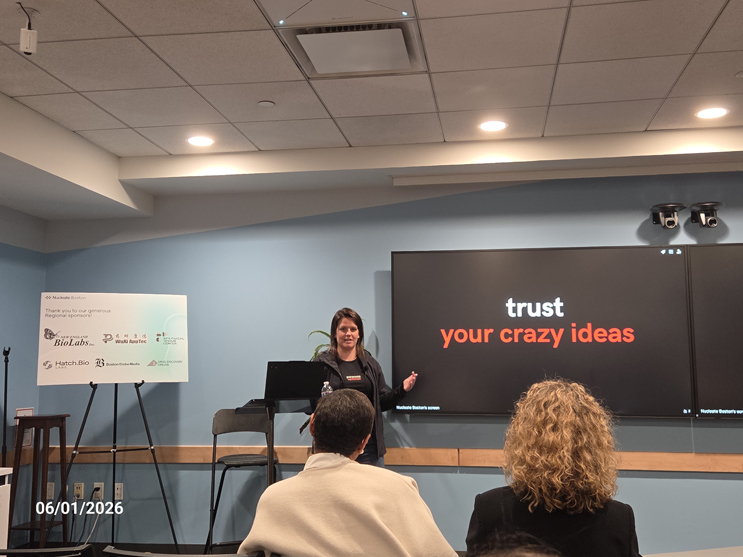
Molly Gibson, Origination Partner at Flagship Pioneering, CEO at Expedition Medicines, and Co-founder of Lila Sciences and Generate Biomedicines. Presenting at the 2026 Nucleate Boston Final Forum.
At this year’s showcase, Molly Gibson (serial entrepreneur and self-proclaimed paranoid optimist), led the event with a presentation on the importance of founders believing in their crazy ideas and the serious potential of scientific superintelligence. To be successful as an entrepreneur, she reminded the crowd, “You have to be incredibly optimistic about the future you want to build, but incredibly paranoid about how you get there.”
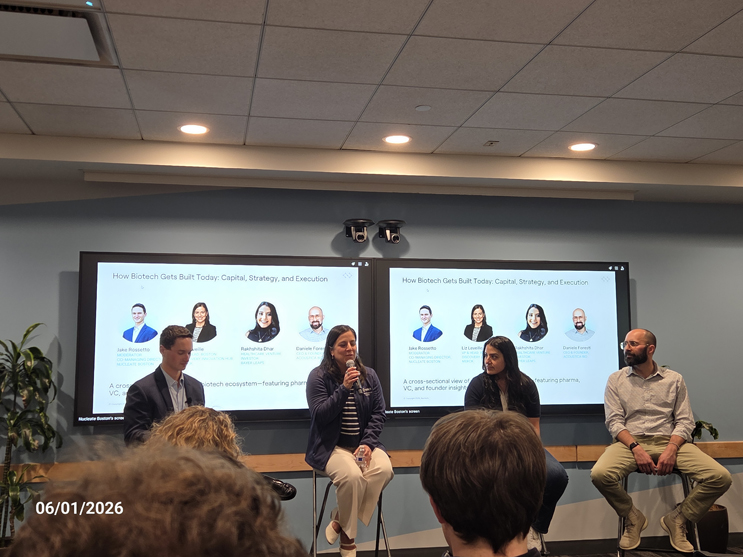
Nucleate managing director, Jake Rosetto, moderating a panel on “How Biotech Gets Built Today: Capital, Strategy, and Execution,” with panelists Liz Leveille, VP & head of Merck’s discovery innovation hub; Rakhshita Dhar, healthcare venture investor at Bayer Leaps; and Nucleate alumnus Daniele Foresti, CEO & founder of Acoustica Bio.
Early-stage and preclinical drug discovery programs require a special kind of nurturing because oftentimes the final product is years away from being developed, and funding never comes easy. In the last couple years, the lack of interest in high-risk startups from typical venture capitalists has created an opportunity for big pharma companies to leverage their deep pockets and technical capabilities to partner with early-stage companies.
The 2026 Activator Cohort
The program focused not just on the technologies, but on how teams clarified technical risks, strengthened their business case, and learned to present a credible path forward.
That is one of the clearest signs of the Activator’s value: the cohort experience helps move projects from raw scientific promise toward venture readiness.
I had the chance to interview many of the founders focusing on drug discovery relevant problems during their practice pitch workshop a few weeks before the Final Forum to get a better sense of their Activator experience and better understand the solutions they are building.
To learn more about these startups and get a deeper sense of their founders, you can watch the interviews in the links below.
List of Founder Interviews
- Carlos Ezio — CrioCore (Winner of the “Millipore Sigma The Lab of the Future Award”)
A cryobioprinting platform delivering on-demand, relevant human 3D models for predictive, non-animal preclinical drug development.
- Chris Clifford — Mimic Therapeutics (Winner of the Regional “Scientific Excellence Award” and the “Lilly Platform Architect Award.”)
A novel hypoimmune HLA integration platform enabling universal allogeneic stem cell–derived therapies.
- Anna Kazatskaya — Fervid Tx, previously Antozero (Winner of the "Audience Choice Award")
A human neural circuit platform quantifying functional network resilience to transform CNS drug discovery.
- Michael Cronce — Omni Therapeutics
An AI-driven platform developing first-in-class small-molecule cancer inhibitors from novel non-canonical nucleotide chemistry.
- Chathuraka Jayasuriya — EnkaBio
A cell-based biologic enhancing meniscus healing alongside sutures, reducing cartilage erosion and osteoarthritis progression.
- Arvin Soepriatna — TEEM Therapeutics
A human iPSC-derived cardiac microtissue platform enabling human-specific drug discovery and precision cardiology.
- Ryan Posey & Anusha Manglik — Resilientia
An AI platform combining functional genomics and organ-on-chip models to repurpose drugs for human resilience.
The Value of Mentorship as Infrastructure
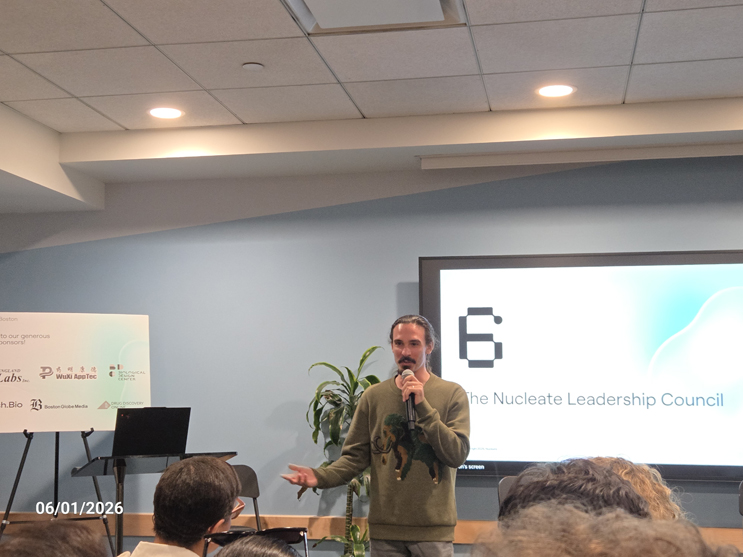
Oliver Dodd, Nucleate co-founder and executive director announcing the Nucleate Leadership Council.
The strongest takeaway from the event is the value of mentorship, which was highlighted by Nucleate’s co-founder and executive director, Oliver Dodd, in his announcement of the Nucleate Leadership Council, a group of experienced biopharma executives who volunteer
to help guide the Nucleate’s future. The inaugural 29 member council will be led by Greg Erman, who shared the importance of forming strong relationships, referencing his 11+ year connection with Dodd.
In Boston, there is no shortage of breakthrough science, ambitious trainees, or entrepreneurial energy. What is harder to build, and more important over time, is the infrastructure that helps first-time founders learn how to think like company builders.
Nucleate helps fill that gap by turning mentorship into a discipline rather than a one-off interaction. Founders are not only introduced to experienced operators, investors, and regulatory and legal experts; they are taught how to absorb feedback, refine a scientific and commercial narrative, identify the next milestone, and understand what it takes to de-risk a venture.
That kind of guided learning is especially valuable for academic founders who may know their science deeply but are navigating company formation, financing, intellectual property, and market definition for the first time.
That matters because ecosystems do not run only on capital and ideas; they run on translation. Boston’s biotech strength comes from its density of universities, hospitals, investors, startups, and established companies.
Programs like the Activator create connective tissue across that ecosystem, helping emerging founders access the unwritten knowledge that usually sits inside experienced networks. In that sense, the program is not just supporting individual startups. It is strengthening the region’s capacity to repeatedly turn research into companies.
Expanding the Founder Pipeline
For all of Boston’s advantages, one of the ecosystem’s biggest needs remains accessible, practical founder education. The Activator addresses that need by giving talented scientists a structured environment in which to learn entrepreneurship, build confidence, and receive high-quality mentorship before the stakes become much higher.
The program expands the pool of venture-ready founders and fosters unique biotechnologies to be developed in a resource-strapped financial environment.
In the end, science is a community. Communities need to have some foundational beliefs underlying everything else they do. And the Nucleate community is helping to reinforce those foundations through mentorship, shared learning, and a culture that treats scientific promise as something worth building around.
If you want to be part of this flourishing community, Nucleate is hosting their global summit at the Southfork Ranch in Dallas, Texas from August 16-18.
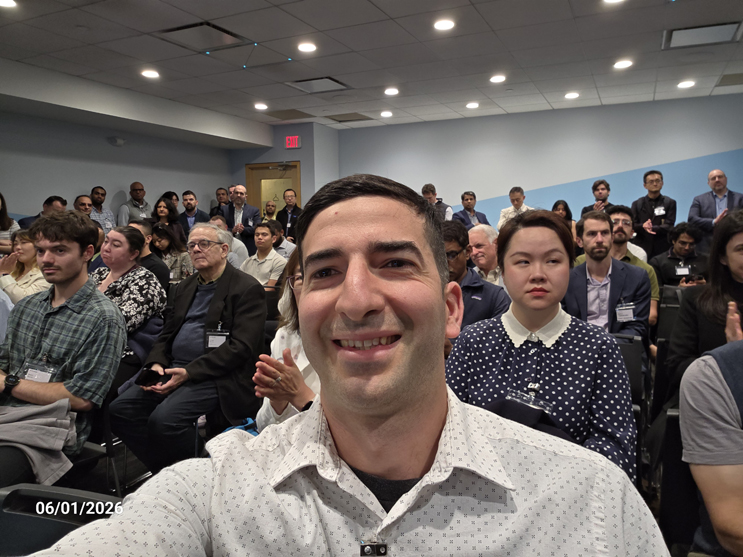
Ray Dogum, Drug Discovery Online’s chief editor, at Nucleate Boston’s Final Forum hosted at the Cambridge Innovation Center.