
2026 Nucleate Boston Activator Cohort Interview: Michael Cronce — Omni Therapeutics

By Ray Dogum, Chief Editor, Drug Discovery Online
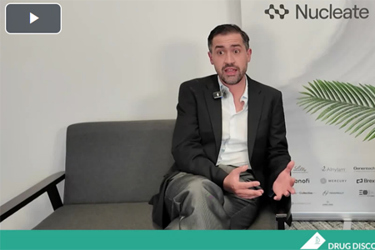
This video series was created in partnership between Drug Discovery Online and Nucleate Boston.
Summary
In this interview, Michael Cronce, CEO of Omni Therapeutics, described how the company emerged from his dissertation research on a newly identified metabolite that regulates immune signaling. Founded in May 2023, Omni is using that discovery to identify drug targets and design first-in-class therapeutic nucleotides, with an early focus on colorectal cancer and Wnt signaling.
He said the Nucleate Boston Activator program helped sharpen the company’s direction, build a stronger preclinical roadmap, and connect him with key advisors and collaborators, including MIT’s Omer H. Yilmaz.
Cronce explained that Omni is at the pre-seed stage, balancing publication, preclinical animal studies, and fundraising, with a goal of raising roughly $2 million pre-seed and eventually $5 million for a seed round. He emphasized that strong interdisciplinary collaborators keep the team motivated, and said one major founder challenge is translating deep biochemistry into a therapeutic platform investors understand. He praised Nucleate and suggested a post-Activator funding program to help teams progress faster.
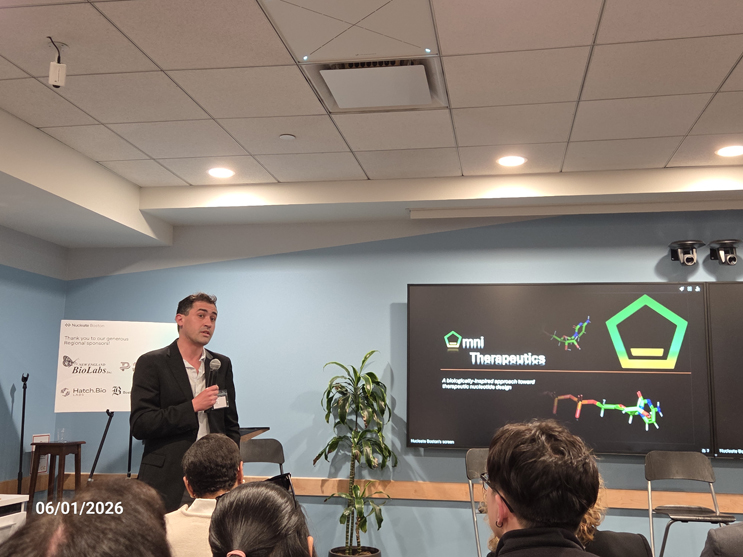
Michael Cronce at the Nucleate Final Forum.
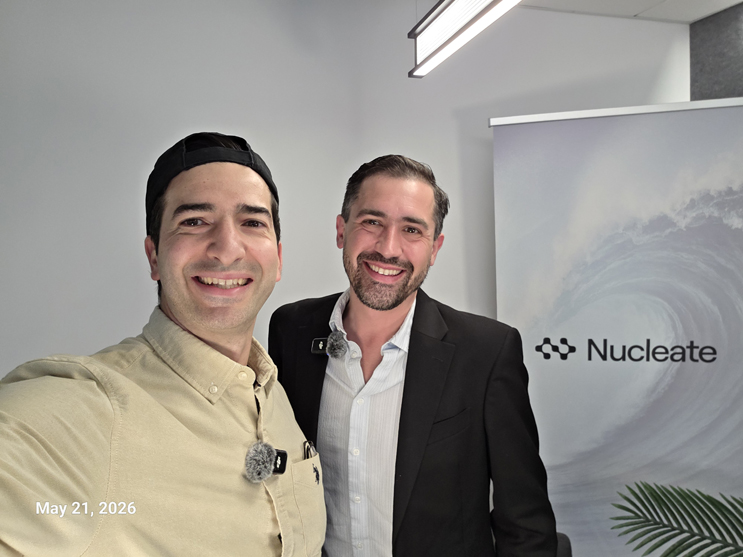
Ray Dogum and Carlos Ezio at the Nucleate Boston Practice Pitch Day (date of interview recording).
Transcript (Edited for Clarity)
Ray: Can you give me your name, the company you founded, when you founded it, and a 30-second pitch?
Michael Cronce: Hi, I'm Michael Cronce. I'm the CEO of Omni Therapeutics. I founded the company in May 2023, at the end of my dissertation work, and what we're working on is a concept that grew out of the work I did during my dissertation.
Researchers have already discovered a novel metabolite that regulates the immune system and identified a number of drug targets based on that and are designing new drugs around that compound structure. Through the Nucleate program, we're taking it to another level by using AI-based drug discovery and design to develop novel therapeutic nucleotides in a similar manner for the other targets we've identified as well.
Ray: So you went through the Nucleate Boston Activator program. What did you actually change about how you're building the company?
Michael Cronce: A lot of it came from a synergy between the Nucleate Activator program and being part of the Harvard Medical School community.
One of the most exciting things is that we've been able to take the first concept that came out of my dissertation work and match it with startup and pharmaceutical industry experience in the ecosystem, mostly through the Nucleate Activator program, but also with faculty at MIT and Harvard Medical School.
We've been able to narrow our focus to some of the most impactful aspects of the disease area we're targeting, which is colorectal cancer. We've focused our drug targets in that direction and revamped our concept to concentrate on very specific opportunities.
Ray: So did you make that decision to go into colorectal cancer while here at Nucleate?
Michael Cronce: No. The foundational concept from my dissertation work was that there was this novel chemistry — a structure nobody knew existed.
Ray: Can you describe it a little bit?
Michael Cronce: The chemistry?
Yeah. For those who know basic biology, DNA and RNA include the Cs, Gs, As, and Ts. CTP, or cytidine triphosphate, is one of those nucleotides. What was discovered in 2018 by one of Omni Therapeutics' founding academic advisors is that there's an enzyme in our body that turns on during infection.
What it does is take cytidine triphosphate, change the stereochemistry, and reorient the 3D molecule. That change allows it to be recognized by a range of proteins in our body that we didn't previously know were involved.
It turns out that enzyme is one of the most ancient parts of our immune system, and we have many ways of sensing that molecule and breaking it down. My dissertation work focused on identifying the enzymes that break it down, the receptors that sense it, and how that unique chemical change regulates the immune system in ways that affect not just immunology, but also cancer and tissue regeneration.
Ray: What stage are you at now in terms of development?
Michael Cronce: Pre-seed. What I'm doing here is finishing the end of my dissertation work by doing some of the preclinical animal work with collaborators I've met here, and hopefully we'll publish the work in the next year while also raising our pre-seed round.
We're talking to a lot of pre-seed and early investors in the biotech and pharmaceutical ecosystem here.
Ray: Are there any conversations you had that might have changed the trajectory of your company?
Michael Cronce: Yeah, very much so. One of the most impactful relationships I've developed while being here in the Boston area is with Omer Yilmaz at MIT's Koch Institute.
Ray: Wait, hold on. Yeah, so I worked in the Omer Yilmaz lab.
Michael Cronce: Did you really?
Ray: Yes, I did. I was a lab tech and lab manager there for a while, so I'm familiar with the lab. Very cool.
Michael Cronce: Okay, yeah. So you know him.
When I met with him, we had a really strong interpersonal connection, and he immediately understood and was excited by the foundational mechanistic work we did. He's also been on the other side of it, studying colorectal cancer and building the infrastructure for a drop-in, CRISPR-based knockout model using Wnt-signaling-focused organoids. In that system, you can knock out genes of interest to see how they synergize with common forms of colorectal cancer present today.
What we've found is that I've focused on the biochemistry, and when I spoke to him, he said, "We know Wnt signaling. We've been focusing on this as a therapeutic target for a long time." That was where the Nucleate Activator Program really came into play, because he said, "Let's focus on Wnt signaling, and we can study it with our xenograft models."
I said, "Well, I have 110 different host proteins, some of which engage with Wnt signaling." These are first-in-class host factors with implications for Wnt signaling. Through the Activator Program, I'm also working with two scientific contributors who have very specific expertise in cancer.
Through the Activator Program, we've been building out preclinical models and preclinical roadmaps for the different targets we may want to pursue.
Ray: Very interesting. What's one thing you wish you had taken more advantage of during this program?
Michael Cronce: I've been very lucky to work with two advisors. Dave and Pranav have both been incredibly helpful. One of our advisors, Pranav, has expertise in techbio investments, the VC community, and early-stage startups, so it was wonderful to have weekly conversations with him.
Dave is an affiliate at Harvard Medical School who understands tech transfer and early-stage spinouts. I'm also working with Minal Mehta at Moderna, who is helping map our preclinical roadmap, and Gil, who I'll be presenting with tonight at Beth Israel and who brings deep bioinformatics experience.
I feel like we've created a real nexus of value through these weekly meetings and the chance to talk through the different concepts we're focusing on. But it's still not enough time to do all the experiments you need and fully integrate their expertise.
So what we're doing now is talking about the next stage of those relationships — hopefully raising money so we can retain them as advisors and contributors to the work, get the company off the ground, and keep that traction going.
Ray: Sounds like a really great team you have.
Ray: How do you keep them motivated aside from money?
Michael Cronce: One of the things I was most blessed by is that everybody came to the team with a different subject-matter expertise. I think a lot of it is wanting to contribute to the things that other people do better.
A lot of it is being able to find synergy between the work that we do together, while also creating something and learning from that experience. I think a lot of the contributors in the Nucleate Activator Program want to be part of the ideation process, but they haven't had the opportunity to spend four years building the foundational data you need to say, "There's a there there."
My hope is that, should we be able to raise money and should the opportunity be there, we can build on that relationship and retain them as team members in the long term.
Ray: That's a really good point. What is the most challenging part of being a founder in the space?
Michael Cronce: One of the biggest challenges of being a founder in this space is the difference in the approach we've taken to our work. Frequently, people start from the biotech side and then find the application area. We really came from the foundational biochemistry and had to work with medicinal chemists in another part of the world just to make and manufacture those molecules.
Ray: Do you know how much you're raising?
Michael Cronce: We would like to raise $5 million for the seed round, but for the pre-seed, $2 million is what we're aiming for.
Ray: What are your company's primary goals for the rest of 2026?
Michael Cronce: The rest of 2026 is about raising our first checks.
I've been blessed to work on this project for over six years, and having lived in the Bay Area community and really knowing the best talent there that does this kind of work, I actually have my first hires already lined up. I have people saying, "As soon as you raise the first check, I want to quit my job to join the company."
We're also managing the conflicts of interest involved in not having them quit their jobs and not having them do work for the company before we raise that first check. So we actually don't need very much money to get going. We're hoping to land a first check of about $500,000.
But if we can raise $2 million — and the investors we've been speaking to have been telling us to ask for the full $2 million and get going — that's where we are right now.
Ray: Yeah, and from what I know of the Nucleate network, you're getting that opportunity to find investors who would be interested.
Michael Cronce: Yeah.
Ray: If you were an organelle —
Michael Cronce: Mm...
Ray: Or a cell, which one would you be, and why?
Michael Cronce: So if I were — because I find it cool, or because —
Ray: I'll let you make that decision.
Michael Cronce: Okay. So if I was an organelle-
Ray: Or a cell ...
Michael Cronce: or a cell.
Ray: Any kind of cell.
Michael Cronce: Okay. Because, for my dissertation work, I come mostly from cell biology and evolutionary biology, and from where those two fields fit together, right? The way things evolve over time. So I would like to be a mitochondrion.
Ray: I was gonna guess you're gonna say that one.
Michael Cronce: Yeah.
Ray: Based on the context.
Michael Cronce: Yeah, because they're so weird. They have so many parallels with bacteria, and to know they have their own biology and their own transcriptional machinery is fascinating. They engage with all kinds of different cellular processes in a very unusual way, and people have a really hard time studying them. We all like to be mysterious.
Ray: I love that answer. Michael, thank you so much for your time.
Michael Cronce: Yeah, it's great to talk to you.
Ray: Anything else you want to share with the audience? Maybe things you wanted to announce, or even thoughts you want to share?
Michael Cronce: For anybody who is watching this interview and is thinking about Nucleate and the Activator program:
I was actually working at the Wyss Institute a decade ago when it was founded, and to see the way it's grown over time and the range of enriching programs it now has is both world-renowned and unique. I think the kindness and interest of everybody involved in this program is really special. It's just fun.
It's a very unique experience, and I think anybody who has an idea in one of our local ecosystems should seriously consider getting involved in one way or another, because it really can change the trajectory of not just your startup company, but also your training.
Ray: If you had to give some constructive feedback to the Nucleate mission, what would that be?
Michael Cronce: The Nucleate mission,
Ray: Or the Activator program that you participated in.
Michael Cronce: Honestly, I was here when they started. I'm so proud of them. The professionalism of everybody involved is remarkable. I don't even know how they do it, especially the senior team, who's always reaching out to keep us on track and make sure we're still hitting our deadlines.
The one thing I would encourage them to think more about is how to create more programs that are independent of the work cycle, because I think one of the challenges is that a lot of us have primary responsibilities while we're trying to fundraise.
Ray: What do you mean by work cycle?
Michael Cronce: A lot of us have primary responsibilities while we're trying to fundraise, and it would help to have a mechanism that takes one step beyond Activator.
For example, some big institutional investors have 12-week training programs where they essentially give you your first check — something like Y Combinator — because they know your idea is good enough. Then they help get it off the ground and make sure you reach the next step within a set number of weeks.
Ray: I guess I have one more question. How was it transitioning from academia into startup land?
Michael Cronce: I've been in a very unique position. I worked for many years before going to graduate school, and I worked at the Wyss for a couple of years immediately beforehand.
During my dissertation work, I worked in a lab that specifically focuses on industrial and translational technology. A lot of my colleagues and friends in that lab spun out their own companies. So for me, it was a natural extension of my dissertation work to ask the scientific questions that lead to enabling data, as opposed to treating it as just an academic project.
I think a lot of the challenge of starting a company or building a concept from the ground up is that, to get to the right answer — a technology people want to buy — you have to ask the right question. You can spend many years developing a concept and get to a widget you want to sell, only to hear, "Nobody really wants to buy it," or, "This is the 20th widget we've seen this month."
For me, it really hasn't been that much of a transition. One of the challenges we've been having is that, because we've been around for so long, we really do need to publish the papers, get them out, and show why we're so excited and the depth of the data that we have.
Ray: Well, I look forward to those papers very much. Fingers crossed. Thank you.
Michael Cronce: Yeah. Thank you.