
2026 Nucleate Boston Activator Cohort Interview: Dr. Chathuraka Jayasuriya — EnkaBio

By Ray Dogum, Chief Editor, Drug Discovery Online
This video series was created in partnership between Drug Discovery Online and Nucleate Boston.
Summary
Dr. Chathuraka Jayasuriya, co-founder of Enka Bio, describes the company’s effort to develop a cell-based therapy for meniscus repair that could prevent arthritis after injury. He explains that the startup is raising $2 million to complete CMC, biodistribution, and GLP toxicology work needed to advance toward an IND and phase 1 trial.
Jayasuriya credits Nucleate with helping the team better understand market sizing, end users, and business strategy.
He also discusses the challenge of balancing startup leadership with his academic role at Brown, the need to hire a CEO, and ongoing tech transfer and licensing discussions with Rhode Island Hospital where he is Assistant Professor of Orthopedics.
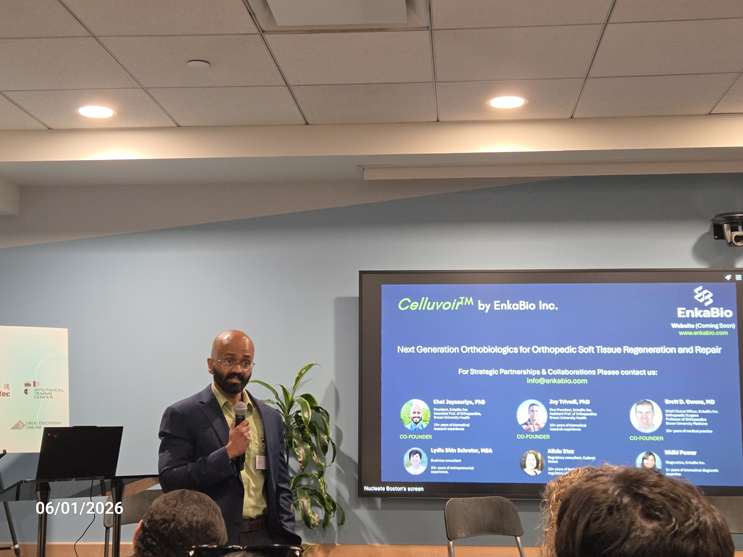
Chathuraka Jayasuriya pitching at the Nucleate Final Forum.
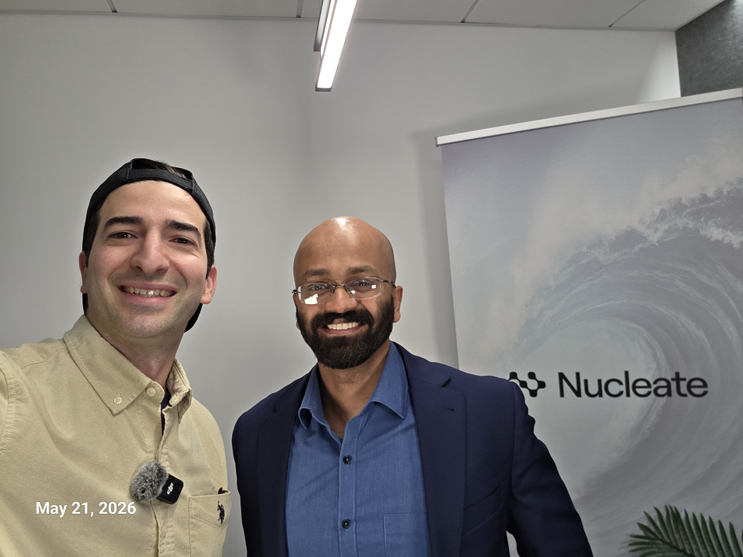
Ray Dogum and Chathuraka Jayasuriya at the Nucleate Boston Practice Pitch Day.
Transcript (Edited for Clarity)
Ray: [00:00:00] Can you give me your name, the company you founded, when you founded it, and the 30-second pitch?
Chathuraka Jayasuriya: Sure. My name is Chat Jayasuriya. I'm one of three co-founders of Enka Bio, Inc. We founded it in September 2025, and we're developing an orthobiologic that's going to change the way meniscus tears are repaired.
Currently, the clinical standard for meniscus repair is suture repair or partial meniscectomy, where part of the injured tissue is removed altogether. The problem is that, while both are standard approaches, they essentially ensure the patient will develop arthritis in the near future.
That's because the meniscus doesn't heal. So we're developing a technology that actually stimulates healing. It's a cell-based therapy. We are at the IND stage right now. We've done preclinical testing, and everything looks promising. We just need to complete CMC, biodistribution, and [00:01:00] GLP toxicology testing, so we're raising a round to do that.
Ray: How much are you raising?
Chathuraka Jayasuriya: Two million dollars for now, but eventually, when we go to phase one, that's going to be around three million dollars, and phase two, six million dollars. Phase three will be twenty-five million dollars. But we're hoping that once we get phase two done, we'll be at a point where we have de-risked the technology enough that a large pharmaceutical firm can partner with us or essentially acquire us.
So that's our exit plan.
Ray: So you went through the Nucleate Boston Activator program.
Chathuraka Jayasuriya: Yes.
Ray: What did it actually change about how you're building the company?
Chathuraka Jayasuriya: Yeah. So the Nucleate program opened our eyes to the business world and what's important for business. We focused on science because we are—you know, I am a professor—so we focused on the science and the details of those things.
But with Nucleate, we had mentors that talked us through how to determine our [00:02:00] market size—like, what's the correct way to calculate that? Who would be our end user? These are things that we didn't really think about, because originally we thought, "Hey, this is for meniscus repair, so it's gonna... the patient will be the user." But actually, it's the surgeon that implements it.
So things like this might be fundamental for most business-savvy people, but for us, we kind of needed that push to get that information and to think of things that way.
Ray: What's the one thing you wish you'd taken more advantage of during the program?
Chathuraka Jayasuriya: You know, it's hard. I think we took full advantage of pretty much everything, and we loved every minute of it, honestly. It was really helpful for us. And I think that the relationships we have, the networks we built, the mentors—they're going to stay with us for a while. So this was really a pivotal moment for us to actually become a productive company moving forward. [00:03:00]
Ray: What's the most challenging part of being a founder in the space?
Chathuraka Jayasuriya: Oh, yeah. Um, well, so I mentioned that I'm a professor. This is sort of like a second full-time job that I have. We don't have a CEO as of yet because we haven't selected one, and honestly, this is kind of like our baby—like my baby—so I want to try to develop it as much as possible.
So it's really the time commitment. It's difficult to commit to... and then also have a family and a kid as well. So yeah, that's the most challenging.
Ray: Yeah, I feel you there. So you mentioned you're a professor. What are you a professor in? And did this research come from your lab?
Chathuraka Jayasuriya: Yes, absolutely. So I am an associate professor at Brown University and at Rhode Island Hospital in orthopedics, the Department of Orthopedics. And my lab focuses on cartilage and soft tissue repair.
Ray: All joints, all parts?
Chathuraka Jayasuriya: Every joint. Well, we focus on the knee because, well, the meniscus is in the knee.
And right now, I think the way meniscus [00:04:00] injuries are treated, it's just not... If you talk to any surgeon, they'll tell you we can do way better than this.
Ray: Yeah. I wonder, how does this type of solution translate from preclinical animal models to humans in the clinic?
Chathuraka Jayasuriya: Yeah. So where we are is that we completed large animal studies in pigs. So from there, what we would need to do is a long-term efficacy study if the FDA asks for it. And then if that's approved and we're able to, again, finish the CMC, GLP toxicology, and biodistribution studies, they will give us our IND, and we can go on to a phase one clinical trial.
So that's the safety component of it. Um, so that's generally how it moves along. And of course, it has to be backed by lots of money—funds for phase one.
Ray: You mentioned it's a cell-based therapy.
Chathuraka Jayasuriya: Yes.
Ray: How are you going to do CMC? Is it through a CRO?
Chathuraka Jayasuriya: That's a great question.
So we have to actually develop our SOP for CMC studies, and then we're going to work with a CRO, of course, and they're going [00:05:00] to develop our master cell bank and the primary cell bank that we'll use for our therapy. So we've already reached out to several to figure out what that's going to look like, and yeah, we're looking forward to doing that.
It's certainly doable. There are other groups that have done this, I mean, with CAR T-cells and... So in a way, we're trailblazers for orthopedics, but in other ways, things like this have already come along in more developed fields, so we have a blueprint to follow.
Ray: Do you think the cost of cell-based therapy might be an issue for the market you're trying to enter?
Chathuraka Jayasuriya: Yeah. So the first time we pitched this, we were going to use autologous cells, which means it comes from the patient. So you get it from a surgery, then you put it back in. They have to come in for another surgery. The problem with doing that is it's exorbitantly expensive.
You have to do this for every single case. But we realized that the animal work we've done used allogeneic cells, and if that works, why would we go to autologous? Why don't we just make that our model? [00:06:00] And this is what our business consultants told us. And, you know, as a scientist, we try to prevent any kind of immune reactions, but we haven't seen that in the animal models.
So we're going to go with this model. It makes it much cheaper. Allogeneic is the way to go if you want to get things into the market and have it be profitable.
Ray: So you already mentioned some of your goals moving forward. But for 2026, what are your primary goals?
Chathuraka Jayasuriya: Yeah. So for the rest of this year, our goal is to find a CEO. And then, in addition to raising the round, we want to try to apply for an NIH SBIR. You have to have two institutions do it: an academic institution and a business institution, and they can't be intermingled.
So I can't be the head of the company and also this. So I need to kind of hand it off to someone who is responsible and will take this seriously and move from there. So I'm hoping to do that by the end of this year.
Ray: [00:07:00] Best of luck there. Yeah. Thank you. How has it been doing the tech transfer from—
Chathuraka Jayasuriya: Yeah.
Ray: academia to you?
Chathuraka Jayasuriya: Yeah. We're still in the process of doing that. So the way Rhode Island Hospital and a lot of institutions work is any work that you do in that lab belongs to them, okay? And it's completely fine. You use their facilities. It's typical. That's what they hired you for.
So we have one patent, and we have filed another patent, so that patent is pending. Both of those are integral to the technology. The hospital has said that they're willing to give us an exclusive license—our company, an exclusive license to this technology—primarily because it's not de-risked enough for a large company like, say, Johnson & Johnson to come along and pick it up from us.
It will be at some point, once we've done a lot of the work. So they've said they're willing to play ball with us, and we just need to get the agreement—or the conditions that we want—to move forward. And actually, that's the most important thing that we're going to be [00:08:00] doing the rest of this year.
Hopefully it'll be done in the next couple of months.
Ray: Did Nucleate help with forming those agreements, potentially?
Chathuraka Jayasuriya: Well, one of the mentors is going to be the person that we have hired to do this. So he understands the technology really well. Most importantly, he's from the Boston ecosystem, so he doesn't have a conflict of interest with people at Brown.
Brown, you know, is from Providence. Providence is a very small place. Rhode Island's a very small place. It seems like all the lawyers, at some point or another, worked for Brown or Rhode Island Hospital. So we tried to reach out to several, and they were like, "Sorry, we have COI, COI, COI." But our guy here, he doesn't.
He's like, "No, I'm going to work for you guys. We're good."
Ray: If you were a cell—or if you were an organelle—which one would you be, and why?
Chathuraka Jayasuriya: Oh, boy. If I was a cell or organelle, I would probably be—and I'd be biased—I do like chondrocytes.
I'm a cartilage [00:09:00] biologist, and the reason I say that is because chondrocytes have a lot of space around them and no other cells nearby. I'm kind of an introvert, so having my own space is nice.
Ray: That's a really good answer.
Chathuraka Jayasuriya: I appreciate that.
Chathuraka Jayasuriya: Yeah.
Ray: Well, Chet, I appreciate your time.
Is there anything else you want to share with the audience?
Chathuraka Jayasuriya: Um, not really. I had fun doing this.
Ray: Thanks.