
2026 Nucleate Boston Activator Cohort Interview: Arvin Soepriatna — TEEM Therapeutics

By Ray Dogum, Chief Editor, Drug Discovery Online
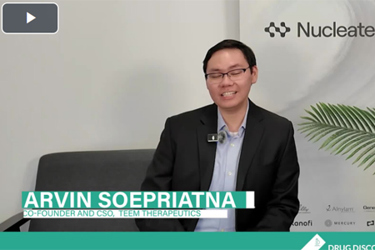
This video series was created in partnership between Drug Discovery Online and Nucleate Boston.
Summary
Arvin Soepriatna, co-founder of TEEM Therapeutics, describes the company’s mission to build scalable, predictive 3D human heart tissue models for cardiac drug development.
TEEM uses living tissue-engineered models to generate both electrical and contractile data, helping pharmaceutical companies assess efficacy and cardiotoxicity earlier in preclinical screening.
Arvin says the Nucleate Boston Activator program helped TEEM sharpen its business model and pivot from an atrial fibrillation drug discovery company to a broader platform company. The company’s goals for 2026 include securing SBIR and pre-seed funding, validating the platform further, and scaling it from academia into commercial use.
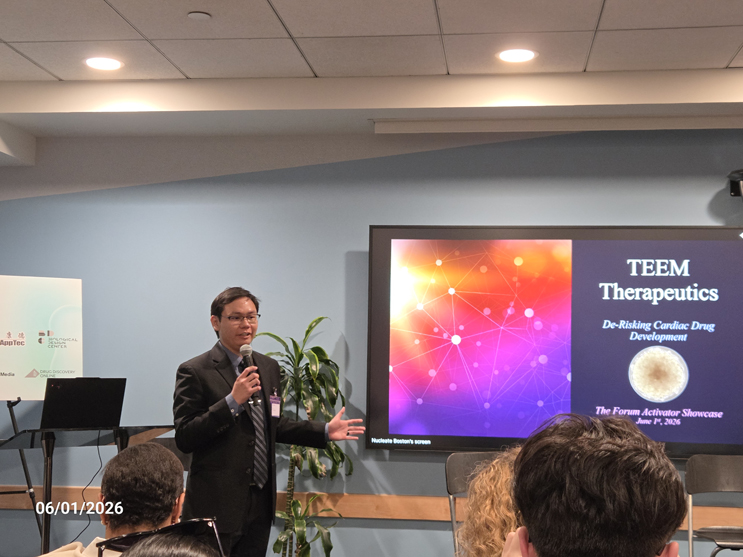
Arvin Soepriatna pitching at the Nucleate Final Forum.
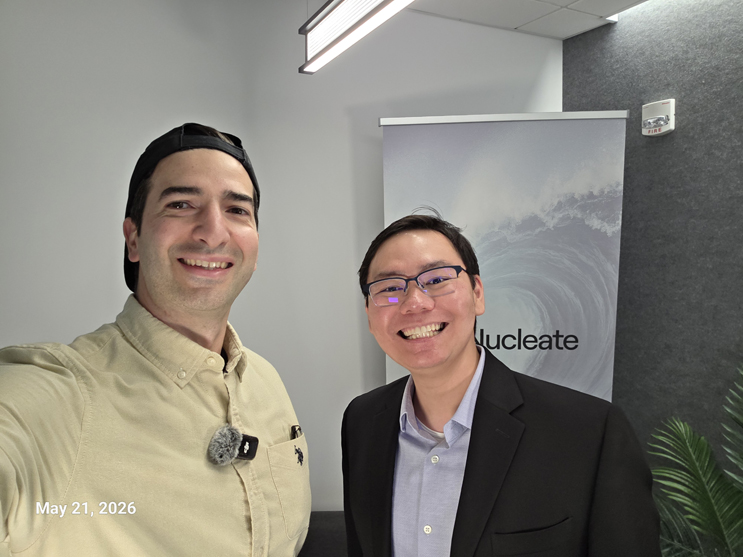
Ray Dogum and Arvin Soepriatna at the Nucleate Boston Practice Pitch.
Transcript
Ray: [00:00:00] Can you state your name, your company, and when you founded it?
Arvin Soepriatna: My name is Arvin Supriyatna. I am co-founder and CSO at TEEM Therapeutics.
We incorporated at the end of 2025. End of '25.
Ray: Can you give me the 30-second pitch?
Arvin Soepriatna: Yes. So, at TEEM, we are building scalable, predictive human tissue-engineered models in order to inform efficacy and toxicity data for cardiac drug development.
Ray: You went through the Nucleate Boston Activator program. What did you actually change about how you're building the company?
Arvin Soepriatna: I think coming from an academic standpoint, I don't really have much of a background in terms of business, and what Nucleate really helped with is connecting me with business contributors and also mentors who are familiar with the way the business and the pharmaceutical industry runs.
So we have strengthened significantly our business model in order to make TEEM from a conceptual academic [00:01:00] idea into a viable business model.
Ray: Was there a specific conversation or moment in the program that changed your trajectory?
Arvin Soepriatna: I would say that my mentorship with Rajiv from Sanofi really helped me figure out where our value proposition lies for our team. Initially, team started off as an atrial fibrillation drug discovery company, but we overlooked kind of the strength of our team platform, and now we've pivoted from simply a drug discovery company for atrial fibrillation to a platform company that has the ability to support drug development and drug discovery.
So we've basically expanded the value proposition for team.
Ray: Yeah, it sounds like you reprioritized during the program. So you mentioned you have, you're building these cardiac tissue models.
Mm-hmm. Correct?
Arvin Soepriatna: Yes.
Ray: [00:02:00] Can you tell me how many you've made so far?
Arvin Soepriatna: Yeah, so we are able to use a single plate of cells, stem cells, that we can differentiate into upper and lower chambers of the heart, and a single plate of cells is enough to generate 1,500 of our, highly scalable tissue engineered models.
So these tissue-engineered models are beating, living, 3D human heart tissues, and because they are human heart tissues, we are able to really i- use it as a way to understand how drugs that we test in the lab correlate to results that we see in the clinic.
Ray: So I know for preclinical research, cardiotoxicity is a major, important milestone you need to overcome—yes, yes—right, for any drug research. Will this new platform that you're building, model, change the way we do cardiotoxicity?
right, for any drug research. will this new platform that you're building, model, change the way we do cardiotoxicity?
Arvin Soepriatna: Yes, we hope that PEEM can be incorporated into the early phases of drug development because currently the way it's done [00:03:00] is they use animal models, which obviously have very different biology than adult human heart, or 2D monolayer cultures, which lack the three-dimensionality that is important in how cells respond to drugs.
Ray: Why do you think animal models have become so much of the status quo in preclinical research?
Arvin Soepriatna: In the early stages of drug development, they don't know what the drug, what are some of the toxic effects of the drug, and which organ they will affect. And so animal model is still, to some degree, useful for identifying how drugs target multiple organ systems, but you will still need to incorporate organ-specific models in order to understand how specific drugs target, specifically cardiac in our case.
Ray: What's one thing your company believes that most of the industry disagrees with? [00:04:00]
Arvin Soepriatna: We believe that cardiac side effects are unacceptable, and a lot of oncology drugs that go through the pipeline end up having cardiac side effects. Um, and yeah.
Ray: That's, yeah, makes sense. Um, you—I'm sure you're seeing lots of organ-on-chip models out there—mm-hmm—both commercially and in the academic lab setting.
What makes your model unique?
Arvin Soepriatna: Right. So what makes Team very unique is our ability to really characterize and capture the electrophysiology of the human heart. While other competitors and cardiac stem cell companies that try to contribute to pharmaceutical development focus on contractile metrics, we provide electrical data in addition to contractile data.
Ray: What’s the most challenging part of being a founder in this space?
Arvin Soepriatna: I would say the [00:05:00] most challenging part of being a founder is fundraising.
Ray: You're probably not the only one saying that. What are your company's primary goals for the rest of 2026?
Arvin Soepriatna: Our primary goal in 2026 is to first apply for an SBIR grant and secure pre-seed funding.
And in terms of milestones, what we aim to do is further validate our platform and also scale up our model from the academic space into the business space.
Ray: Has your model been used in specific use cases already that you can share?
Arvin Soepriatna: So we've used our platform to test compounds that have different cardiac risk profiles, and we use that as a validation study to match what drug was eventually removed from the market because of cardiotoxicity.
Ray: Did you see-- What kind of results did you see?
Arvin Soepriatna: That it overlaps very well with cardiac drugs that were removed from the market.
Ray: And so, in [00:06:00] terms of the product or solution you're offering to the market, it is this model—who would be a potential buyer?
Arvin Soepriatna: So at Peame, we are working very closely with pharmaceutical companies, as our goal is to better inform pharmaceutical companies what are some of the most promising cardiac drug candidates that can move on toward clinical trial.
So our goal is to inform pharmaceutical companies earlier on before they invest in the wrong compound to go to clinical market.
Ray: How, how early on can this model be used?
Arvin Soepriatna: In the preclinical space during the lead screening phase. And when they've narrowed down some of their compounds that shows, let's say, for an oncology compound, if they have some efficacy data there, and they need to test what are their side effects on the cardiac side of things, we hope that we have a very predictive platform that will allow us to identify and capture those toxicities so that those don't move [00:07:00] forward into clinical trials.
Ray: Do you think that your model will ever replace some animal studies?
Arvin Soepriatna: It will complement animal studies, but it will provide a much stronger predictive, power for cardiotoxicity.
Ray: How did you make the t- the, the name of the company Team?
Arvin Soepriatna: So TEEM stands for tissue engineered models, which is what, our patented platform is.
Ray: I should've asked that first.
Ray: Thank you.
Arvin Soepriatna: Thank you.
Ray: Appreciate it.