
2026 Nucleate Boston Activator Cohort Interview: Anna Kazatskaya — Fervid Therapeutics, previously Antozero

By Ray Dogum, Chief Editor, Drug Discovery Online
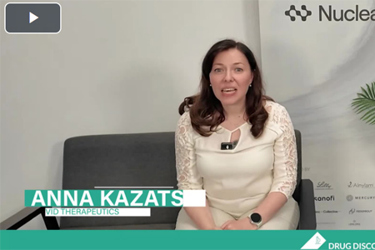
This video series was created in partnership between Drug Discovery Online and Nucleate Boston.
Summary
Anna Kazatskaya, CEO of Fervid Therapeutics, founded about a year ago, and recently incorporated, is developing a novel anti-seizure therapy for rare pediatric developmental and epileptic encephalopathies (DEEs).
The company’s approach moves beyond traditional ion channel and GABA targets by promoting formation of new inhibitory synapses to restore brain balance. Early in vivo data in three mouse models support progress toward a $2M pre-seed raise.
Participation in Nucleate Boston provided critical mentorship and industry connections. Kazatskaya emphasizes improved preclinical rigor using emerging models, cites fundraising and infrastructure gaps as challenges, and aims to advance CRO-driven studies and validation through 2026.
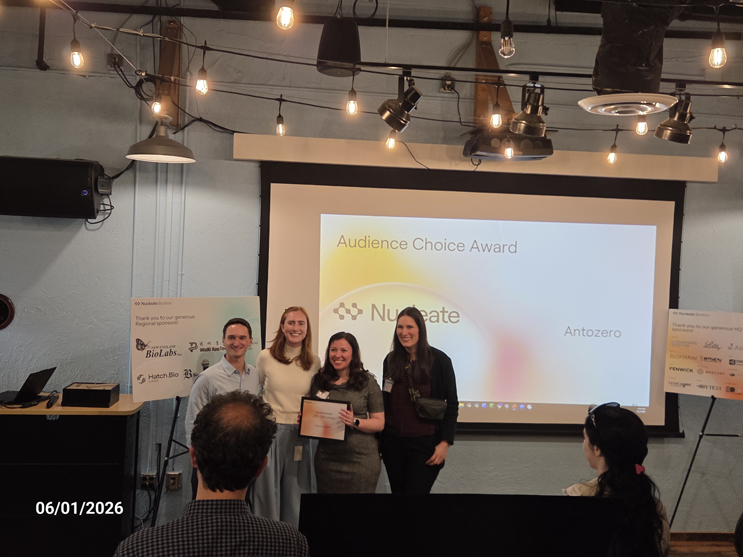
Nucleate Boston Managing Directors, Jake Rossetto and Regan Ellis, awarding Anna Kazatskya and Vera Valakh, Fervid Tx, previously “Antozero”, with the “Audience Choice Award” at the Nucleate Final Forum.
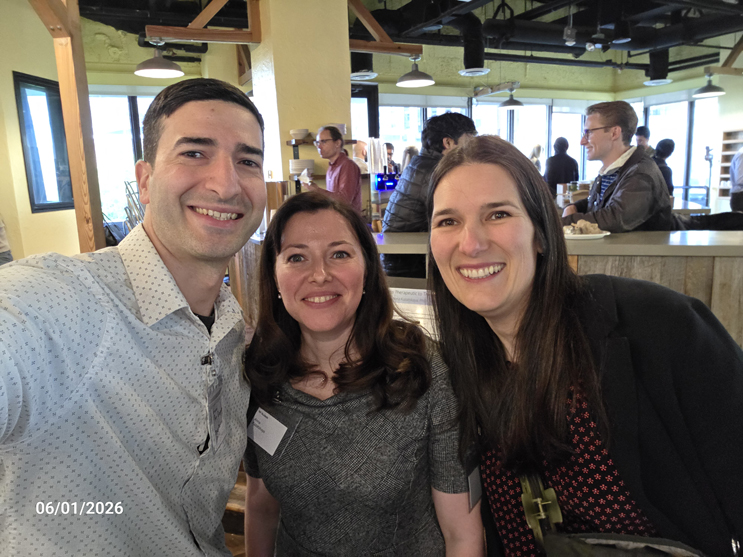
Ray Dogum with Fervid Therapeutics co-founders, Anna Kazatskaya and Vera Valakh, at the Nucleate Final Forum.
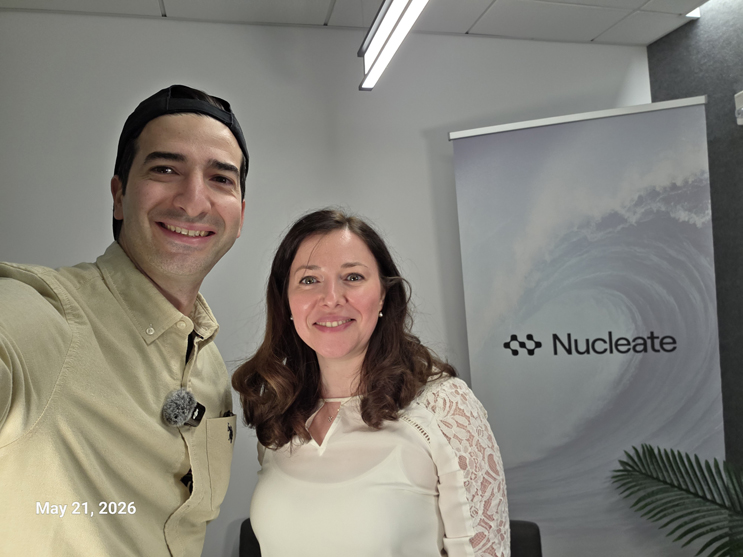
Ray Dogum and Anna Kazatskaya at the Nucleate Boston Practice Pitch Day
Transcript
Ray: [00:00:00] Can you tell me your name, the company you founded, when you founded it, and the 30-second pitch?
Anna Kazatskaya: Sure. my name is Anna Kazatskaya, and I'm the CEO of Fervid Therapeutics. we are targeting rare pediatric epilepsies, called developmental epileptic encephalopathies or DEEs. And our company is bringing a new anti-seizure medication to children affected by severe life-threatening seizures
Ray: When did you found the company?
Anna Kazatskaya: We have founded the company around a year ago, but we are freshly incorporated. We've incorporated only two weeks ago.
Ray: Oh, congratulations.
Anna Kazatskaya: Thank you.
Ray: Wonderful. So you went through the Nucleate Boston Activator program. What did it actually change about how you're building the company?
Anna Kazatskaya: before participating in Nucleate, we didn't have access to any infrastructure at all.
we were working with the university and working through their tech transfer office, and through professors, and [00:01:00] trying to get sort of, random ideas of how to develop a company. This had given us access to actual professional mentors from VC world, from biotech companies, who could actually tell us how to bring an academic idea into a startup environment.
Ray: Was there any specific conversations or any moment in the program that changed your trajectory?
Anna Kazatskaya: Uh, absolutely. I think we had a- a regional pitch day, where we started meeting all the advisors and people who were actually interested in our idea, and there were people from companies developing anti-seizure medications approaching us and saying, "Oh my God, your idea's so cool and we should totally work together."
Ray: Let's talk about the idea. What is the big idea?
Anna Kazatskaya: the big idea is to move away from just looking at ion channels or modulating GABAergic transmissions, which is the only two [00:02:00] mechanism that current anti-seizure medications are targeting, and develop a completely novel therapy, which is what we are doing.
We're increasing the number of inhibitory synapses in the brain. We're just basically taking the brain and saying, "Hey, you should stop seizing."
Ray: And how are you doing that?
Anna Kazatskaya: by increasing changing inhibitory excitatory balance in the brain. So we have a peptide, a therapy, that's gonna promote the formation of completely new inhibitory synapses, and that will promote, changes in excitation inhibition in the brain.
Ray: How far along is the development of the research
Anna Kazatskaya: We have developed, preliminary in vivo, data in three distinct epilepsy mouse models. and we are, ready for our pre-seed, rounds.
Ray: Do you know how much you're raising?
Anna Kazatskaya: We are raising $2 million, to move from this more academic, lab [00:03:00] environment to develop our lead further, and to generate early in vivo efficacy, to move to our seed round.
Ray: what's one thing that you wish you'd taken more advantage of during the program?
Anna Kazatskaya: Huh. Um, we actually, so we were offered only one advisor and we asked for two.
Ray: Mm. Okay.
Anna Kazatskaya: And I wish I asked for three.
Ray: That's, I can see why that would make sense. Yeah, definitely. Um, so the drug discovery industry is huge, a lot going on.
If you can change one thing about it and the process the way it's, you know, it works today, what would it be?
Anna Kazatskaya: Um, I, uh, from my point of view, I think people should, really concentrate more on preclinical testing before moving into human trials. So I would actually, there are a lot of new systems coming out where you can do early testing.
Um, and I think a lot [00:04:00] of biotech would benefit by investing more in their preclinical platforms. Right now, a lot of drugs are tested preclinically, haphazardly, not in a systematic manner, and I think that would improve, biotech significantly.
Ray: Why is it that way? I think maybe it's because, these companies are trying to hit milestones, and perhaps they're, one of the milestones is reaching the clinic, phase one.
And do you agree? Is that sort of like the misincentive or misalignment maybe of incentives?
Anna Kazatskaya: I think, we are at inflection point, where before I think a lot of very developed preclinical models were not available. But right now you can do, like we just watched somebody present iPSC-derived cardiomyocytes, which are disease relevant, and you can really test, new drugs and look whether they would have an effect in the heart.
you can do the same in neurons, and that would be amazing. So I think we are ... It's not like they weren't doing it. I think it wasn't available, and we're in inflection point where we can make [00:05:00] it available and move away from more in vitro testing and move away from too much maybe animal testing.
Ray: Interesting. what's the most challenging part of being a founder in this space?
Anna Kazatskaya: specifically for us, we're in, epilepsy space. we are addressing a severe, need in the pediatric patients, and it's, honestly very hard to see, that there are ... All of these therapies that I know in my head are available for them, but I think there is no infrastructure right now to bring it forward.
So I think that's very heartbreaking.
Ray: What are your company's primary goals for the rest of 2026?
Anna Kazatskaya: we are really aggressively looking for investment, and just getting this initial somebody to believe in us, to give us a little money that will push us forward to generate more and more data that we can, just put the package together and just, become an [00:06:00] actual big boy company.
Ray: Yeah. A big girl company.
Anna Kazatskaya: Big girl company.
Ray: Yeah. so with that money, what kind of tests still need to be conducted?
Anna Kazatskaya: So we are actually, running the virtual lab model, where we are running all of our experiments through a CRO. So we are establishing an agreement with CRO to run our in vivo, testing in mice.
So we are conducting some, communication with the CROs who are gonna develop our mouse epilepsy models, and we'll test the drugs, that we are, developing.
Ray: How is that going? 'Cause I know with CROs, there's the communication between your company and the CRO is crucial. have there been any missteps or learnings from the work with the CRO?
Anna Kazatskaya: I think we work with pretty small CROs that specialize specifically in developing, epilepsy in vivo models. We've had really good success with them, but I know, I think if you work with [00:07:00] larger CROs, then maybe it becomes harder.
Ray: So this is a fun question If you were a cell or if you were an organelle, which one would you be and why?
Anna Kazatskaya: Oh, mitochondria, 100%. Everybody says mitochondria, right?
Ray: You are the third person to say mitochondria I asked.
Anna Kazatskaya: Yeah. You're just like the energy of the cell. You just keep going.
Ray: I appreciate that. is there anything else you think that our audience should know about you, Fervid, preclinical space?
Anna Kazatskaya:
Ray: If not, then I did my job.
Anna Kazatskaya: I think you did your job. Thank you so much.
Ray: I appreciate your time.
Anna Kazatskaya: Thank you.
Ray: Thank you, Anna.