
2026 Nucleate Boston Activator Cohort Interview: Chris Clifford — Mimic Therapeutics

By Ray Dogum, Chief Editor, Drug Discovery Online
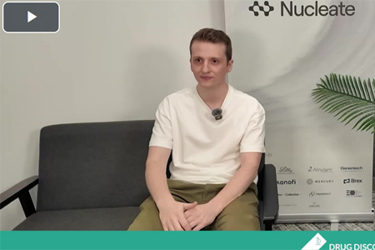
This video series was created in partnership between Drug Discovery Online and Nucleate Boston.
Summary
In this interview, Chris Clifford, founder of Mimic Therapeutics, describes the company’s mission as protecting cell therapies from immune rejection, with an initial focus on Type 1 diabetes.
Drawing from his own experience living with the disease, he explains that Mimic uses gene modification to help transplanted insulin-producing cells survive while aiming to avoid the safety tradeoffs of “stealth” or hypoimmune approaches.
He says the company has generated promising preclinical transplant data, has patented its core technology, and plans to expand its intellectual property portfolio. Chris Clifford credits the Nucleate Boston Activator program with sharpening the company’s commercialization strategy, especially around proving safety in clinically meaningful ways.He also highlights the challenge of balancing startup leadership with PhD work and argues that broader investment in cell therapy manufacturing and scale-up is needed to unlock the modality’s potential across diabetes, cancer, Parkinson’s, and other diseases.
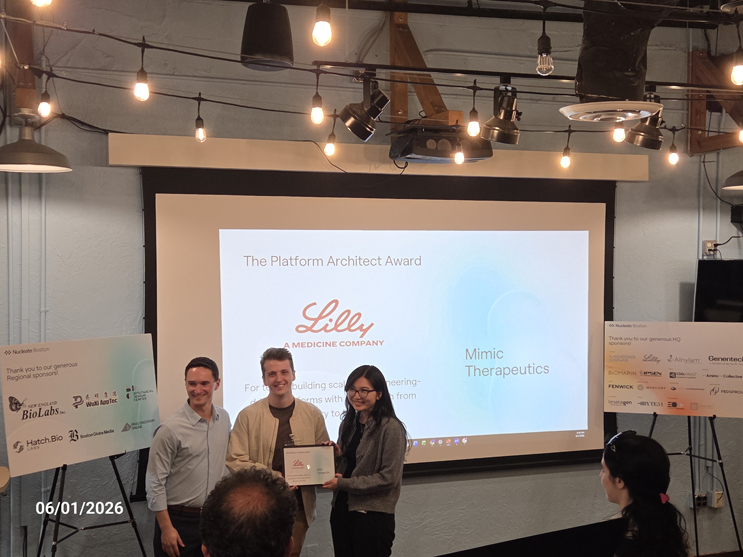
At the Nucleate Final Forum, Mimic received the “Scientific Excellence Award” and the “Lilly Platform Architect Award.”
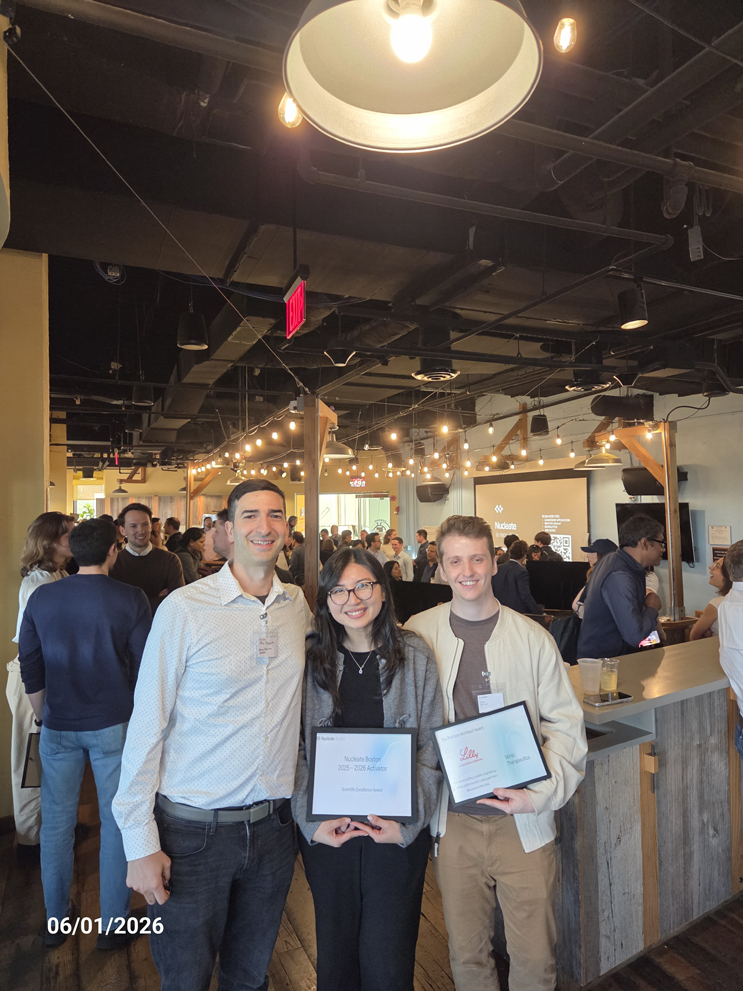
Ray Dogum with Jiun Tseng and Chris Clifford, Mimic Co-Founders, at the Nucleate Final Forum.
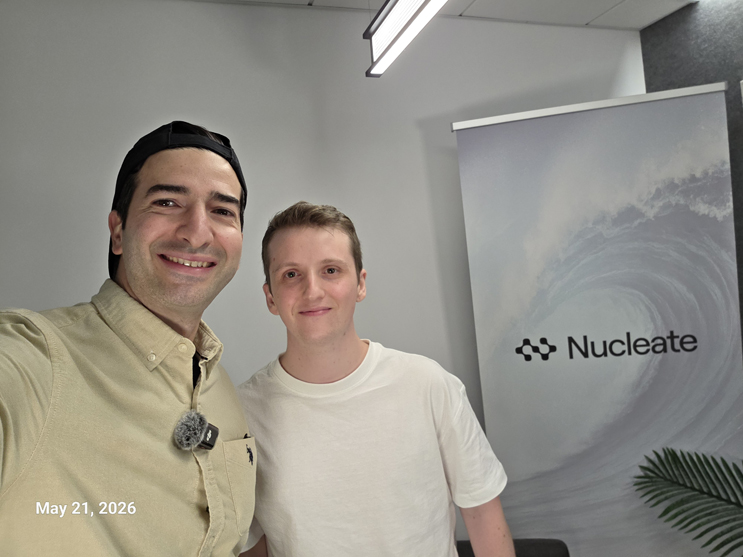
Ray Dogum and Chris Clifford at the Nucleate Boston Practice Pitch Day.
Transcript
Ray: [00:00:00] Can you give me your name, the company you founded, and when you founded it?
Chris Clifford: Yeah. So my name's Chris Clifford. the company that's going through Nucleate is Mimic Therapeutics. It's something that we've been spinning out of, Harvard Medical School for the last year now.
Ray: And can you give me, like, a 30-second pitch?
Chris Clifford: Yeah. So Mimic is largely focused on how we can protect cell therapies.
So for me personally, I've lived with Type 1 diabetes for 14 years, and one of the really exciting treatments for Type 1 diabetes is transplanting insulin-producing cells. And one of the biggest obstacles to doing that right now is after you transplant the cells, they get rejected by the recipient, so we do gene modification to protect the cells.
Ray: How far along are you in
Chris Clifford: So we have some exciting data, some exciting preclinical and animal data showing that if we transplant the cells into transplant models, um, we see protection of the cells. And also, we think that we have some really interesting, um, advantages over other approaches where we can potentially offer a safer cell product.
Ray: So you went through the Nucleate Boston Activator program [00:01:00] this year. What did it actually change about how you're building the company?
Chris Clifford: Yeah. I think Nucleate has a really great network. So it, it really gave us access to a lot of pharma that we didn't previously have connections with, and it just gave us, I think, a much more grounded understanding of what it takes to commercialize a company.
Ray: Was there any specific conversation or any moments in the program that changed the company's trajectory?
Chris Clifford: Yeah. I think, I think one of the really useful pieces of information that we got is, like, one of our value propositions is safety, right? And specifically the feedback that we got is, "Okay, well, safety's great, but how do you actually prove that it's valuable in a product?"
Which is a really hard question to answer. It sounds simple, but it's like you have to be looking for particular pathogens, and you also have to have clinical ways to measure it. Like, I think learning that, you know, it's not just about having a good technical product. You have to be thinking ahead of time how you're gonna run a clinical trial and what are your readouts gonna be.
I think that's been [00:02:00] very good feedback.
Ray: Yeah, the whole, like, build it backwards mentality.
Chris Clifford: Exactly. Yeah.
Ray: So obviously this is a personal issue for you as well. I'm sure you've, you know, been through the medical system for your Type 1 diabetes.
Chris Clifford: Mm-hmm.
Ray: when did you come up with the idea to do this?
Chris Clifford: So I never
I wouldn't say it was, like, a one moment where I came up with the idea. Actually, the idea came from my PI. Um, so I did electrical engineering in undergrad, and just kind of by chance ended up getting exposed to regenerative medicine. So I was working at the Mayo Clinic making these insulin-producing cells from stem cells, and I kind of fell in love with the idea of being able to cure someone from Type 1 diabetes by just giving them the cells that they're missing.
so that's when I decided that I was gonna do my PhD, and the rest is kinda history. I started my PhD here at MIT and Harvard Medical School, and, um, I work at a lab at Joslin where me and my PI kind of came up with the idea together.
Ray: Very interesting. so obviously the drug discovery industry is so large, it's very complicated.
if there was [00:03:00] one thing you could change about it, what would it be?
Chris Clifford: About the drug industry?
Ray: The drug discovery process, the industry itself. Yeah.
Chris Clifford: That's a very hard question to answer. I think, um, well, I'm biased, but I feel very strongly about cell therapies, but it's also probably one of the hardest modalities to push to clinic right now, so.
Ray: And why is that?
Chris Clifford: It's very expensive, it's very high risk, it's very new, so it's not, you know, de-risked as much as it could be. but I also think that it has so much potential for not just diabetes, but for a lot of diseases, cancer, Parkinson's, and many others. So I, I wish that there was more, work being done, especially on the manufacturing and scale-up side to, like, support these kind of cell therapies getting to patients.
Ray: What's the most challenging part of being a founder in the space?
Chris Clifford: I think personally, because I'm still a fourth-year PhD student, balancing the academic life with the startup spin-out kind of [00:04:00] life. It's been a really exciting experience to get to kind of see more of the industrial lens of my science, but they are very different.
The kind of questions that you ask in academia and industry don't always align. But the good side of it is that there's a lot of questions that have come up through the spin-out commercialization process that I actually had never thought of in, in the academic setting, and that's really informed kind of how I'm finishing my PhD.
So it's been really cool.
Ray: So a little bit of synergy
Chris Clifford: there. Mm-hmm. Exactly.
Ray: Interesting. And obviously one question you've probably received numerous times is how big is the market?
Chris Clifford: Yeah. So there's, like, about 2 million patients with Type 1 diabetes in the US.
and there's many more patients that could benefit from cell therapy, even potentially Type 2 diabetics, if we're just talking about diabetes. But if you expand out to oncology and dementia and eye diseases, there, and heart, there's so many other diseases that could benefit.
Ray: Does the company have any intellectual property at this time?
Chris Clifford: Yeah, so we have a, we do have a patent on the core technology. [00:05:00] and we're also gonna be filing for, for more IP in the future, um, yeah, as we kind of progress.
Ray: What's the most exciting thing for you about the, all of this?
Chris Clifford: Honestly, I think it's just been the people that I've met, like through the, the Nucleate team, I'm very fortunate to have three great team members, and also the mentors that I've had and the connections that they've given me.
It's been really great. I think regardless of what happens with Mimic, it's really tied me into the Boston industry and just the local ecosystem.
Ray: If there was anything you could have taken advantage of more in Nucleate during this program, what would it be?
Chris Clifford: I think probably this is hard to do in practice, but there's a lot of amazing network mentors and connections and things, and I would do everything possible to, like, grab a coffee with them and meet, 'cause some- they're some of the most interesting people, and they really are super generous with their time.
Ray: Yeah, there's only so much time-
Chris Clifford: Yeah ...
Ray: as well,
Chris Clifford: so. Yeah, but it, [00:06:00] it is, it is really great. I think, you know, no matter what capacity you go through Nucleate, if you have a particular interest, especially in industry, like you can find someone that can really help you kind of figure out how to fulfill that.
That's really cool.
Ray: What are the company's Mimic's primary goals for the rest of the year?
Chris Clifford: So for the rest of the year, we're focused on this issue of safety and how do we demonstrate. So, um, without getting too much into the weeds, kind of, um-
Ray: Get into the weeds if you want.
Chris Clifford: Okay. Yeah. Well, um, one of the big cell therapy approaches right now is called hypoimmune, or you can think of it as stealth.
So basically what that is you gene edit the cells to where the recipient's body can't detect them, so it's like a stealth cell. that's great for protecting the cells, but potentially might raise safety concerns, because the cells can't be detected if they become dangerous. So, one of the questions that we wanna answer in the next year is how can we demonstrate that in the lab, because that's not something that we've seen clinically happen in early clinical [00:07:00] trials.
And, as a patient, it's something I care about a lot. If we're pushing these therapies to patients, I think it's important to demonstrate that there aren't huge immune blind spots that potentially could, negatively affect patients.
Ray: Do you know if there's any other therapeutics now that involve these stealth cells?
Chris Clifford: There are, yeah. Um, uh, some of the... I mean, there's, there's a lot of companies that are going this approach. It's the stealth cells are like HLA knockout, so they remove this really important immune molecule called HLA. normally in like when you get a kidney transplant, those are the genes that you match on.
Mm-hmm. so any solid organ transplant. And companies that are going that approach, like some examples would be like, I think BlueRock and Sana Biotechnology and there's lots of others. It's a very common, CRISPR. There's a lot of, a lot of companies that go this approach. It's, it's a very smart approach, because essentially it allows you to use one universal line is what they call it, one line that everyone could receive.
Whereas when you do HLA, you need to match. So that's like when you, when you get an organ transplant, right? You have to find a compatible [00:08:00] organ donor. So that's the complexity that's added with doing HLA matching, which is what Mimic does, is that you have to be able to match your graft to the patient.
Whereas with these stealth approaches, because they're not recognized, you could just use one source and everyone can receive it.
Ray: Right. W- with the risk of potentially- With, with the safety issues,
Chris Clifford: yeah ... safety
Ray: if you were a cell or an organelle, which one would you be,
Chris Clifford: and why?
That is a good question. I think, I think it would be the endoplasmic reticulum, and I think it would be because, it's because that is where the HLA gets loaded with all of their fun, their fun peptides on them. So that's the, that's the gene that I care the most about. So yeah. Love that. Yeah. That's
Ray: right.
Chris Clifford: It's like, uh, all your proteins go into a blender basically, and then little pieces of them get presented on HLA, and that's how when your immune system comes by, if a virus or something bad got blended up, it senses it and it kills those cells.
Ray: And so e- every cell obviously has m- multiple-
Chris Clifford: Every cell with a nucleus [00:09:00] expresses HLA on it.
Ray: Interesting.
Chris Clifford: Yep.
Ray: Appreciate your time.
Chris Clifford: Yeah.
Ray: Thank you, Chris.
Chris Clifford: For sure. really cool.
Ray: Yeah. Anything else you wanna share with the audience perhaps? Anything on your mind? Any advice for future founders?
Chris Clifford: Good luck.
Ray: Yeah, good luck indeed.
Chris Clifford: I think it takes a lot of, you just have to be really passionate about what you're doing 'cause it's, a lot of times it's you supporting yourself.
You have to be able to really steel yourself.
Ray: I appreciate that.
Chris Clifford: Yeah.
Ray: Thanks.
Chris Clifford: For sure.