
Are NAMs Validation Centers Really Needed To Drive Greater NAMs Adoption? Scientists Are Wondering

By Ray Dogum, Chief Editor, Drug Discovery Online
Regulators have opened the door to new approach methodologies (NAMs). The harder work now is building enough confidence to actually replace animal studies, and the field is still working that out.
C-Path And Its Partners Are Helping Drug Discovery Rely Less On Animals
Going back centuries, mouse models were once a new method. So were 2D cell cultures. Nobody fully understood how either translated to working medicine, and both became standard tools anyway.
Graham Marsh, Ph.D., scientific director at the non-profit Critical Path Institute (C-Path), opened his talk, at the Drug & Development US 2026 conference, with that zoomed out perspective. He also asked, "How do we build out the evidence to make these new methods just methods, so that they can be accepted and widely used in drug discovery?"
The FDA's April 2025 roadmap for reducing animal testing in preclinical safety studies favors validated NAMs, and its April 2026 progress report cites more than 16 active submissions.
On a panel I moderated, Marsh and Tobias Raabe, Ph.D., of the University of Pennsylvania described different ways of using NAMs and the benefits of having regulatory validation to build scientific confidence, but an audience member questioned whether the effort is aimed correctly.
Building Shared Evidence
Marsh focuses on infrastructure that lets a NAM be trusted beyond the lab that built it. About a decade ago, C-Path advanced a hollow-fiber tuberculosis model that Marsh said helped enable the first new TB therapy in 50 years. He’s also the interim executive director of the NAMs Developer Coalition (NAMs-DC), launched in May 2026 to build a qualification framework for complex in vitro models and a database for evaluating tools by context of use.
He also supports the National Center to Accelerate Cures (NCAC), launched Oct. 1, 2026, in Baltimore by C-Path and two other nonprofits, Blackbird Laboratories and the Arrowpoint Labs Foundation, with $3 million in congressional funding. Marsh described it as a nonprofit CRO for independent validation studies that will also publish shared terminology and an open data standard for FDA review.
Context of use, Marsh said, sets the burden of proof. A tool qualified through the FDA's ISTAND program can be used by anyone for its defined purpose without re-justification; by his count, ISTAND has accepted 16 of 49 letters of intent. But a disease-specific efficacy model "might be an N of one," so validating it within a single application may make more sense.
A Challenge From The Audience
From the audience, James Hickman, Ph.D., a University of Central Florida professor and co-founder and chief scientist of “human-on-a-chip” company, Hesperos, challenged the database idea.
"You create a validation database, right? It's still going to be limited," he said. Instead, biotechs should just call developers such as Hesperos or Emulate directly, review their data, and pick a platform. Most Hesperos customers, he noted, are small biotechs that can't afford to fund validation dataset studies. He questioned the need for various validation initiatives and centers, including the Texas A&M Tissue Chip Validation Consortium.
Marsh countered that such case studies are exactly what shared evidence should capture, but the proprietary data belongs to sponsors. Both were describing the same gap: trust built in one biotech-vendor conversation doesn't carry over to the next company unless the evidence is shared.
Human Disease Biology And Standardization
Raabe's Penn lab derives organoids from the livers of patients with end-stage metabolic dysfunction-associated steatohepatitis (MASH), adds myofibroblasts and macrophages to model fibrosis, and tests RNA therapies delivered by cell-targeted lipid nanoparticles.
He argued that complex diseases will need agreed-upon benchmarks, such as panels of iPSC lines reflecting human genetic diversity, that every company would screen new drugs against. Hickman estimated that differentiating 10 motor neuron lines would cost about half a million dollars. "Right now, yeah, too expensive, but it's not going to stay like that," Raabe agreed.
He was also realistic: "Animal studies will never disappear, that's clear. ... But you can greatly reduce them."
Where Confidence Is Building First
Marsh called IND-enabling efficacy studies "a killer application right now," while toxicology is harder because no single system captures systemic toxicity. Raabe added target identification for diseases such as Alzheimer's that lack good animal models. Marsh pointed to rare disease, where a custom animal model can cost millions.
When I noted that organoids aren't humans either, Marsh said, "You have to pick your poison": human-relevant data from a system limited in cell types, or data from a mouse whose disease progresses differently. He would bet on the human system. He added that since the FDA's guidance, the push for NAMs comes from executives, not just bench scientists.
Why These Conversations Need To Continue
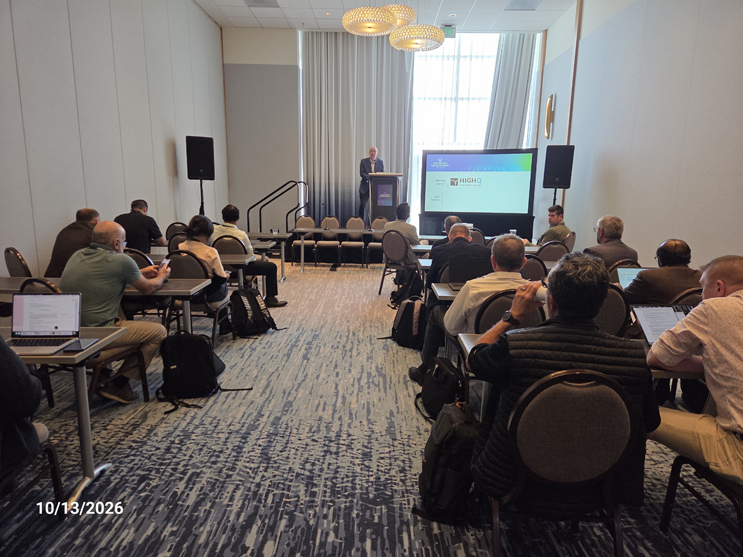
Tobais Raabe, Ph.D., presenting at the NAMs Track during the Drug and Development US 2026 conference in San Diego.
Open questions remain. How should context of use be defined for efficacy? Who pays to generate shared validation data? How can sponsors share clinical outcomes without losing their competitive edge? No guidance document, coalition, or center alone will settle these issues.
Asked what milestone would show NAMs has graduated to just "methods," instead of “New Approach Methods,” Marsh said he hopes that within three to five years, more companies will bring rare disease therapies to market "because of the efficacy studies that these tools can enable." Raabe expects standardization first for genetically defined diseases, then for complex ones such as fibrosis. "But it will happen eventually," he said.
How quickly that happens depends on having more academia/industry/regulatory wide conversations.
The key takeaway for early-stage drug developers is that they don't need to wait for complete validation databases to start talking with NAM developers, many of whom already have robust internal data that can help guide programs today. Asking questions about these assays doesn't commit you to running an experiment. Ask the tough translational questions that should drive any drug discovery program: What context of use does this data support? How have results translated to the clinic? Where does the model fall short?
Disclaimer: Emulate is a sponsor of Drug Discovery Online.
About the panelists
Graham Marsh, Ph.D., is scientific director at the Critical Path Institute, where he leads work on the New Approach Methodologies Developer Coalition and supports the National Center to Accelerate Cures. He is a biomedical engineer with a Ph.D. from the University of Rochester.
Tobias Raabe, Ph.D., is a research assistant professor of medicine in translational medicine and human genetics at the University of Pennsylvania, where he has directed the Translational Genome Editing Laboratory since 2020. His lab builds MASH patient-derived liver organoid models and uses targeted lipid nanoparticles to develop RNA therapies for liver fibrosis. He earned his Ph.D. in molecular genetics at the University of Basel in the lab of Nobel laureate Werner Arber.