
Discovery & Development US 2026 - Key Notes From San Diego

By Ray Dogum, Chief Editor, Drug Discovery Online
San Diego, CA is the #2 place in the world to find drug discovery innovation, at least in my opinion. It has it all. Amazing research history and institutions, startup culture, the beaches, tacos, and recently, Oxford Global’s Drug Discovery & Development US 2026 conference.
Of course, you don’t need me to tell you where I think #1 is. Our readers are all wicked smaht.
Here are a couple keynote summaries from the event.
New Modalities Are Redefining the Drug Target
I had the privilege of kicking off day two and introducing keynote speaker Jadwiga Bienkowska, Ph.D., senior director and head of Pfizer’s computational biology oncology unit.
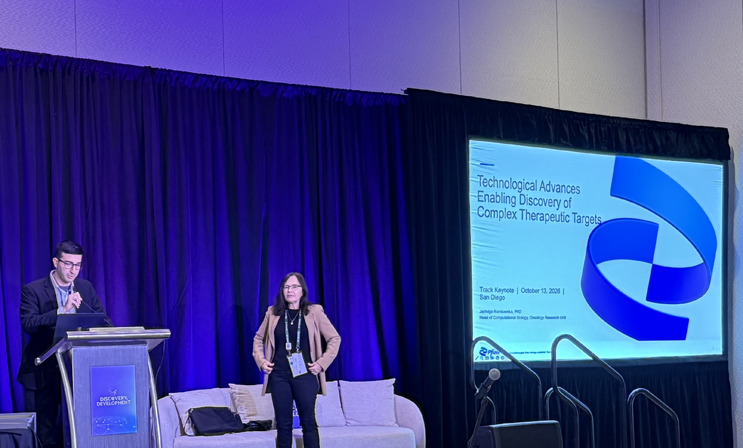
Ray Dogum introducing Jadwiga Bienkowska at Drug Discovery & Development US 2026.
With more than 20 years of experience in biopharma, Bienkowska has led multidisciplinary teams applying computational biology, machine learning, and AI to target discovery, mechanism-of-action research, and patient and biomarker selection across cancer, neurological, and immune diseases.
Her central message was that new therapeutic modalities are changing the basic definition of a drug target.
Ten years ago, Bienkowska said, a target was often a kinase or enzyme to inhibit with a small molecule. Today, it may be a protein pair, a multiprotein complex, or the spatial relationship between a tumor cell and a T cell. “The challenge is no longer to find the right target protein,” she said. “The challenge now is to specify, measure, and engineer the therapeutic relationship.”
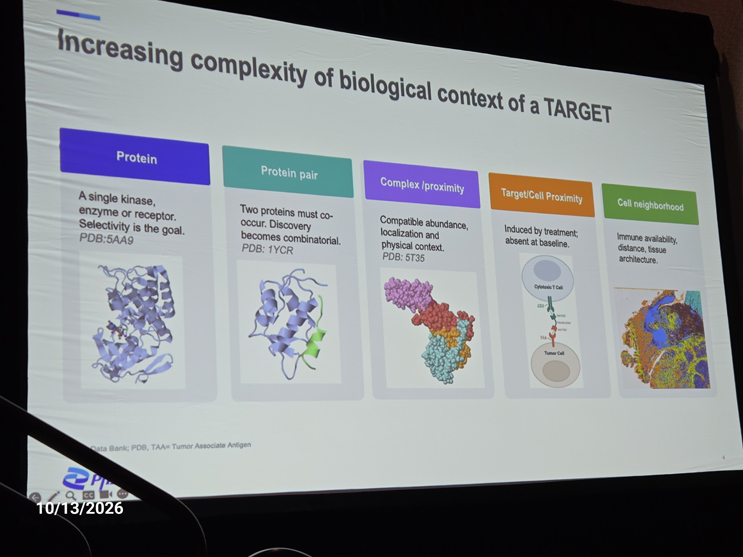
Slide shared by Jadwiga Bienkowska on the increasing complexity of biological context of a TARGET.
Pfizer has built what Bienkowska called a “multimodal intelligence platform” to tackle that complexity. It combines internal and external genomics, proteomics, single-cell, spatial, and treatment-linked patient data across more than 40 metrics. “Not every evidence is important for every type of therapeutic modality,” she said. Pfizer therefore creates modality-specific desirability scores for T-cell engagers, bispecific antibodies, antibody-drug conjugates (ADCs), and induced-proximity medicines.
One example was Pfizer’s analysis of a potential OR-gated T-cell engager target pair. Using a single-cell pan-cancer atlas, the team identified two undisclosed tumor antigens that were individually considered safe, but each appeared on only about half of the tumor cells. Selecting cells expressing either antigen increased predicted coverage by nearly 38 percent. Immunohistochemistry then showed that at least one target was expressed in 89 percent of the tumor samples analyzed.
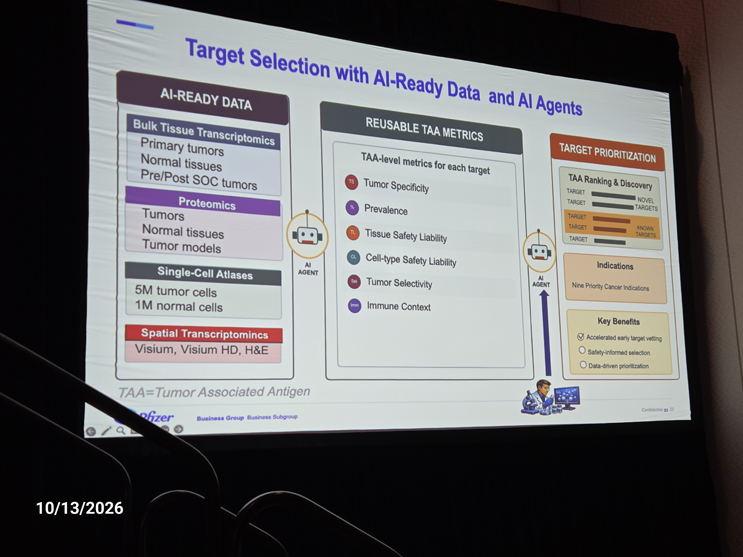
Slide shared by Jadwiga Bienkowska on target selection with AI-ready data and agents.
A separate analysis examined whether two targets were close enough together on the membrane surface of cancer cells to support a strong therapeutic interaction. “The presence of the targets is often not enough,” Bienkowska said. “The two targets have to be close enough to elicit therapeutic activity.” To assess potential on-target, off-tumor toxicity, Pfizer combined protein-level measurements with predictive modeling to estimate receptor abundance in healthy and tumor tissue, where even low expression can create safety concerns.
Together, these T-cell engager examples show that a target cannot be evaluated apart from the modality designed to act on it.
ADCs raise a different target question: Does the target remain available after a patient has already received treatment? “Targets are also dynamic and are altered by the treatment,” Bienkowska said. Pfizer compared patient data from before and after ADC treatment and found that expression dropped significantly for two targets but not for a third. In other words, one ADC may reduce the target expression that a later therapy needs, while another may not.
“You cannot make a blanket statement across all the ADCs as a class of therapy,” she said. AI helps Pfizer combine this evidence and rank targets for specific uses, but scientists still decide which data matter most. As Bienkowska put it, “We select the evidence that goes into our ranking.”
NAMs Are At A Critical Inflection Point
In April 2025, the FDA announced a roadmap to reduce animal-testing requirements for investigational new drug applications, beginning with monoclonal antibodies and encouraging tools such as organoids, organ-on-chip systems, and computational models. In September 2026, the agency went further with a direct final rule that replaces “animal” with “nonclinical” testing terminology, effective February 4, 2027. The wording change does not eliminate animal studies, but it makes room for a broader evidence base in IND-enabling work.
The NIH is reinforcing that shift through funding and infrastructure. In 2025, it announced that it would no longer seek proposals built exclusively around animal models, pushing applicants to incorporate human-based approaches.
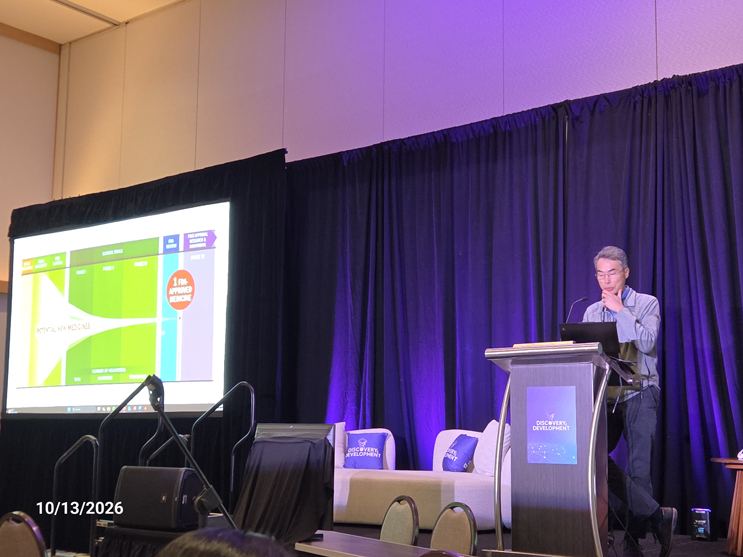
Joseph Wu presenting at Drug Discovery & Development US 2026.
In his talk, Joseph Wu, M.D., Ph.D., director of the Stanford Cardiovascular Institute and co-founder of Greenstone Biosciences, argued that the real opportunity for NAMs in combining patient-derived models, genome editing, and computational tools around human biology.
Wu said, “The four key platforms I want to impress upon you: first is the human platform using iPS cells as your biological twin. Second is next-generation sequencing, which serves as your digital twin. Third is CRISPR editing that gives you a way to determine the causality of the genetic variants. And the forth is AI computational modeling to predict and prioritize drug targets. Each one of these four platforms, while individually powerful, can become transformative when you integrate them synergistically, especially in the context of human-centric biology.”
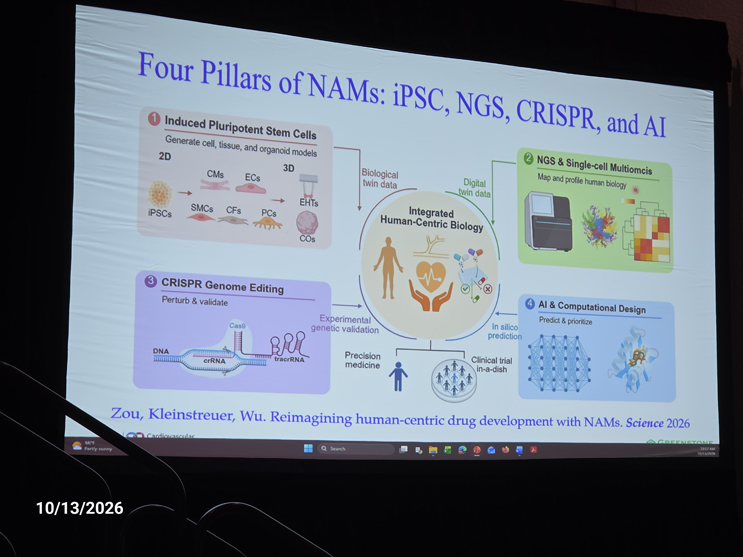
Slide shared by Joseph Wu on the four pillars of NAMs: iPSC, NGS, CRISPR, and AI.
Wu and his heart organoid-centric lab have helped pioneer the use of patient-specific induced pluripotent stem cells to model inherited and acquired cardiovascular diseases, connect genetic variants to disease phenotypes, predict drug responses and cardiotoxicity, and advance the “clinical trial in a dish” concept.
“One of the major problems with the high failure rate in drug discovery and basic science research is the lack of genetic diversity and pharmacogenetic difference with traditional models. When I give the drug to everybody in this room, the response cannot be the same because all of us are genetically different. That is otherwise impossible to capture using a traditional mouse or traditional immortalized cell line, but it is likely better predicted with the use of human iPS cell lines.”
When I asked when the “clinical trial in a dish” model could become clinical standard, he described the importance of the industry’s current inflection point. Wu explained, “We’ve been working on it for the past 20 years. For the first 19 years, nobody cared. It was only in 2025, when the NIH and the FDA made the announcements, that people started caring. Then, all of a sudden, the NIH shifted and the drug companies shifted.”
Last year, through the Foundation for the NIH (FNIH), the Validation and Qualification Network began soliciting pilot concepts to help establish where new approach methodologies are fit for purpose and how they can earn regulatory confidence. The NIH also launched the Standardized Organoid Modeling (SOM) Center to develop reproducible, scalable frameworks across multiple organ systems.
Ray Dogum, chief editor of Drug Discovery Online at Drug Discovery & Development US 2026 in San Diego, CA.