
When The Cat Is Away: The Institutional Test Of FDA Modernization
By Zaher Nahle, Ph.D., MPA
The durability of regulatory reform is tested not by the ambitions of its leaders but by the institutional practices that persist after their departure. This distinction is particularly consequential at the FDA, where scientific conventions, regulatory precedents, and administrative practices can outlast successive commissioners. Former FDA Commissioner Martin Makary made ambitious public commitments to reducing animal testing and accelerating human-relevant research. In a December 2025 interview with investigative journalist Lisa Fletcher on Full Measure with Sharyl Attkisson, Makary declared that the FDA would “not only conform” but “exceed” congressional expectations in reducing animal testing.1
Following Makary's departure in May 2026, the FDA published a direct final rule in the Sept. 22, 2026, Federal Register, titled Nonclinical Testing Terminology.2 The rule addressed a central objective of FDA Modernization Act 3.0 — previously examined in my Drug Discovery Online commentary3 and in my review “Path Dependency and the Rescuing of the Biomedical Research Enterprise,”4 — by bringing longstanding FDA regulations into conformity with the legislative intent and modernization objectives of FDA Modernization Act 2.0, enacted nearly four years earlier. This included replacing outdated animal-specific terminology with language recognizing scientifically appropriate nonclinical testing methodologies. The update was welcome, but its qualifications deserve scrutiny. The FDA characterized the amendments as “noncontroversial changes in terminology” that were “not expected to affect industry practice.” The agency further stated that “the rule adds no new requirements.”2
The FDA’s accompanying September 2026 announcement went further, explicitly stating that the rule would recognize scientifically valid new approach methodologies without “changing FDA’s evidentiary standards.”5 Read alongside the Federal Register’s expectation of no change in industry practice, that qualification raises a consequential question: whether regulatory modernization is intended merely to clarify permissible methodologies or to produce measurable changes in the evidence accepted and relied upon in drug development. Importantly, the statements appear in official FDA communications, including the Federal Register, which is the formal publication of federal regulatory actions. Unlike speeches or press releases, explanations accompanying rulemaking document an agency’s regulatory rationale and anticipated consequences. Although preambles are not necessarily independently binding, they can inform regulatory interpretation and oversight. The concern is therefore not simply why FDA took nearly four years to update its regulations, but why an action associated with biomedical modernization was characterized as unlikely to change industry practice while the FDA expressly emphasized that its evidentiary standards would remain unchanged under this rule.
For proponents of preserving established animal-testing practices, these qualifications may reasonably be viewed as a victory. After years of legislative reform, scientific advocacy, and public commitments to reducing reliance on animal experimentation, the FDA's assurance that the rule is not expected to affect industry practice offers reassurance that existing practices need not change. Whether intended or not, the agency's language may therefore be more reassuring to defenders of the status quo than to those seeking substantive modernization.
This position is difficult to reconcile with the administration's broader agenda to reduce reliance on animal testing and the Department of Health and Human Services' commitments to modernizing drug development, particularly in light of the bipartisan reforms embodied in FDA Modernization Act 2.0. If these initiatives are intended to transform biomedical evidence, assurances of unchanged evidentiary standards and industry practices demand further explanation.
A Necessary But Unnecessarily Chary Regulatory Action
FDA Modernization Act 2.0, enacted in December 2022, expanded statutory recognition of nonclinical testing methods beyond traditional animal experimentation, creating greater flexibility for human-cell systems, organ chips, computational models, and other scientifically appropriate technologies. Yet statutory permission and regulatory implementation are distinct accomplishments. Drug developers must consider not only which methods the law permits but also which evidence the FDA reviewers will accept as sufficient for particular decisions. Regulatory uncertainty can preserve established testing practices even when scientifically credible alternatives exist.
The September 2026 rule addresses part of that problem by harmonizing outdated terminology. The FDA employed direct final rulemaking, anticipating that the amendments would be noncontroversial, with an effective date scheduled for Feb. 4, 2027, subject to the applicable adverse-comment process.1 But modernization cannot be measured solely by changes in regulatory language. Its significance depends on whether scientific advances can influence evidentiary expectations, regulatory decisions, and industry behavior. This distinction is central to the history of FDA Modernization Act 3.0.
FDA Modernization Act 3.0: From Legislative Ambition To The Proverbial Graveyard?
FDA Modernization Act 3.0 was introduced in February 2024 as H.R. 7248.6 Its original scope extended beyond terminology to include qualification pathways for innovative nonclinical methodologies, review timelines, prioritization mechanisms, and public reporting. A revised Senate proposal, S. 5046, followed in September 2024.7 Subsequent versions narrowed the legislation, increasingly emphasizing regulatory alignment with FDA Modernization Act 2.0. The Senate passed S. 355 in December 2025, followed by House passage of H.R. 2821 in July 2026.8,9 Although significant, these separate measures did not result in enactment. Of note, Congress operates in two-year terms, and legislation that does not complete the legislative process before a Congress adjourns expires. Unless FDA Modernization Act 3.0 completes the legislative process before the current Congress concludes, it must be reintroduced in the 120th Congress beginning in January 2027. Whether the legislation's failure to reach the president's desk reflects broader political tensions, including the widely reported fallout between Senator Bill Cassidy, chairman of the Senate Health, Education, Labor, and Pensions (HELP) Committee, and President Trump, or an assumption among lawmakers that administrative actions had already accomplished its objectives remains unclear.
As discussed in my earlier Drug Discovery Online commentary,3 modernization should be evaluated as an institutional process rather than a single legislative achievement. Several administrative developments corresponded to objectives of the original proposal. In July 2025, the FDA made its Innovative Science and Technology Approaches for New Drugs (ISTAND) pilot a permanent drug-development-tool qualification program. Although ISTAND predated FDA Modernization Act 3.0, its institutionalization aligned with the proposal's emphasis on durable qualification pathways for innovative methodologies within defined contexts of use.
In September 2026, the National Institutes of Health (NIH) issued a request for information on the feasibility of annual reporting of live vertebrate animal numbers at institutions operating under Public Health Service animal-welfare assurances.10 While distinct from the original legislation's reporting provisions, the initiative reflected related objectives of transparency and measurement. The FDA's September 2026 direct final rule subsequently addressed the regulatory terminology objective central to the narrower legislative proposals.2
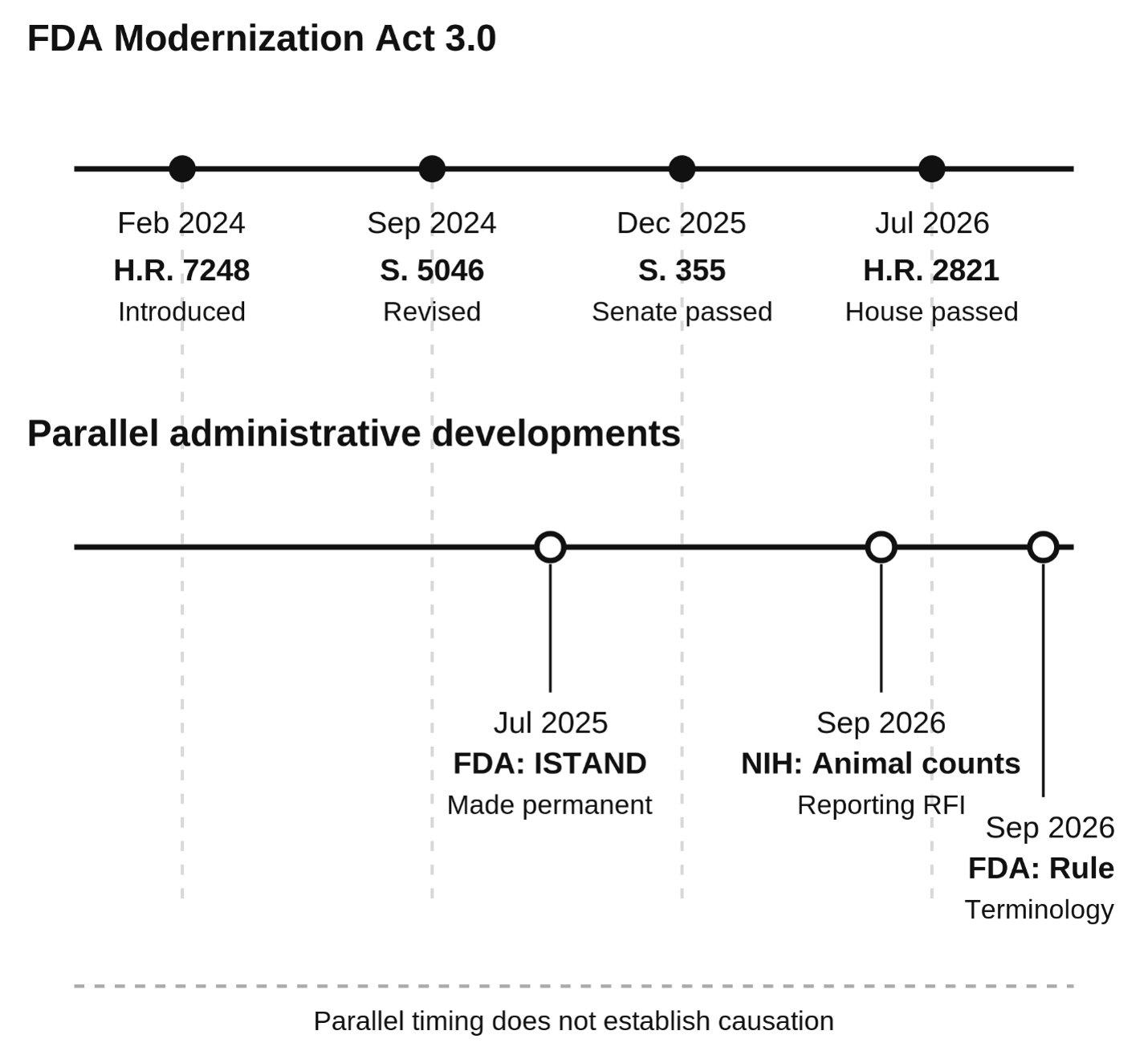
Figure 1. FDA Modernization Act 3.0: Legislative progression and selected parallel administrative developments, 2024 to 2026. The timeline depicts major legislative milestones and selected administrative actions corresponding to provisions of the original proposal, including the FDA's establishment of ISTAND as a permanent qualification program, NIH's request for information on animal-use reporting, and the FDA's publication of the Nonclinical Testing Terminology direct final rule.
These parallel developments do not establish that FDA Modernization Act 3.0 caused the administrative actions. Their institutional histories differ, and chronological proximity is insufficient to demonstrate causation. Nevertheless, their substantive correspondence is noteworthy. Legislative proposals, congressional scrutiny, and anticipated statutory requirements can influence administrative priorities even without enactment. The September rule illustrates both the potential and limits of this process: The FDA acted on regulatory terminology while formally anticipating little change in industry practice.

When Leadership Changes, What Happens To Reform?
Institutional continuity is essential to effective regulation. Scientific expertise, consistency, and predictable review practices protect public health. Yet continuity can also reinforce inherited assumptions. This is the central problem of institutional path dependency, examined in greater detail in my earlier review.4 Practices established under previous scientific and regulatory conditions may persist because they are familiar, administratively convenient, or supported by accumulated investments and professional expectations. In biomedical regulation, established methodologies can retain decision-making authority even when their predictive relevance to particular human outcomes remains uncertain.
Makary's departure provides a timely test of whether modernization commitments have become embedded in the FDA's operations or remain dependent on individual leadership. The timing does not establish that his departure caused a retreat from reform, nor does the September rule represent the entirety of the FDA's modernization agenda. The agency has undertaken other initiatives involving streamlined nonclinical safety studies and new approach methodologies. Nevertheless, the contrast between ambitious public commitments and the limited anticipated effects described in the Federal Register warrants examination. Durable reform requires measurable objectives, transparent implementation, and accountability that survive leadership transitions.
The international regulatory landscape is also shifting. On October 1, 2026, the International Coalition of Medicines Regulatory Authorities (ICMRA) issued a landmark joint statement calling for accelerated development and adoption of scientifically valid alternatives to animal testing in medicines development, with the long-term objective of eliminating animal use in major toxicity and pharmacological studies. The statement also encourages international regulatory alignment, underscoring the importance of translating modernization commitments into measurable regulatory practice.11
The deeper question is whether biomedical institutions are structured to reassess established practices as evidence evolves or whether their operations remain organized around administrative continuity and the tenure of individual decision makers. Scientific complexity undoubtedly contributes to the time required to develop and validate new methodologies. But complexity should not become a universal explanation for institutional delays, particularly when the changes concern regulatory terminology, qualification procedures, reporting, or administrative decisions rather than unresolved biological questions. Distinguishing scientific uncertainty from institutional inertia is essential to evaluating progress.
Why FDA Modernization Act 3.0 Should Return Stronger In 2027
The FDA's September action should not mark the conclusion of FDA Modernization Act 3.0. Instead, it should prompt Congress to revisit the legislation's original ambitions. When the next Congress convenes in 2027, a revised FDA Modernization Act 3.0 should restore and strengthen substantive provisions narrowed during the legislative process. These should include qualification pathways for innovative nonclinical methodologies within defined contexts of use, predictable review timelines, transparent implementation milestones, meaningful public reporting, and mechanisms for reassessing established testing expectations as scientific evidence evolves.
The legislative setback should therefore become an opportunity for renewed ambition, not diminished expectations. A revitalized FDA Modernization Act 3.0 should make explicit what recent regulatory qualifications have left uncertain: Modernization must be capable of changing industry practices and advancing evidentiary standards, not merely expanding the menu of permissible methodologies. The measure of success should be whether scientific advances translate into meaningful changes in regulatory decisions, development practices, and ultimately human health outcomes.
Such legislation would build on administrative developments already underway, including ISTAND and NIH's exploration of animal-use reporting, while establishing a more coherent and durable framework. Congress should not prescribe scientific conclusions or require automatic acceptance of emerging technologies. Nor should modernization mean replacing animal studies irrespective of scientific context. Rather, regulatory methods should earn and retain decision-making authority through reproducibility, rigor, demonstrated relevance to human biology and outcomes, and continuing assessment of their performance.
The September rule illustrates the distinction. A requirement to update regulatory language can be satisfied through textual amendments. A mandate to modernize regulatory practice requires mechanisms capable of changing how evidence is evaluated, how established expectations are revised, and how progress is measured. Without such mechanisms, reform risks becoming a succession of announcements, pilot programs, and regulatory revisions that document the appearance of progress without demonstrating its substance.
Concluding Remarks
The FDA's September 2026 Federal Register publication represents a legitimate and overdue step toward implementing FDA Modernization Act 2.0. Its formal qualifications, however, expose the distance that can separate regulatory alignment from substantive modernization. The lesson extends beyond any one administration, commissioner, or rulemaking: Scientific reform cannot depend primarily on the ambitions, tenure, or public commitments of individual leaders. It must be embedded in durable processes capable of evaluating evidence, measuring performance, and correcting established practices.
The original FDA Modernization Act 3.0 anticipated important elements of that architecture. Selected parallel administrative developments indicate progress on related objectives, but they should not be mistaken for completion. Congress has an opportunity in 2027 to restore the legislation's broader ambitions and establish a more accountable framework for biomedical modernization. When the cat is away, the question is whether institutional rules have changed enough to leave no room to play.
Author's note: The views and opinions expressed in this article are solely those of the author and do not necessarily reflect those of any organization with which he is affiliated.
References
- Full Measure with Sharyl Attkisson. Interview with FDA Commissioner Martin Makary by Lisa Fletcher concerning animal testing and FDA modernization. December 2025. Animal Testing. https://fullmeasure.news/newest-videos/animal-testing#
- U.S. Food and Drug Administration. Nonclinical Testing Terminology; Direct Final Rule. Federal Register. September 22, 2026. https://www.govinfo.gov/content/pkg/FR-2026-09-22/html/2026-19350.htm
- Nahle Z. From Path Dependency to Demonstrable Progress: FDA Modernization Act 3.0. Drug Discovery Online. July 2026. https://www.drugdiscoveryonline.com/doc/from-path-dependency-to-demonstrable-progress-fda-modernization-act-0001
- Nahle Z. Path Dependency and the Rescuing of the Biomedical Research Enterprise. Frontiers in Medical Technology. 2026;7:1683835. DOI: 10.3389/fmedt.2025.1683835
- U.S. Food and Drug Administration. FDA Actions to Accelerate and Modernize Early and Late-Stage Clinical Development. September 2026. https://www.fda.gov/industry/fda-actions-accelerate-and-modernize-early-and-late-stage-clinical-development
- U.S. Congress. FDA Modernization Act 3.0. H.R. 7248, 118th Congress. February 2024. https://www.congress.gov/bill/118th-congress/house-bill/7248
- U.S. Congress. FDA Modernization Act 3.0. S. 5046, 118th Congress. September 2024. https://www.congress.gov/bill/118th-congress/senate-bill/5046
- U.S. Congress. FDA Modernization Act 3.0. S. 355, 119th Congress. December 2025. https://www.congress.gov/bill/119th-congress/senate-bill/355
- U.S. Congress. FDA Modernization Act 3.0. H.R. 2821, 119th Congress. July 2026. https://www.govinfo.gov/app/details/BILLS-119hr2821eh
- National Institutes of Health. Request for Information on Feasibility of Annual Reporting of Live Vertebrate Animal Numbers. NOT-OD-27-001. September 21, 2026. https://grants.nih.gov/grants/guide/notice-files/NOT-OD-27-001.html
- International Coalition of Medicines Regulatory Authorities (ICMRA). Statement on Animal Testing for Human Medicines. October 1, 2026. https://www.pmda.go.jp/english/int-activities/int-harmony/icmra/0031.html
About The Author
 Zaher Nahle, Ph.D., MPA, is the founder of The Ivyctory Group, a life sciences and strategic advisory firm, and a former biomedical research executive whose work has helped shape national policy and regulatory reforms at the FDA and NIH. He serves as senior scientific advisor to the Center for a Humane Economy and is a member of the Drug Discovery Online Editorial Advisory Board. Nahle has held executive leadership positions at medical research organizations, including as CEO, chief scientific officer, and vice president for research. His scholarly contributions include pioneering analyses of biomedical path dependency and the reform of evidentiary standards in healthcare. Earlier in his career, he led independent research programs, oversaw the development of biobanks and patient registries, and served as a founding investigator of an NIH-funded data management and coordinating center. His research has appeared in leading scientific journals, including Nature, and he has received competitive grants and distinctions from institutions including the American Heart Association, Qatar Foundation, and the U.S. Department of Defense, as well as an American Cancer Society Scholar Award designation. He earned a Ph.D. in physiology and biophysics through the Stony Brook University–Cold Spring Harbor Laboratory joint program, a certificate in public policy and management from Harvard Kennedy School, and an MPA from Harvard University, where he was a Mason Fellow.