
From Path Dependency To Demonstrable Progress: FDA Modernization Act 3.0
By Zaher Nahle, Ph.D., MPA

With House passage of the FDA Modernization Act 3.0 (H.R. 2821), Congress has taken another major step toward modernizing biomedical research and drug development. Building upon the bipartisan FDA Modernization Act 2.0, enacted in 2022, the legislation continues the evolution of the nation's drug development framework toward evidence that is increasingly grounded in human biology while preserving the FDA's scientific discretion in evaluating safety and efficacy.
While much of the public discussion has understandably focused on reducing reliance on animal testing, the broader significance of FDAMA 3.0 extends well beyond any single testing methodology. Together, FDAMA 2.0 and 3.0 represent successive milestones in a broader transformation of how medicines are discovered, evaluated, regulated, and ultimately delivered to patients.
Editor's note: One procedural congressional step remains before the legislation is presented to the president. Because revenue-related legislation must originate in the House, H.R. 2821 returns briefly to the Senate for final approval, even though the Senate unanimously passed an identical companion bill (S. 355) last December. No substantive legislative changes are anticipated.
Modernization Is A Process, Not An Event
Scientific revolutions are often portrayed as singular breakthroughs. In reality, they are more commonly the product of gradual advances in science, technology, regulation, legislation, and institutional practice that accumulate over time to produce lasting systems change.
Earlier this year, drawing on my work at the intersection of biomedical research, regulatory science, and public policy, I explored this broader evolution through the lens of path dependency in my review published in Frontiers in Medical Technology. That work, together with my engagement in legislative and regulatory modernization efforts over the past several years, has reinforced my view that lasting scientific progress requires the coordinated evolution of science, policy, and regulation.
The figure below, adapted from that review and updated to reflect House passage of FDAMA 3.0, builds upon a conceptual framework I originally developed to illustrate how successive scientific, regulatory, legislative, and institutional milestones collectively shape the modernization of biomedical research. The updated timeline extends that framework to incorporate the latest milestone in this continuing evolution.
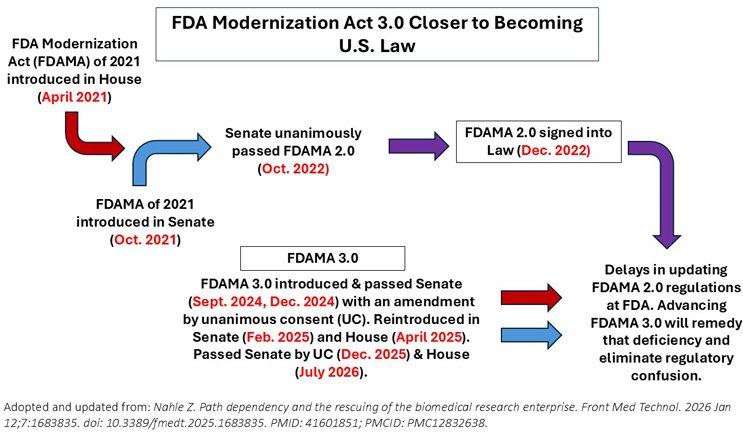
Figure 1. Evolution of the modernization of biomedical research. Adapted from my review and updated to include House passage of the FDA Modernization Act 3.0 (H.R. 2821). The timeline illustrates how successive scientific, legislative, regulatory, and institutional milestones have collectively advanced the modernization of biomedical research. Viewed through the lens of path dependency, these interconnected developments demonstrate how sustained systems change emerges through the cumulative interaction of scientific innovation, public policy, regulatory reform, and institutional implementation rather than through any single event. The original conceptual framework was developed by the author and has been updated here to reflect the latest legislative milestone.
This historical perspective is particularly relevant to the role of animal models in drug development. For decades, animal studies occupied a central position in preclinical research. While they became the dominant scientific paradigm of their era, they were adopted during a period when many of today's expectations for prospective validation and human predictive performance had not yet been established. As discussed in greater detail in my review, their widespread adoption reflected a combination of historical practice, technological limitations, and regulatory precedent rather than systematic demonstration that they were optimal surrogates for predicting human safety and efficacy. This historical context helps explain why modern biomedical research is increasingly reassessing long-standing assumptions in light of new scientific capabilities.
Today, advances in human cell biology, stem cell technologies, organoids, organ-chips, microphysiological systems, computational modeling, artificial intelligence, and data science are expanding the scientific toolkit available to researchers and regulators. The challenge is no longer whether these technologies exist. Increasingly, the challenge is ensuring that regulatory frameworks evolve alongside scientific progress.
FDAMA 2.0 And FDAMA 3.0: Complementary Reforms
The FDA Modernization Act 2.0 removed an 84-year-old statutory requirement that certain drug applications include animal testing. More fundamentally, it reaffirmed an enduring scientific principle: regulatory evidence should be evaluated according to its relevance, reliability, and fitness for purpose rather than the species from which it is derived.
Legislation alone, however, does not modernize an entire regulatory system. Following enactment of FDAMA 2.0, FDA regulations continued to contain terminology and provisions rooted in the previous statutory framework, creating avoidable uncertainty for sponsors seeking to incorporate scientifically valid new approach methodologies (NAMs) into drug development programs.
FDAMA 3.0 addresses that remaining gap. Rather than creating an entirely new regulatory paradigm, it directs the FDA to harmonize its regulations with the law Congress has already enacted. That alignment provides greater clarity for sponsors while preserving the agency's scientific discretion to evaluate evidence using the most scientifically appropriate methods available.
The experience following FDAMA 2.0 also offers an important lesson in regulatory modernization. Legislative reform does not automatically translate into regulatory implementation. Congressional oversight — including repeated inquiries regarding FDA's timeline for updating its regulations — highlighted that legislation, regulation, and administrative implementation often evolve on different timelines. Viewed through the lens of path dependency, this illustrates why meaningful systems change frequently requires successive legislative and regulatory milestones rather than a single reform.

Science And Policy Must Evolve Together
One lesson from the history of biomedical innovation is that scientific advances alone rarely transform practice. Lasting progress requires parallel evolution in scientific methods, public policy, regulatory implementation, institutional culture, investment strategies, and stakeholder confidence.
That evolution is increasingly visible. I have had the privilege of witnessing — and contributing to — many of these developments through scientific scholarship, policy design, legislative drafting, and engagement with Congress, federal agencies, and numerous colleagues committed to advancing human-relevant science. Over the past several years, Congress has modernized statutory authorities, the FDA has begun updating regulatory frameworks and issuing new guidance, federal agencies have expanded investments in human-relevant methodologies, and scientific advances have continued to strengthen the evidence supporting their application.
Viewed individually, each of these developments may appear incremental. Viewed collectively, they represent a broader system-level transformation in how biomedical research is conducted and how evidence is generated for regulatory decision-making.
FDAMA 3.0 should therefore be understood not as an isolated legislative achievement but as part of a continuing evolution in which scientific innovation, regulatory modernization, and public policy increasingly reinforce one another.
The Road Ahead
Passage of FDAMA 3.0 should not be viewed as the conclusion of this effort. Continued progress will depend on rigorous scientific validation, regulatory experience, international harmonization, sustained investment in innovative technologies, and constructive collaboration among academia, industry, patient organizations, regulators, policymakers, and Congress.
Modernizing biomedical research is ultimately not about replacing one experimental tool with another. It is about building a more predictive, efficient, transparent, and patient-centered scientific enterprise. And that journey is still unfolding.
The House's passage of FDAMA 3.0 represents another important milestone along that path — and an encouraging reminder that meaningful systems change is achieved through sustained collaboration among scientists, legislators, regulators, industry, patient advocates, and policymakers committed to improving both science and public health.
It has been a privilege to contribute to this ongoing effort, and I remain optimistic that the next generation of biomedical innovation will continue to strengthen both scientific rigor and patient care.
About The Author
 Zaher Nahle, Ph.D., MPA, is a science policy expert, biomedical scientist, and senior advisor whose work has helped shape reforms at the U.S. FDA and National Institutes of Health. He serves as senior scientific advisor to the Center for a Humane Economy and Animal Wellness Action and is the founder of The Ivyctory Group, a market research and life sciences advisory firm. Nahle has held executive leadership positions at medical foundations, including CEO, chief scientific officer, and vice president for research. Earlier in his career, he led independent research programs, was a founding investigator of an NIH-funded data management and coordinating center, published in leading journals, including Nature, and received competitive grants and awards from organizations including the American Heart Association and the U.S. Department of Defense. He earned a Ph.D. in physiology and biophysics from the Stony Brook University/Cold Spring Harbor Laboratory joint program and an MPA from Harvard University.