
Frontier Binder Design Just Became Free
By Morgan Kohler, Executive Editor
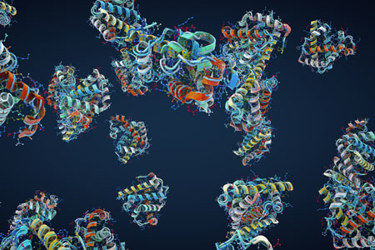
On Nov. 10, the University of Washington Medicine Institute for Protein Design (IPD) announced the open-source release of RFD4-Proteina, its first AI protein model codeveloped with NVIDIA. The model is available under BSD-3, a permissive license that imposes no procurement negotiation, usage restrictions, or obligation to publish what a company builds on top of it.
NVIDIA debuted the same model at the GPU Technology Conference Berlin on Oct. 21, roughly three weeks earlier, with a different emphasis. The chipmaker framed it as a component in an automated discovery stack, while IPD framed the November release around open availability.
The name reflects its parentage. RFD4-Proteina combines IPD’s RoseTTAFold Diffusion lineage (the work that contributed to David Baker’s share of the 2024 Nobel Prize in Chemistry) with NVIDIA’s Proteina-Complexa, a generative model for protein and small-molecule binder design. A Hugging Face model card from the Baker Lab and NVIDIA describes it as a flow-matching model that generates protein sequences and all-atom structures together rather than in sequence. An NVIDIA Inference Microservices (NIM) card lists seven design tasks.
RFD4-Proteina has achieved five- to 10-fold higher design success rates and five- to 10-fold faster candidate generation than previous models, with higher computational success than evaluated baselines across four areas: protein binding, small-molecule binding, enzyme scaffolding, and DNA binding.
Those figures come from a research draft, not a peer-reviewed publication, and they describe computational success rather than laboratory outcomes.
What This Means For Drug Discovery
The binder design bottleneck has been the ratio of designs generated to designs that survive expression, binding confirmation, and early developability assessment. This ratio has historically been punishing enough to keep de novo binder campaigns off many portfolios on FTE cost alone.
A five- to 10-fold improvement in computational success changes how many designs a team can justify putting into a plate; it does not change how many that team can characterize. If generation becomes an order of magnitude cheaper while expression success rate, surface plasmon resonance (SPR) and biolayer interferometry (BLI) throughput, and developability triage stay flat, the constraint relocates downstream and program timelines barely move. NVIDIA’s own framing concedes the point: the model helps researchers explore and prioritize candidates for laboratory testing, where experiments establish how a design performs.
The benchmark coverage deserves attention, too. Enzyme scaffolding and DNA binding are legitimate design problems, but strong performance on them says little about whether a therapeutic antibody or nanobody campaign improves. Seth Woodbury, a University of Washington bioengineering predoctoral candidate, reported designing a pesticide-degrading enzyme in a few days that performed better than a previous results: “In just a few days we designed a pesticide-degrading enzyme that performs many fold better than my previous best, which took months to design.” While that is a meaningful demonstration, it’s not evidence about target binding, proteome-wide selectivity, or immunogenicity.
What open weights do remove is the reason most teams never ran the test. BSD-3 licensing means a discovery organization can fine-tune on proprietary structural data behind its own firewall, with no vendor in the loop. It also means vendors carry no validation risk, benchmark packages don’t exist against any particular target class, and documented failure modes don’t accompany the model on membrane proteins or conformationally flexible epitopes.
Genedata’s AI coscientist coordinates protein design and testing inside Danaher’s autonomous lab, with RFD4-Proteina in the loop so experimental results steer the next design round. That closed loop requires standardized expression and binding assays, structured data capture, and a scoring function everyone has agreed on before the first run. This requires an alignment between computational design, protein sciences, and assay development that most organizations haven’t built.
For teams evaluating this, the defensible test is retrospective rather than prospective.
A possible test could be to run the model against a completed internal campaign with clean negative data, where the answer is already known, and measure the design-to-confirmed-binder ratio rather than the computational success rate. Consider checking for a realistic weekly characterization ceiling with one of your protein science leads. That number, not the model, determines whether any of this can actually shorten a timeline.
The Discovery Question
If your design throughput went up 10-fold tomorrow, how many of those designs could your bench characterize?
Related Drug Discovery Online Editorials
- AI Drug Discovery Is Revealing The Preclinical Bottleneck
- A New De Novo Protein Design Platform For GPCR Drug Discovery
- Beyond the AI Scientist Building Defensible Value with Self-Driving Labs
About The Editor
 Morgan Kohler is the executive editor of guest expert articles for Drug Discovery Online, working with industry experts to develop insightful and informative pieces about drug discovery and preclinical drug development science, regulatory strategy, trends, analyses, and commentary.
Morgan holds a master’s degree in professional writing and web content development and has worked in the publishing industry since 2018. Before working for Drug Discovery Online, she guided and edited industry-expert-bylined content on topics related to radiology and economics.