
Fragment-Based Drug Discovery 2.0, Part 2: Practical Workflow, Difficult Target Classes, And Emerging Capabilities
By Mahmoud Khatib Al-Ruweidi
Make sure to read part 1 before reading part 2.
Part 1 established what FBDD 2.0 means and examined the advances in 19F NMR, ultra-high-field instrumentation, and contrast-engineered screening. This second part will focus on the practical workflow, difficult target classes, emerging capabilities, and the criteria for translating these technologies into better discovery decisions.
End-To-End Workflow
Step 1: Feasibility gate and exchange-regime triage
Before committing screening resources, systematic feasibility assessment prevents failed campaigns. The NMR feasibility checklist evaluates:
- protein expression yield
- solution behavior (monodisperse by size-exclusion chromatography (SEC), stable for 48+ hours)
- target concentration required versus PEARLScreen gains
- reference compound availability for positive control validation.
Exchange-regime triage follows — preliminary titrations establish expected behavior for unknown targets.
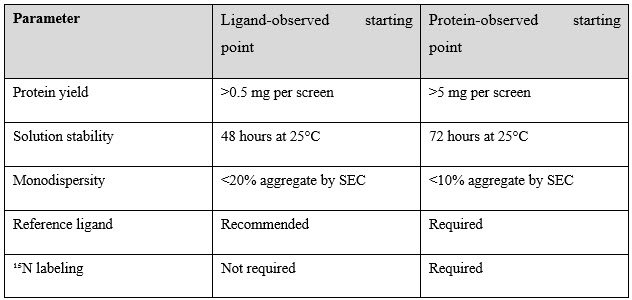
Table 1. Example NMR feasibility checklist (project-dependent starting points)
These values are campaign-planning heuristics, not universal acceptance criteria; target size, stability, exchange regime, pulse sequence, sample geometry, and automation format should determine the final thresholds.
Step 2: Library strategy — design aligned to readout
Vector-first thinking influences library composition. Rather than maximizing diversity abstractly, prioritize fragments representing synthetically accessible elaboration vectors. Amino-substituted aromatics, carboxylic acid-bearing scaffolds, and halogen-containing fragments enable straightforward synthetic connections. The goal is to have hits that translate immediately to chemistry plans, not maximum hit rates from unexploitable scaffolds.
Step 3: Primary screen lanes
Soluble protein lane (default): ¹⁹F CPMG screening in cocktails of 20 to 30 fragments, with protein at 10 to 50 μM; the required concentration should be established empirically for each target and pulse sequence.
Throughput: 1,000 to 3,000 fragments screened per week may be achievable on some automated, cryoprobe-equipped 600+ MHz platforms, but throughput depends on acquisition time, mixture design, controls, and deconvolution burden.
RNA lane: ¹⁹F CPMG with extended relaxation delays (200 to 400 ms); counter screening against DNA duplex and protein panel essential for specificity confirmation.
Membrane protein lane: Target-immobilized NMR screening (TINS) or STD nanodisc-based STD screening can mitigate detergent and partitioning artifacts by using membrane scaffold protein (MSP)-stabilized lipid bilayer discs.16
Step 4: Deconvolution and truth controls
Primary screen hits require individual confirmation. The three-control rule mandates:
- positive control (reference ligand demonstrating expected binding response)
- negative control (structurally similar non-binder confirming specificity)
- concentration dependence (dose-response confirming saturable binding).
Chemical shift perturbations (CSPs) must be interpreted in the relevant exchange regime. Progressive chemical-shift changes are typical of fast exchange, whereas broadening or signal loss can arise from intermediate exchange, tighter binding, aggregation, or sample instability. Dose dependence, line-shape analysis, and matched controls are therefore required for interpretation.
Step 5: Site localization and vector planning
For protein-observed methods (¹H-¹⁵N HSQC), chemical shift perturbation mapping localizes binding sites. The composite chemical shift change Δδ = √[ΔδH² + (0.14×ΔδN)²] quantifies perturbation magnitude, with outlier thresholds defined from the experiment's noise and perturbation distribution; one standard deviation is a screening heuristic rather than a universal cutoff.17 We propose a vector potential score (VPS) framework integrating three parameters: (a) synthetic accessibility (1 to 5 scale), (b) spatial freedom (1 to 5 scale from crystallographic analysis of vector exit geometry), and (c) interaction potential (1 to 5 scale assessing nearby polar contacts). A normalized VPS can support transparent vector prioritization, but its weighting and normalization should be predefined and prospectively validated.
Step 6: Quantification — ligand efficiency as a tool, not religion
Ligand efficiency (LE = −ΔG/heavy atom count) enables cross-series comparisons3 but efficiency metrics favor smaller fragments regardless of optimization trajectory. Practical optimization often requires accepting temporary efficiency losses during molecular weight increases that enable new interactions. Use LE for initial hit prioritization, not as absolute optimization constraints. Kinetic parameters (kon, koff) provide complementary information — residence time can complement Kd, but efficacy relative to Kd depends on exposure, target turnover, rebinding, and downstream pharmacology.
Step 7: Structural closure — NMR-guided structural biology
Fragment hits localized by NMR CSP mapping accelerate crystallographic campaigns. For crystallography-resistant targets, NMR-restrained docking using HADDOCK generates binding mode hypotheses from CSP data alone.18 Complete structural closure requires orthogonal validation — X-ray crystallography remains a high-resolution reference method, while cryo-EM and NMR can provide complementary structural closure depending on the target and sample.
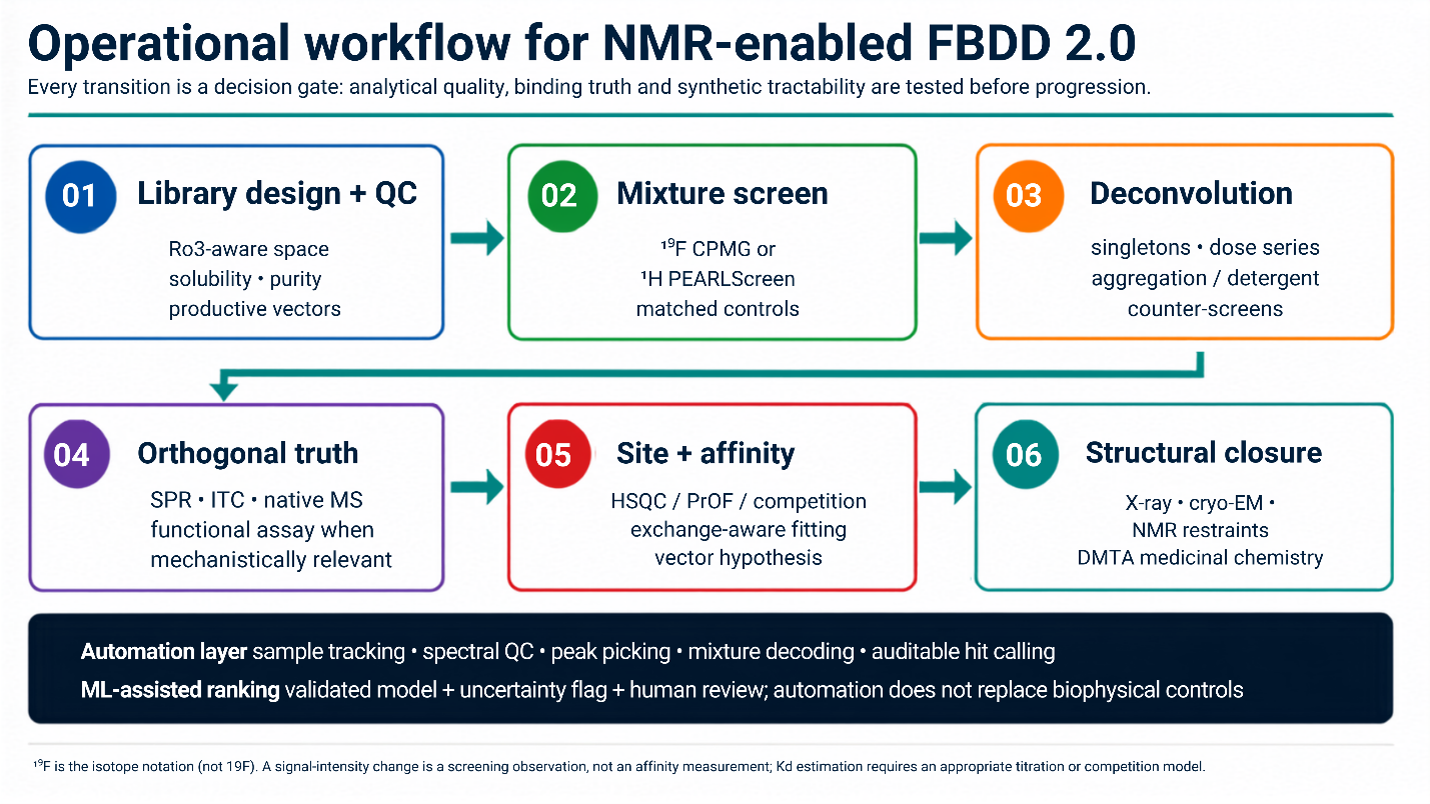
Figure 3. Operational workflow for NMR-enabled FBDD 2.0, from mixture screening and deconvolution to orthogonal validation, site/affinity analysis, and structural closure.
Hard Targets Where NMR Wins
RNA: Shallow pockets and dynamic landscapes
RNA presents unique challenges: binding pockets are often shallow and solvent exposed, lacking deep hydrophobic clefts. Conformational dynamics redistribute on nanosecond-to-millisecond timescales. Electrostatic interactions dominate — the polyanionic backbone creates strong non-specific attraction for cationic fragments. NMR can observe binding equilibria without target immobilization, but electrostatic and intercalative promiscuity still require matched RNA, DNA, and protein counter-screens. The ¹⁹F CPMG screen of 14 RNA constructs demonstrated that hit rates correlate with structural complexity.11 Motif-aware library design — nucleobase isosteres, positively charged heterocycles, planar intercalators — can improve hit discovery, provided that charge and intercalation liabilities are controlled.
Membrane proteins: Encoded peptide strategies
Membrane protein FBDD faces fundamental sample preparation challenges. Detergent solubilization disrupts native lipid environments; micelle partitioning creates false positives from hydrophobic-fragment partitioning. Nanodisc reconstitution substantially mitigates these artifacts. MSP-stabilized lipid bilayer discs maintain native-like environments while eliminating free detergent.16 The target-immobilized NMR screening (TINS) format reduces non-specific interactions further. The ¹⁹F-encoded peptide approach extends fragment concepts to ion channels and G protein–coupled receptors (GPCRs) previously inaccessible to small molecule fragments.13
In-cell NMR: Contextual validation
In-cell NMR provides validation that binding observed in vitro translates to intracellular contexts.19 ¹⁹F NMR of CF3-labeled compounds bound to Hsp90 within human cells demonstrated real-time target engagement monitoring. Current in-cell NMR remains validation-stage technology, but for lead compounds advancing toward candidate selection, in-cell binding confirmation provides failure-mode coverage that in vitro methods cannot offer.
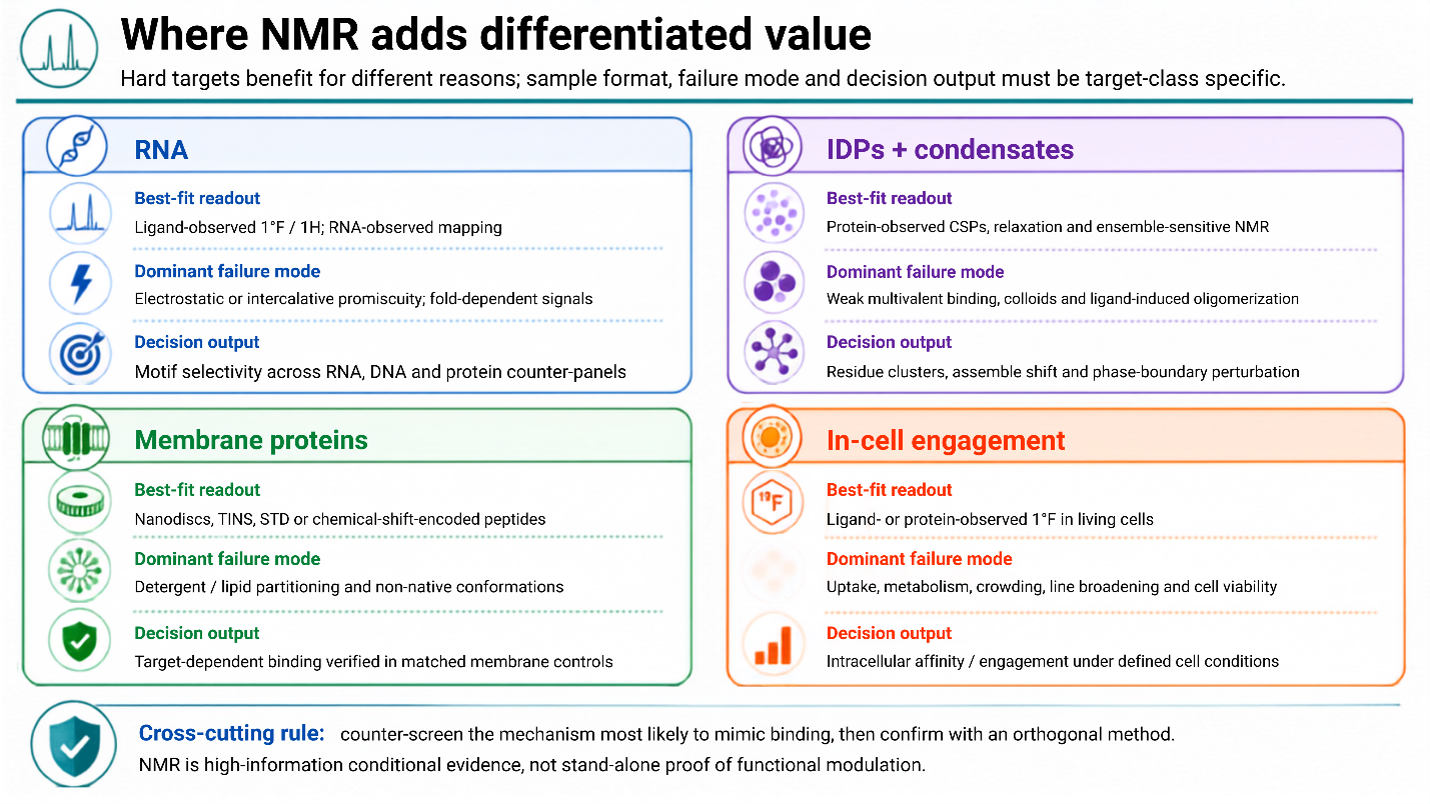
Figure 4. NMR’s differentiated value across hard target classes — RNA, disordered/phase-separating systems, membrane proteins, and in-cell target engagement

Covalent Fragments
Fragment-based methods increasingly target proteases, kinases, and other difficult proteins through targeted covalent interactions. The central challenge is to identify fragments that achieve molecular recognition before — or in concert with — covalent bond formation, rather than reacting indiscriminately with nucleophiles. Time-resolved NMR can help distinguish initial noncovalent recognition from subsequent reaction when the kinetics and exchange regime permit. A robust workflow couples electrophile-library screening with intact-protein mass spectrometry, site mapping, and kinetic analysis to optimize both affinity and intrinsic warhead reactivity.
Forward Capabilities
Photo-CIDNP and hyperpolarized screening
Photochemically induced dynamic nuclear polarization (Photo-CIDNP) achieved 20- to 200-fold signal enhancement in aqueous solution, enabling detection at 5 μM ligand with 2 μM protein and throughput approaching 1,500 samples per day.20 The Torres/Riek group demonstrated practical fragment screening with the NMhare1.0 library: 212 photo-CIDNP-active fragments screened against PIN1 protein, with rapid Kd determination within 5 to 15 minutes using 0.1 mg protein.
Benchtop NMR spectrometers can broaden access to fragment screening, particularly when paired with sensitive pulse sequences and automated handling. However, performance, sample requirements, and instrument pricing vary substantially, so benchtop deployment should be evaluated against target class and assay requirements rather than treated as a direct substitute for high-field systems.
Automation and throughput
Automated sample loading, shimming, acquisition, and spectral processing can support high-throughput operation; the 1,500-sample-per-day figure reported for photo-CIDNP refers to a purpose-built flow-through platform, not to NMR screening platforms in general. Machine-learning models may assist library design and triage, but aggregation, interference, and binding calls still require experimentally validated controls.
Best Practices: Minimum Viable Governance
Artifact hygiene: PAINS and aggregation
Use PAINS and related substructure alerts as triage flags rather than automatic exclusion rules. Aggregation should be tested with concentration dependence and, where compatible with the assay, detergent or other colloid-disruption controls; loss of apparent activity supports an aggregation mechanism but does not by itself prove one. In NMR, concentration-dependent line broadening, sample-quality checks, and orthogonal confirmation help distinguish specific binding from self-association or nonspecific adsorption.
Orthogonality as failure-mode coverage
No single method eliminates both false positives and false negatives. Orthogonal confirmation should therefore be chosen to cover a different failure mode: for example, combine NMR with SPR, ITC, MST, native mass spectrometry, or a mechanistically relevant functional assay. Structural evidence is highly valuable before substantial medicinal-chemistry investment, but the appropriate level of structural closure depends on the target, affinity regime, and decision being made.
Final Word
NMR is valuable in fragment-based drug discovery because a coordinated set of ligand- and protein-observed experiments can support binding detection, site mapping, affinity estimation, and structural analysis. FBDD 2.0 combines engineered ¹⁹F libraries, ultra-high-field instruments, and contrast-engineered experiments, such as PEARLScreen, to improve throughput, spectral resolution, and protein economy.
Multiple approved drugs, including venetoclax and sotorasib, were enabled by fragment-based approaches. NMR is particularly useful for target classes such as RNA, membrane proteins, and intrinsically disordered proteins because it can interrogate weak, dynamic, or context-dependent interactions that are difficult to resolve with any single biochemical or structural method.
Three illustrative, organization-specific adoption tests:
- Protein economics test: If PEARLScreen lowers protein needs enough to make three or more previously unfeasible targets viable, the investment is justified.
- Orthogonality value test: NMR confirmation reducing late-stage failures by at least 30% validates its screening cost — compare attrition rates for confirmed versus non-confirmed hits.
- Decision velocity test: NMR data cutting one week from screen to first analog would indicate a meaningful acceleration of medicinal chemistry.
These tests link technology directly to business impact. FBDD 2.0 works when weak binding info drives faster, practical drug discovery decisions.
References:
- Hann MM, Leach AR, Harper G. Molecular complexity and its impact on the probability of finding leads for drug discovery. J Chem Inf Comput Sci 2001;41:856-864.
- Congreve M, Carr R, Murray C, Jhoti H. A 'rule of three' for fragment-based lead discovery? Drug Discov Today 2003;8:876-877.
- Hopkins AL, Groom CR, Alex A. Ligand efficiency: a useful metric for lead selection. Drug Discov Today 2004;9:430-431.
- Shuker SB, Hajduk PJ, Meadows RP, Fesik SW. Discovering high-affinity ligands for proteins: SAR by NMR. Science 1996;274:1531-1534.
- Feng BY, Simeonov A, Jadhav A, et al. A high-throughput screen for aggregation-based inhibition in a large compound library. J Med Chem 2007;50:2385-2390.
- Baell JB, Holloway GA. New substructure filters for removal of pan assay interference compounds (PAINS) from screening libraries. J Med Chem 2010;53:2719-2740.
- Dalvit C, Vulpetti A. Ligand-based fluorine NMR screening: principles and applications in drug discovery projects. J Med Chem 2019;62:2218-2244.
- Ohio State University. First 1.2 GHz NMR in U.S. installed at National Gateway Ultrahigh Field NMR Center. OSU News, December 19, 2023.
- Bruker Corporation. Swiss High-field NMR Facility acquires 1.2 GHz NMR at University of Zürich. Bruker Press Release, December 20, 2024.
- Lorz N, Czarniecki B, Loss S, Meier B, Gossert AD. Higher contrast in ¹H-observed NMR ligand screening with the PEARLScreen experiment. Angew Chem Int Ed 2025;64(17):e202423879.
- Binas O, de Jesus V, Landgraf T, et al. ¹⁹F NMR-based fragment screening for 14 different biologically active RNAs and 10 DNA and protein counter-screens. ChemBioChem 2021;22:423-433.
- de Castro GV, Ciulli A. Spy vs. spy: selecting the best reporter for ¹⁹F NMR competition experiments. Chem Commun 2019;55:1482-1485.
- Zhang Y, Zhu Y, Zhang Y, et al. ¹⁹F NMR chemical shift encoded peptide screening targeting the potassium channel Kv1.3. Chem Commun 2025;61:6162-6165.
- Gee CT, Arntson KE, Urick AK, et al. Protein-observed ¹⁹F-NMR for fragment screening, affinity quantification and druggability assessment. Nat Protoc 2016;11:1414-1427.
- Divakaran A, Kirberger SE, Pomerantz WCK. SAR by (protein-observed) ¹⁹F NMR. Acc Chem Res 2019;52:3407-3418.
- Fruh V, Zhou Y, Chen D, et al. Application of fragment-based drug discovery to membrane proteins: identification of ligands of the integral membrane enzyme DsbB. Chem Biol 2010;17:881-891.
- Medek A, Hajduk PJ, Mack J, Fesik SW. The use of differential chemical shifts for determining the binding site location and orientation of protein-bound ligands. J Am Chem Soc 2000;122:1241-1242.
- Dominguez C, Boelens R, Bonvin AM. HADDOCK: a protein-protein docking approach based on biochemical or biophysical information. J Am Chem Soc 2003;125:1731-1737.
- Kang C. Applications of in-cell NMR in structural biology and drug discovery. Int J Mol Sci 2019;20:139.
- Torres F, Bütikofer M, Stadler GR, et al. Ultrafast fragment screening using photo-hyperpolarized (CIDNP) NMR. J Am Chem Soc 2023;145:12066-12080.
About The Author
 Mahmoud K. Al-Ruweidi is a pharmaceutics specialist with expertise in rational drug design, discovery, and delivery. Trained as a biomedical engineer, his research spans formulation science and bioengineering approaches to medicine. He has worked across biochemistry, medical devices, and biomaterials, applying interdisciplinary methods to accelerate therapeutic innovation. Beyond the lab, he is an advocate for improving academic systems to better support young scientists and safeguard research integrity.