
Discovery Dialogues: Winston Haynes, VP, Computational Sciences and Engineering, LabGenius Tx

By Ray Dogum, Chief Editor, Drug Discovery Online
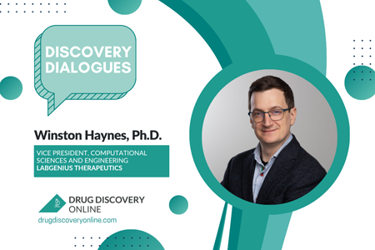
At PEGS 2026, the 2026 Protein & Antibody Engineering Summit, Drug Discovery Online interviewed Winston Haynes, Ph.D., vice president of computational sciences and engineering at London-based LabGenius Therapeutics. We discussed how the company uses machine learning and automation to develop multispecific therapies for solid tumors.
Haynes described LabGenius’ focus on T-cell engagers, including its lead candidate LGTX-101, a Nectin-4 CD3 molecule showing strong preclinical efficacy, selectivity, and a promising safety window. Haynes explained how the company’s EVA platform integrates in silico design, automated lab workflows, and iterative data feedback to evaluate thousands of molecules per cycle.
He also highlighted the growing role of general-purpose AI tools in democratizing data analysis across organizations, while emphasizing the need for human oversight, cross-functional integration, and careful validation when applying AI in drug discovery.
Video Interview
Transcript (Edited for Clarity)
Ray: Here at PEGS 2026, I'm with Winston Haynes. Nice to meet you, Winston.
Winston Haynes: Nice to meet you.
Ray: Can you tell me a little bit about what you do, Winston?
Winston Haynes: I'm the Vice President of Computational Sciences and Engineering at LabGenius. At LabGenius, we're focused on leveraging machine learning and automation to develop new therapies for the treatment of solid tumors.
We have a pipeline with T-cell engagers and ADCs that we're currently working on.
Ray: Can you tell me a little bit about your role as VP of Computational Sciences and Engineering?
Winston Haynes: In that role, I oversee the technical teams at LabGenius, including the software and data science teams, and work with them to deliver the platform that powers the development of these therapies with unprecedented on-tumor, off-tumor killing selectivity values.
Ray: Do you see-- What do you see in the future of machine learning-driven immunotherapies?
Winston Haynes: I think there's a broad opportunity for machine learning across immunotherapies. That includes early stages such as target identification, de novo binder design, and optimization. At LabGenius, we fit in once you have those components and need to turn them into therapeutic antibodies, multi-specifics, and therapies with the desired effector function. There are also opportunities later in clinical development and clinical trial design. We've focused on a niche where there isn't much publicly available data.
And then we've, at LabGenius fit in at the point of once you have all those components, how do you turn them into actual therapeutic antibodies? How do you build them into multi-specifics and therapies that can have that desired effector function? And there's even opportunities at later stages, right?
If you look at target identification and de novo design, there's a large amount of publicly available data supported by different funding agencies. We've focused on this niche because it has strong potential for machine learning application.
Resources like the PDB provide hundreds of thousands of protein-bound structures, and resources like GTEx provide large transcriptomic databases. Those can power earlier stages of target identification and de novo design. But for multi-specific optimization, these are unique molecules that don't exist naturally, so we need to build a machine for acquiring that data and training models that can generate the traction needed to advance those therapies further.
Ray: That's a good point. What are some of your current thoughts on tackling common T-cell engager challenges, including on-target, off-target discovery or toxicity?
Winston Haynes: T-cell engagers have been promising because they're so potent and efficacious, but the flip side is that they can also be potent against healthy cells. This is one of the key challenges to solve in advancing T-cell engager therapies to the clinic. At LabGenius, we focus on an avidity-driven mechanism.
The idea is that while tumor cells have high levels of PD-L1 expression, healthy cells may also have some expression of that protein, but the expression is higher on tumor cells. If we can develop a binder that specifically targets cells with higher expression by using multiple binding arms and building a durable immune synapse only against those tumor cells, we can develop therapies that are safer and realize the potential of T-cell engagers in the clinic.
So if we can develop a binder that is able to bind specifically to those cells with a higher expression by having multiple different binding arms and building only a durable immune synapse against those tumor cells, then we'll develop therapies that are safer, and we can realize the potential of T cell engagers in the clinic.
Ray: I appreciate you sharing that. I know there's a huge opportunity in machine learning for multi-specific antibody design. Can you tell us a little bit about the preclinical data for your lead candidate, Nectin-4 CD3?
Winston Haynes: Yes.
Ray: Yep.
Winston Haynes: LGTX-101 is a Nectin-4 CD3 T-cell engager.
We currently have a strong developability package for that molecule. We have in vivo data showing efficacy at doses at or below 0.1 mg/kg. We can also see efficacy with dosing every week, and we're looking at dosing every two or four weeks as we move toward the clinic.
We're currently doing the CMC and IND-enabling work for this asset and are looking toward the first half of next year to reach the first-in-human stage.
Ray: What are some of the current challenges you're facing?
Winston Haynes: At a high level, the path has been relatively smooth so far.
We didn't know if we would be able to develop a molecule as selective as we have, but we really do see complete on-off tumor killing selectivity. We see killing of tumor cells with only a twofold receptor difference relative to healthy cells, and sub-picomolar potency in those tumor cells, but no discernible killing against healthy cells.
We think that gives us a really good safety window. CMC has been proceeding well. All of our developability packages have looked solid for this molecule, and we think this comes from doing that multi-objective optimization from the very beginning. We're now seeing that the hard work early on is paying off in a smoother downstream process.
Ray: What are some of the key decision points in advancing, uh, the candidate forward?
Winston Haynes: Towards the clinical trials?
Ray: Towards clinical trials.
Winston Haynes: At the moment, it was initially about looking for in vitro selectivity, then in vivo efficacy, which has looked really good as I described earlier. Then it's been about CMC, making sure that progresses smoothly, and preparing the submission packages for the regulatory agencies.
Winston Haynes: And yes—
Ray: Are you working with CROs for the CMC?
Winston Haynes: Uh, yes, that's right.
Ray: Okay.
Winston Haynes: Yes.
Ray: How's that going?
Winston Haynes: It's been surprisingly smooth so far.
Ray: Why do you say surprisingly?
Winston Haynes: It's some of my first exposure to CMC processes, and it's a significant scale-up in the actual production of these molecules.
We've been excited by the degree to which our lower-throughput expression, purity, and related readouts are translating to the early CMC data we're getting now.
Ray: I've often heard that people overlook CMC.
Winston Haynes: Yeah, yeah.
Ray: It's great to hear that it's working well for you.
Winston Haynes: We seem to be gaining some efficiencies at that stage, which is great.
Ray: That's wonderful. I heard about the Eva automated discovery platform. Can you tell us a little bit about what Eva is?
Winston Haynes: The Eva platform is really the engine of LabGenius that has allowed us to build out this pipeline.
It is an integrated lab-in-the-loop system with a fully automated process that includes the in silico design stage, where we generate and predict the T-cell engagers we want to test. It also includes in-house cloning, expression, and purification of these molecules to ensure that we can develop and test the physical protein.
We can evaluate up to 3,200 T-cell engagers per cycle with this system. We can run cell-based high-throughput cytotoxicity assays and other assays for different modalities. For a T-cell engager program, for example, we might do that for three cell lines and two PBMC donors.
Those are crossed with up to 3,200 T-cell engagers. We generate a rich data package alongside developability data such as polarity, activity, thermostability, yield, purity, self-interaction, and other developability assays. That data gets fed back into the data science function, where we generate models, assess how much traction we're getting from the learning, and use those models to generate the next round of designs in six-week cycles.
Those functional readouts allow us to identify the optimal molecules. At that point, we move them toward the later stages of therapeutic development.
Ray: It's exciting how fast you're able to do it. I feel like current models are enabling many drug discovery leaders to do this sort of thing.
Winston Haynes: Totally.
Ray: How do you see the future of using data and machine learning?
Winston Haynes: One of the most transformative things in this space is that it's no longer just data science and software teams driving these models. With general-purpose AI tools like Claude, ChatGPT, and Gemini, people across organizations with no prior technical experience are able to build code apps that support data analysis. We still have to be careful with security at the same time.
I think we're at a real inflection point where these capabilities are no longer just the purview of data scientists and software engineers. More broadly across organizations, there will hopefully be breakthroughs in democratizing access.
Ray: I think that would be great because scientists who aren't familiar with the data side are now able to use these tools much more quickly than before.
Winston Haynes: Yeah ...
Ray: um, much more quickly than they ever did before. Yeah. Are you- I think
Winston Haynes: One of the key related insights at LabGenius has been how important it is to get those teams tightly integrated together.
The six-week Evo platform cycle I described is based on significant handoffs between different functional teams at LabGenius. If those teams don't work smoothly together, those cycles don't progress smoothly. Being able to empower wet-lab team members who are part of that cycle makes it a much more scalable and sustainable process.
Ray: Have you ever experienced an AI glitch or gone down the wrong path because of some of the results you might have seen?
Winston Haynes:
Winston Haynes: With regard to general-purpose AI models, you can only trust them so far, so we ensure there's human validation of any assertions they make.
We wouldn't let that guide decision-making on its own. In our platform, there's also human oversight baked into the process. Before the next round of designs moves into cloning and expression, we make sure the models' proposals look sensible, and only then do we proceed with experimental characterization.
That has been consistently positive.
Ray: Working? Yeah.
Winston Haynes: Yeah.
Ray: Winston, is there anything else I should ask that you'd like to share with our audience today?
Winston Haynes: Um, I think that pretty well covers it.
Ray: Are you-- What are you looking forward to most at PEGS?
Winston Haynes: PEGS is great because there are so many parallel tracks of people working on different application areas. There are a lot of opportunities in the I&I space for T-cell engagers and other therapies, so it's been great to hear the work others are doing there.
I'm also hearing about other ways people are thinking about the next generation of T-cell engagers and the different capabilities that are emerging, and thinking about how we can bring it all together.
Ray: Have you heard anything today or yesterday that sparked your interest?
Winston Haynes: Yeah.
Winston Haynes: A really great talk earlier today focused on a dual pH-sensitive T-cell engager, which was very cool. It had a CD3 arm gated to a mesothelin arm. It's another approach to getting the kind of safety window we're hoping to help enable at LabGenius as well.
Ray: Thank you very much, Winston, for sharing some time with us at Drug Discovery Online. I appreciate your time. Thanks.