
Unfolding Protein & Antibody Discovery At PEGS 2026

By Ray Dogum, Chief Editor, Drug Discovery Online
The 2026 Protein & Antibody Engineering Summit (PEGS) in Boston offered a working map of where biologics R&D is headed next.
Across five packed days, the meeting brought together protein engineers, translational scientists, computational biologists, analytical experts, and drug developers for a program spanning antibody engineering, oncology, immunotherapy, protein expression, analytics, immunogenicity, and machine learning.
Why This Summit Felt Unique
For anyone focused on discovery and preclinical development, the value was not just in the breadth of topics, but in how often the same themes surfaced across tracks: better target selection, earlier developability assessment, smarter molecular design, and more realistic expectations about what AI can and cannot yet deliver.
With 20 conference programs and 350+ presentations, there was something for every one of the 2200 participants who walked through the balloon decorated entrance.
That scale can be overwhelming, but it also made one point clear: biologics innovation is no longer advancing in isolated silos. Discovery, analytics, manufacturability, and translational strategy are increasingly being discussed as one connected workflow rather than separate handoffs.
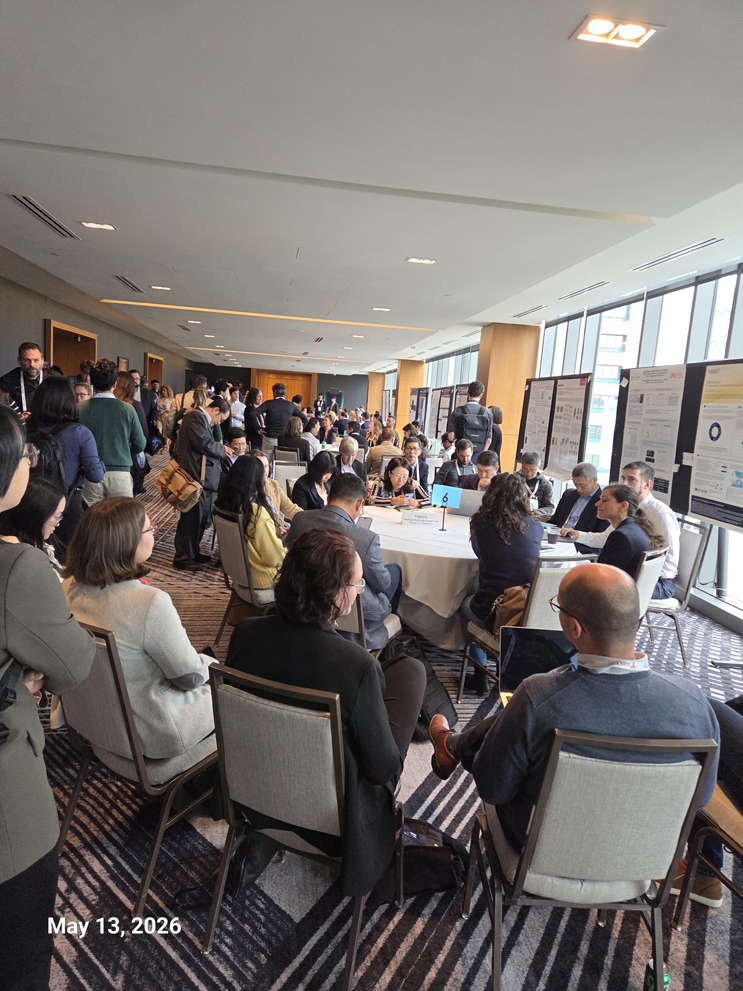
Twelve discussion tables were set up to allow participants to discuss specific industry topics such as Unlocking the Dark Genome, Practical Considerations for In Silico Risk Assessment, and Optimizing the CNS delivery of Biotherapeutics.
That may explain why PEGS has such a strong return-attendee culture. Even as a first-time attendee, it was easy for me to see why scientists come back year after year. The meeting balances forward-looking talks with practical discussions about screening, characterization, assay design, and candidate quality.
Speaker Headliners
Plenary and featured sessions included Michel Sadelain (Director, Columbia University Initiative in Cell Engineering and Therapy), whose keynote on CARs underscored the convergence of engineered cell therapy and biologics design.
Jamie Spangler (Associate Professor, Johns Hopkins University) and Kipp Weiskopf (Head of Antibody Therapeutics and Biologics, Cancer Research Institute, Beth Israel Deaconess Medical Center) also appeared in the young scientist keynote alumni panel on innovation in protein science.
Rebecca Croasdale-Wood (Senior Director, Augmented Biologics Discovery & Design, Biologics Engineering, Oncology, AstraZeneca) joined a panel on designing smart biologics in the age of GenAI.
Improving Antibody Discovery and Design Strategies
Across antibody, oncology, and multispecific-focused sessions, the emphasis was on designing molecules that solve development problems by achieving selectivity in complex tissues, balancing potency against safety, and building formats that can withstand the realities of development.
T-cell engagers stood out as a particularly active area, reflecting the field’s push toward more conditional, better-controlled immune activation.
That momentum was reflected in speakers who included Patrick Baeuerle (Chief Scientific Advisor, Cullinan Therapeutics), who helped establish the T‑cell engager field through foundational work on NF‑κB signaling and BiTE antibody Blincyto, including the approved therapy blinatumomab, and Andrew Rankin (Executive Director, Immuno-Oncology, Amgen), who brings over 20 years of industry experience across Pfizer, Five Prime Therapeutics, and now Amgen, where he leads immuno-oncology discovery efforts.
Antibody discovery and design remained one of the clearest anchors of the meeting, but the conversation has moved well beyond identifying high-affinity binders.
Limited Drug Developability Prediction AI Models
Another recurring theme was the industry’s still-limited ability to predict developability early and confidently. AI and machine learning were prominent throughout the summit, but the tone was more measured than promotional.
The strongest discussions treated AI as a way to improve decision quality, not as a shortcut that removes the need for high-quality assays, strong biological hypotheses, or translational judgment.
Developability prediction remains difficult because the problem is multidimensional: aggregation risk, viscosity, stability, immunogenicity, expression, formulation behavior, and clinical performance do not collapse neatly into a single score.
The practical takeaway was that better models will require better training data, and better training data will require tighter integration between discovery, CMC, analytics, and clinical learning loops.
Lead Optimization Is The Best Working Use Case For AI
If there was one AI use case that felt closest to operational maturity, it was lead optimization.
Here, the promise is easier to understand: use computational tools to narrow design space, prioritize variants, and reduce the number of experimental cycles needed to improve a molecule. That is very different from claiming that models can independently invent clinical winners de novo.
Several sessions across the machine learning and analytics tracks reinforced this distinction. AI appears most useful when paired with a rich experimental backbone of screening data, structure-informed design, developability readouts, and iterative validation.
In that setting, models can help teams move faster and ask better questions. But they still struggle when training data are sparse, biased, or disconnected from the downstream endpoints that matter most.
Panel on Near-Term Challenges for ML/AI in Biotherapeutic R&D
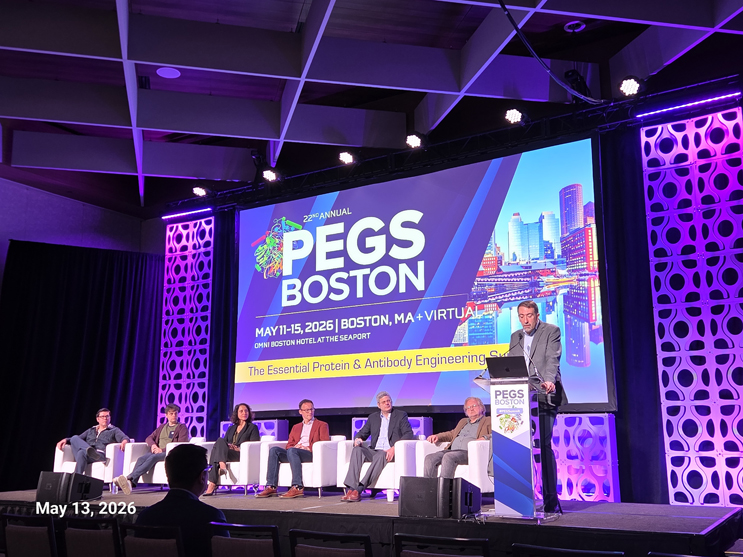
Konrad S. Krawczyk, PhD (Founder & CSO, NaturalAntibody), Norbert Furtmann, PhD (Head, Biologics AI & Design, Sanofi), Melody Shahsavarian, PhD (Senior Director, Data Strategy & Digital Transformation, Eli Lilly & Company), Andrew C.R. Martin, DPhil (Emeritus Professor, University College London), Bernhardt L. Trout, PhD (Chemical Engineering Professor, MIT), Peter M. Tessier, PhD (Albert M. Mattocks Professor of Pharmaceutical Sciences and Chemical Engineering at the University of Michigan).
In a panel expertly moderated by Peter M. Tessier, leaders from pharma, biotech, and academia offered a pragmatic assessment of where AI is delivering value in biotherapeutic R&D and where limits remain.
“AI already works well for molecular optimization, but clinical prediction—especially immunogenicity—remains extremely challenging,” said Konrad S. Krawczyk, while Norbert Furtmann emphasized that “prediction of function is still a major challenge,” even though “thermal stability is something we can predict quite well,” particularly for developability triage.
As biologics grow more complex, Furtmann added that “in multispecifics, the design space is huge,” reinforcing the need for lab‑in‑the‑loop workflows.
From a data perspective, Melody Shahsavarian stressed that “standardization and common ontology are critical” to scaling AI across organizations.
Despite major breakthroughs, structural gaps remain: “AlphaFold has transformed structure prediction, but antibody CDR (complementarity-determining regions) modeling—especially CDR‑H3—remains a major challenge,” said Andrew C.R. Martin, while Bernhardt L. Trout grounded the discussion by noting that “chemistry is more complex than hydrophobicity and charge.”
Forming Closer Networks of People and Data
The scientific community is asking for better target biology, cleaner datasets, more predictive preclinical systems, tighter feedback between design and characterization, and more disciplined candidate selection. And this community is trying hard to figure it out, together.
That is why PEGS 2026 felt important. It did not present a single breakthrough narrative. Instead, it showed a field learning how to connect discovery, developability, and translation earlier in the process.
For teams working on proteins, antibodies, multispecifics, and other emerging biologics modalities, that shift from silos to intense collaborations may be the most consequential takeaway of all.
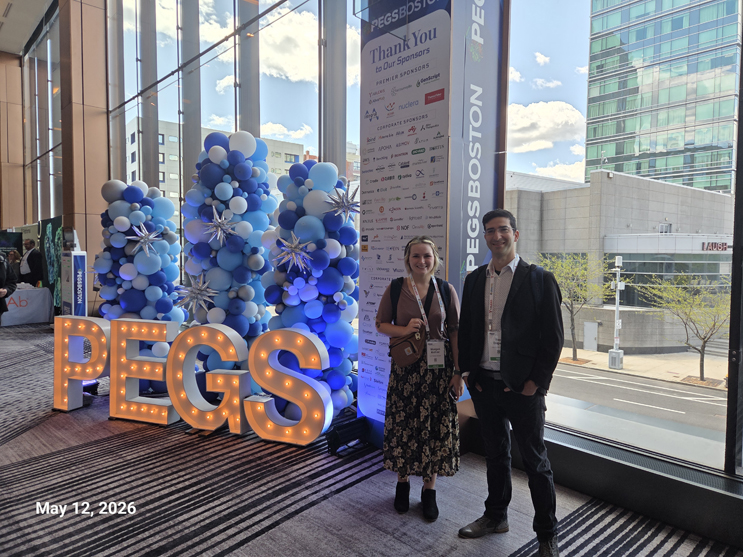
Morgan Kohler (DDO’s executive editor) and Ray Dogum (DDO’s chief editor) at PEGS 2026.