
Discovery Dialogues: Stef van Grieken, CEO, Cradle Bio

By Ray Dogum, Chief Editor, Drug Discovery Online
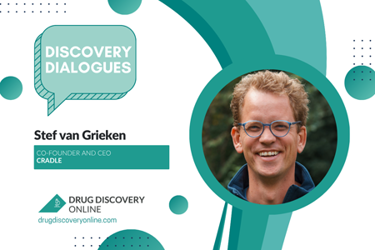
At PEGS Boston, the 2026 Protein & Antibody Engineering Summit, Drug Discovery Online chatted with Stef van Grieken, Ph.D., chief executive officer at Cradle Bio.
In this interview, Grieken explains that while antibody discovery is advancing rapidly, challenges remain in difficult targets and in integrating safety, immunogenicity, and CMC early.
Cradle’s software model focuses on training on proprietary data, enabling bench scientists to design and test candidates directly. AI is accelerating lead optimization and shifting workflows toward engineering and scalability.
As adoption spreads, success will be measured by AI-assisted molecules entering the clinic. Broader impacts include faster cycles, greater creativity, and a modernized ecosystem spanning LLMs, cloud labs, and CRO integration overall.
Video Interview
Transcript (Edited for Clarity)
Ray: Ray Dogum here from Drug Discovery Online. I’m with Stef van Grieken from Cradle Bio. Stef, can you tell us a bit about the company?
Stef van Grieken: Thanks for having me. I’m the CEO and co-founder of Cradle, a software company for protein engineering. We work with eight of the top 25 global biopharmas on peptides, gene editing, and antibodies. We support hit identification and lead optimization through later stages, with the goal of bringing these capabilities to the bench so scientists can design their own libraries.
Ray: There’s a lot of momentum in AI-driven drug discovery. What are people misunderstanding about how quickly this will change pipelines?
Stef van Grieken: We’re far ahead in areas like antibody discovery, but there’s still work to do. De novo discovery works well for well-characterized targets with good structural data, but more difficult targets like ion channels or GPCRs remain challenging.
Lead optimization is progressing faster, supported by strong CRO capabilities, but gaps remain—such as integrating immunogenicity, safety, and CMC earlier in discovery. These are still active frontiers.
Ray: Your approach emphasizes training models on customer-specific data while preserving IP. How important is that in winning large pharma versus traditional partnerships?
Stef van Grieken: It depends on the company you want to build. If you’re pursuing a specific asset with a partner, your organization becomes structured around that. We chose to build software infrastructure.
Machine learning isn’t magic. Performance differences between models are often smaller than perceived. Over time, this will commoditize, which makes a software model attractive.
Ray: Lead optimization is inherently multi-objective—binding, stability, manufacturability. How are teams prioritizing trade-offs, and where does AI help?
Stef van Grieken: Users define targets via a TPP—for example, affinity thresholds or developability ranges—and models generate solutions. They can also enforce sequence constraints.
Teams increasingly design and compare experimental plates. We provide probability distributions for outcomes, helping anticipate lab results. This enables more informed trade-offs and turns discovery into a more engineering-driven process.
Ray: Cradle supports major pharma like Johnson & Johnson, AbbVie, Novo Nordisk, and Bayer. What are teams doing differently after adopting the platform?
Stef van Grieken: Adoption typically starts small and expands. At Bayer, all antibody programs are now on Cradle. Work has become more exploratory—teams can test multiple modalities and TPPs before committing to a candidate.
Tools are now in the hands of bench scientists, reducing reliance on centralized computational teams. Those teams are shifting toward infrastructure and data. This also enables scaling across many programs simultaneously.
Ray: The Bayer collaboration focuses on antibodies. Are they the clearest near-term win for AI-designed proteins?
Stef van Grieken: Antibodies are the most advanced, though challenges remain—like radioligands and multispecifics. The data available for antibodies also helps.
Other modalities are catching up. Peptides are important, especially with non-natural chemistries. We’re seeing convergence between small molecules and proteins. Our models generalize well across domains, including agriculture and industrial enzymes.
Currently, about 60% of our work is in therapeutics, with around 60% focused on antibodies. We have about 70 active molecules on the platform.
Ray: You’ve raised over $100 million and are expanding. How tightly coupled do engineering and wet lab teams need to be?
Stef van Grieken: This is a major challenge. Few people excel in both domains. At Cradle, ML engineers spend time in the lab to understand experimental workflows. We also train staff in biology fundamentals.
On the commercial side, finding people with both scientific and business skills is also difficult.
Ray: What are your biggest challenges right now?
Stef van Grieken: Scaling. We’ve grown from about five active programs at the start of 2025 to 4–5x that today while still building infrastructure.
Technically, we’re focusing on immunogenicity, safety, and CMC to shorten preclinical timelines.
Ray: What milestone would signal that AI-designed proteins are mainstream?
Stef van Grieken: The number of AI-generated or AI-assisted candidates entering the clinic.
We already see efficiency gains—teams moving from two or three rounds of lead optimization to one or two. Faster development creates a competitive advantage.
A recent example: work with the Danish Technical University produced a cross-reactive snake antivenom in six months, with minimal resources. That’s where the field is heading—faster cycles and more creative freedom.
Ray: Where do LLMs fit into this ecosystem?
Stef van Grieken: They’ll support reasoning—integrating genomics and literature to guide target selection.
Our focus is molecular engineering. Beyond that, cloud labs are modernizing CRO workflows, which have traditionally been slow and manual. This infrastructure is becoming more like modern software development ecosystems.
Ray: Are CROs integrating with your platform?
Stef van Grieken: Mostly through our customers. Pharma companies bring their preferred vendors onto the platform for execution.
Ray: What about federated learning and privacy-preserving data sharing?
Stef van Grieken: It’s technically challenging. These methods remove unique signals from data to preserve privacy.
In biology, those unique signals are often what matter most—especially when trying to design novel solutions outside known biology. As a result, these approaches may improve generic metrics but not the most relevant outcomes.
Ray: What has stood out at PEGS so far?
Stef van Grieken: I’ve mostly been in meetings without a badge, so I haven’t attended sessions. My focus has been meeting customers and prospects.
Ray: Thanks for your time.
Stef van Grieken: Thank you.