
Advancing Spatial Multiomics for Discovery: From Promise to Practice

By Ray Dogum, Chief Editor, Drug Discovery Online

Spatial multiomics is widely regarded as one of the most powerful additions to the modern drug discovery toolkit — yet its translation into routine R&D and clinical workflows remains uneven. That tension shaped a panel discussion at the NextGen Omics Spatial and Data conference in Boston, featuring leaders from Merck, Takeda, AstraZeneca, and Georgia Tech.
While enthusiasm for spatially resolved biology is unmistakable, panelists repeatedly returned to three hard realities: cost‑prohibitive tools, tissue procurement bottlenecks, and the unresolved question of why clinicians should care.
Cost‑Prohibitive Tools: When Power Outpaces Practicality
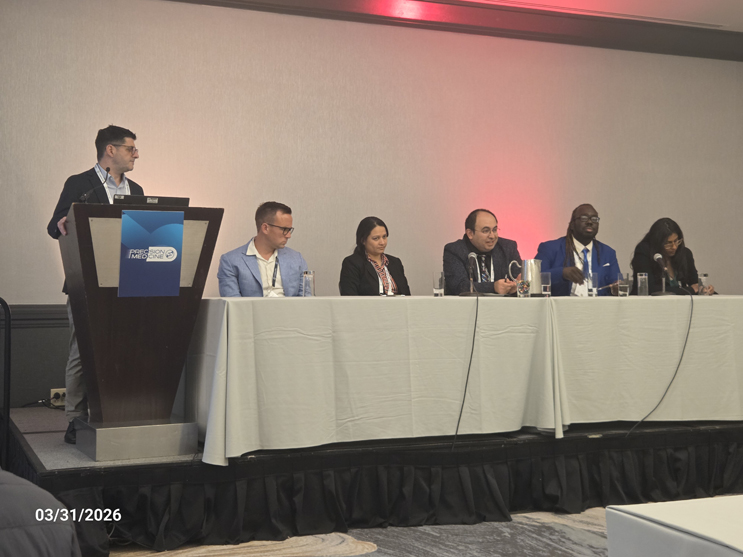
From left to right: Moderator Nir Ben Chetrit and panelists, Alex Tamburino, Banishree Saha, Ahmet Coskun, Colles Price, and Kisha Sivanathan.
Spatial multiomics can reveal biology that is otherwise invisible, but panelists were candid about the price of that insight. High‑plex assays demand significant investment, and not just in reagents and instrumentation, but also in computational infrastructure and specialized expertise.
As Alex Tamburino, director of spatial and single cell multiomics at Merck, noted, spatial technologies cannot be justified simply because they are powerful. “Spatial biology is incredibly high dimensional, but in discovery we still have to ask whether that complexity actually changes the decision we’re trying to make.” Tamburino's 20 years in the industry spans time at Harvard, GSK, UMass, and more than ten years at Merck.
This reality has pushed many pharma teams toward more focused, hypothesis‑driven spatial studies, rather than open‑ended atlasing. Several panelists emphasized that if a bulk or single‑cell assay answers the question sufficiently, spatial approaches must demonstrate clear incremental value to justify their cost.
Kisha Sivanathan, senior scientist at AstraZeneca, echoed this sentiment from an industry execution standpoint. “In an academic lab, you can run experiments over and over again. In industry, cost becomes a real constraint very quickly, and that shapes what is actually feasible.”
At the same time, panelists noted that spatial biology today feels reminiscent of early single‑cell genomics: expensive, complex, and limited to specialists.
The Tissue Problem: A Structural Bottleneck
If cost is the most practical barrier, tissue procurement may be the most fundamental. Across therapeutic areas, access to high-quality, well-annotated tissue remains inconsistent, particularly when moving from research samples to clinically-derived material.
Panelists stressed that this is not merely a technical issue.
Ahmet Coskun, associate professor of biomedical engineering and co-director of SODA Center at Georgia Institute of Technology, framed tissue as a systems problem rather than an assay problem. “Even if the technology is ready, the ecosystem is not. Sample collection, fixation, and standardization vary enormously, and that variability limits what we can confidently interpret.” Coskun’s lab combines biomedical imaging, systems biology, and data visualization to explore six key areas: cancer research, chronic kidney disease, regenerative medicine, fibrosis, aging and brain health, and neurodegeneration.
Clinical workflows are optimized for speed and diagnosis, not for preserving molecular integrity across multiple spatial modalities. As a result, spatial studies often rely on small cohorts or highly-curated samples, making it difficult to establish power, reproducibility, and cross-site consistency.
Without improvements in tissue pipelines — including procurement, handling, and data harmonization — spatial multiomics risks remaining confined to specialized settings, regardless of how advanced the tech platforms become.
Why Should Clinicians Care About Spatial Multiomics?
Perhaps the most pointed question raised during the discussion was also the most pragmatic: Why should clinicians care about spatial multiomics at all?
From a clinical perspective, more data does not automatically translate into better care. Clinicians need clear, validated signals that inform diagnosis, prognosis, or treatment decisions — not complex spatial maps.
Associate director at Takeda, Banishree Saha, framed it as, “The first step is defining what actually matters clinically. Is it a gene signature? A cell type? A microenvironmental feature? Without that clarity, it’s very hard to translate.”
Panelists emphasized that clinicians do not need full spatial atlases. What they need are distilled features — biomarkers or spatial patterns derived from discovery studies that can be deployed reliably, quickly, and cost‑effectively.
Colles Price, CEO of TALOX, highlighted a deeper tension in the field. “We talk a lot about personalized medicine, but then we spend a lot of time mathematically removing patient-specific variation so we can analyze populations.” He also reminded the audience that digital pathology wouldn’t be where it is now without COVID. This emphasizes the weight that black swan events, like COVID, can have on technology adoption in the broader clinical landscape.
For spatial biology to matter clinically, Price argued, it must show how individual spatial context — not just population‑level averages — changes outcomes such as response, resistance, or recurrence.
Approaching an Inflection Point
Despite the challenges, the panel struck a cautiously optimistic tone. Spatial multiomics is still early, but there was broad agreement that the field may be approaching a familiar inflection point — where usability, scale, and integration suddenly converge.
As Coskun observed: “We’ve seen this pattern before. When platforms mature, everything downstream — cost, standardization, and adoption — starts to move much faster.”
From Visual Maps to Medicines That People Trust
The discussion concluded with a shared recognition that spatial multiomics will not succeed by trying to do everything at once. Its impact will come from selective focus: pairing the right spatial strategy with the right biological question, grounding discovery in clinical reality, and resisting the assumption that more data automatically means more value.
As the moderator Nir Ben Chetrit, assistant professor at Cornell University, summarized well: “The challenge isn’t whether spatial biology works, it’s whether we can turn that complexity into decisions people trust.” Chetrit has over 20 years of research experience and his work focuses on harnessing the power of innate immunity against cancer.
If cost curves continue to fall, tissue pipelines improve, and spatial insights are translated into decision‑ready features, spatial multiomics may soon move from an exploratory luxury to a practical pillar of drug discovery and development.
In an industry that has repeatedly made the impossible possible, the question may no longer be if spatial biology breaks through — but how ready we are when it does.