
Next‑Generation Omics: Latest Insights From A Growing Field

By Ray Dogum, Chief Editor, Drug Discovery Online
By peering into the inner workings of cells and their surrounding microenvironments in both healthy and diseased tissues, scientists can now see biology in ways that were unimaginable just a few years ago.
Researchers can interrogate biology at single-cell resolution and across spatial, temporal, and molecular dimensions; yet it is still unclear what that means in practice for cost constrained drug discovery leaders and for patients who are hoping for new treatments.
As the industry works out how to translate these technological advances, I recently attended the NextGen Omics Spatial & Data conference in Boston, where I had the chance to speak to, and hear from, the experts in this field. The event topics included spatial transcriptomics/spatial proteomics in formalin-fixed, paraffin-embedded (FFPE) and fresh-frozen tissue, including subcellular ribonucleic acid (RNA) localization, multiplex immunofluorescence (IF)/imaging mass cytometry (IMC), and high-plex protein panels.
Discussions also covered spatial multiomics stacks with cell segmentation, cell typing, and neighborhood/interaction analyses, alongside spatial readouts in 3D organoid/spheroid systems with in situ barcodes.
Finally, multiple sessions focused on the unglamorous but essential work of batch correction, cross-platform integration, and harmonization across cohorts-- the infrastructure needed to scale these capabilities for accelerated discovery research.
Why Data Harmonization, Not AI, Is the Real Bottleneck For Biological Insights
One panel underscored that while multiomics technologies are advancing rapidly, harmonization remains the central bottleneck between data generation and biological insight.
Harmonization refers to the process of aligning, integrating, and making comparable multiomics datasets—often across experiments, platforms, tissues, or disease contexts—while preserving a biologically meaningful signal so the data can be interpreted and used for decision‑making.
Speakers repeatedly emphasized that harmonization is not a purely technical exercise, but a contextual and question‑driven process that must preserve biology while enabling integration at scale. As Sanofi Associate Director Manisha Brahmachary, cautioned, “We are not there yet in terms of AI that can codify everything—from data ingestion to harmonization—and still give us something biologically sensible.” Her comment highlights the risks of over‑automating decisions that require scientific judgment.
From an academic perspective, Aditi Singh, director of bioinformatics at Wayne State University, reinforced this tension, noting that “harmonization is always a balancing act between removing noise and preserving biological context,” particularly when rare but biologically critical cell states are at risk of being averaged away.
From the industry and platform‑building viewpoint, the discussion expanded toward cross‑disease integration and scalable representations of biology.
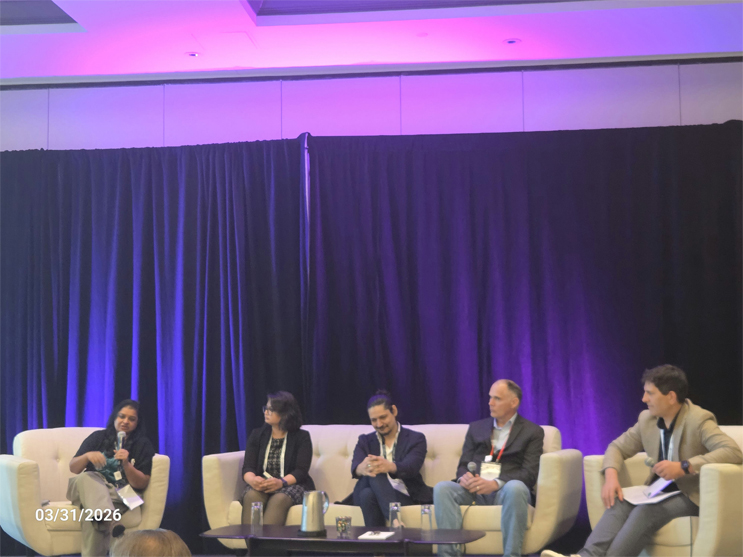
Speakers from left to right: Manisha Brahmachary, Aditi Singh, Vitalay Fomin, Hansueli Meyer, Iulian Pruteanu-Malinici.
Vitalay Fomin, CEO of Numenos, argued that meaningful harmonization requires rethinking how biological data are represented altogether, stating that “biology is not aware of our disease classifications, our silos, or our organizational charts.”
At the same time, Iulian Pruteanu‑Malinici, senior director of bioinformatics for Flagship Pioneering, stressed that harmonization must ultimately serve interpretation and decision‑making, not just model performance. “It’s still on us to understand the biology—models don’t replace that responsibility,” he said.
Moderating the discussion, Takeda Senior Scientist David Gallegos highlighted the importance of evaluating harmonization outcomes, noting that there are tools made to evaluate the fidelity of individual harmonization and integration efforts. One of the big ones, he said, is single-cell integration benchmarking (scIB).
Taken together, the panel made clear that harmonization is not a single tool, but a discipline at the intersection of biology, statistics, and human expertise, and is foundational to translating multiomics data into therapeutic impact.
Subtle Flex, Serious Plex
Spatial biology is attempting to reach a level of completeness where inference can give way to direct observation, partially driven by sample multiplexing: the ability to measure many molecular targets (such as nucleic acids or proteins) simultaneously within the same tissue sample while preserving spatial context.
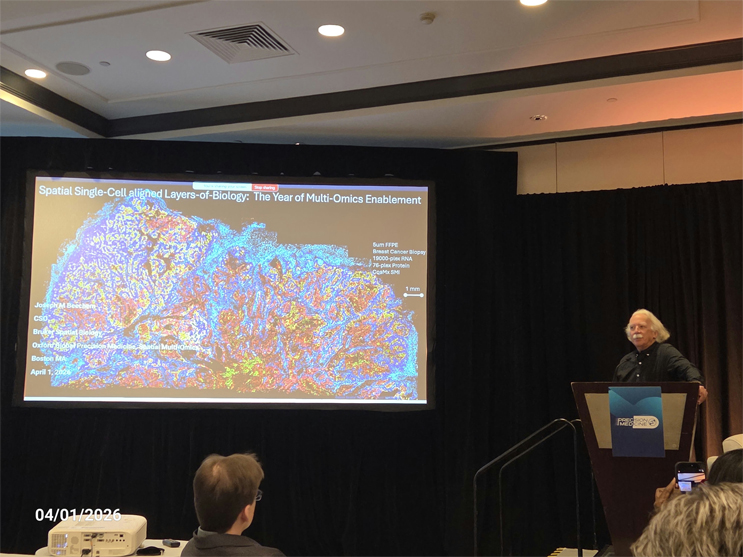
Joseph Beechem presenting at the event.
In his remarks, Joseph Beechem, chief scientific officer of Bruker Spatial Biology, reflected on plexing in the context of protein panels, noting that “the plexing is finally to a place that's reasonable, where I can actually see what's happening in the biology.” But, he was clear that today’s capabilities are only a waypoint. “I’m still not happy with 1,200,” Beechem said. “I want 12,000 or 16,000…there’s no technical reason why we can’t get to that side of the equation with protein as we are with RNA.”
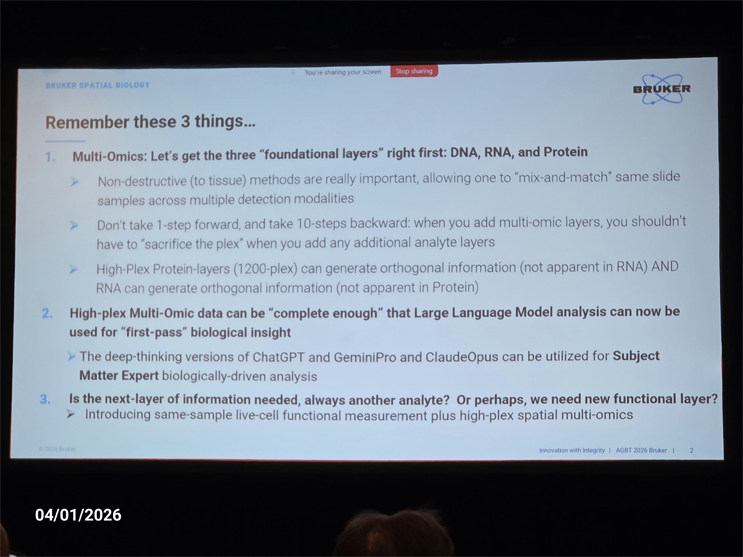
Slide from Joseph Beechem’s presentation – The 3 things to remember.
Beechem also hinted at how this richness integrated with AI should change the experience of analysis itself—AI taking the first pass, and researchers spending their time interrogating biology directly, even if that exploration happens informally, over a glass of wine on a quiet weekend, rather than through weeks of gated, specialist workflows.
In a separate session, Merck Senior Scientist Mengwei (Carol) Hu, showed what that level of data completeness enables in practice, describing how spatial CRISPR screening in FFPE 3D spheroids becomes transformative only when perturbation identity, whole‑transcriptome RNA, protein expression, and spatial context are captured together.
As Hu put it, “by combining CRISPR identity, whole‑transcriptome RNA, 68‑plex protein, and spatial context on a single FFPE slide, we can interrogate genetic perturbations at true single‑cell resolution,” enabling unbiased discovery of tumor interactions at screening scale.
These moments captured a broader shift across the meeting: as plexing rises high enough to reflect the true complexity of tissues, both discovery and interpretation are becoming more direct, more accessible, and more faithful to the biology itself.
Scientific Elegance Isn’t Enough To Invest In
A recurring theme throughout a panel focused on omics funding priorities was the growing gap between innovation and impact.
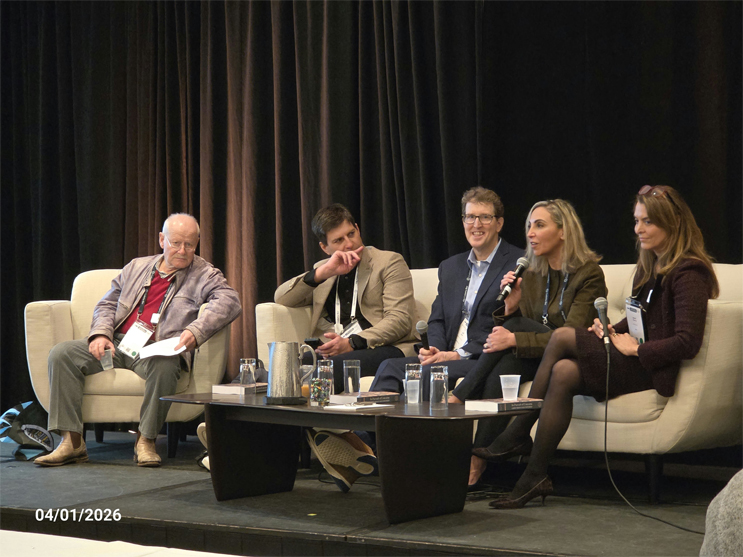
Speakers from right to left: Tim Harris, Iulian Pruteanu-Malinici, Jeff June, Irene Ghobrial, and Maria Forero
Framing the issue early, Tim Harris, venture partner at SV Health Investors, pointed to “the difference between scientific elegance and deployable biology,” arguing that many omics platforms validate technically but stall before real clinical intervention. That framing resonated across perspectives.
From the clinic, Irene Ghobrial, senior VP of experimental therapy at Dana‑Farber Cancer Institute, underscored the disconnect bluntly: “You can have the best technology in the world, but if it doesn’t serve the purpose of helping patients or helping physicians, then I don’t care,” noting that clinicians still rely on decades‑old diagnostics even as sequencing and multiomics advance rapidly.
On the adoption side, Jeff June, CEO of Ischemia Care, emphasized that translation depends as much on systems as on science, stressing that new technologies must “fit into a specific workflow that is going to enable a better decision.”
Exciting Progress Ahead
The conference reinforced a shared conclusion: durable value in omics will be created not by technological sophistication alone, but by translating complex biology into tools that integrate seamlessly into clinical practice and measurably change patient outcomes.
Spatial multiomics is still relatively early—but the tone of this conference, reinforced by industry buzz such as the upcoming 10x Genomics’ 04.18.26 product announcement, suggests the field is edging toward significant advancements sooner than we think possible.
Happy Hour Draw Me Bot souvenir