
Using Synthesis And Route Design Technology To Approach API Complexity
By Dr. Ryan Littich, Head of Advanced Chemistry Technologies, Global R&D, Lonza, and Dr. Juergen Swienty-Busch, Director of Product Management for Chemistry, Elsevier Information Systems

Small molecule active pharmaceutical ingredients (APIs) continue to grow more complex. As a result, API syntheses are growing longer and, at times, undermining drug sponsors’ speed-to-clinic. These longer synthetic pathways present challenges for process chemists hoping to achieve an efficient API manufacturing process, due to factors such as elaborate raw material needs and supply chain obstacles. These compounding layers can delay start times and extend preclinical development. To help mitigate these issues for sponsors, Lonza Small Molecules has partnered with Elsevier Information Systems to leverage a synthesis planning and route scouting solution that combines Lonza’s intellectual property (IP) with Elsevier’s AI-enabled route design technology – Reaxys predictive retrosynthesis.
Rising API Process Complexity
Over the last 15 years, Lonza has observed a substantial rise in the molecular complexity of drug candidates coming out of discovery efforts. Drug sponsors’ observations in the peer-reviewed literature capture this dynamic well. In a 2006 analysis of 128 syntheses of development-phase drug candidates, colleagues from GSK, AstraZeneca, and Pfizer observed an average synthetic step intensity of 8.1 (Figure 1). Eleven years later, leaders from Bristol-Myers Squibb and Boehringer Ingelheim observed that it had become commonplace for process chemists to receive small molecule syntheses of more than 20 steps (Figure 1). Finally, in 2019, Eisai reported the longest disclosed development phase synthesis effort to date, a 92-step process, for their highly potent microtubule inhibitor, E-7130 (Figure 1).
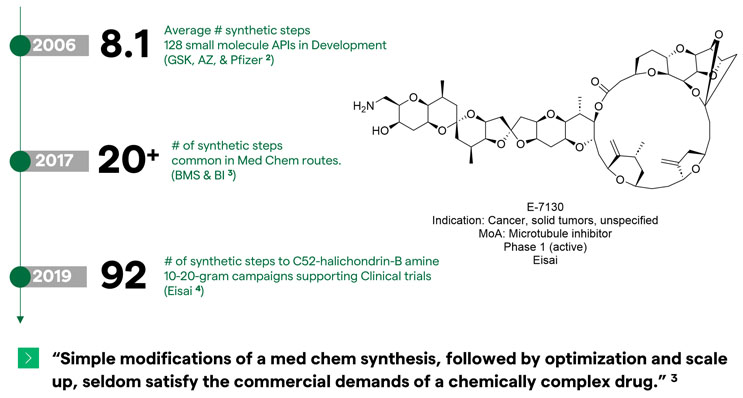
This complexity creates a significant challenge for process chemists as they strive to realize API manufacturing ideals. Achieving high productivity, ensuring high overall process quality and reproducibility, and delivering sustainable and supply chain secure processes has become more difficult. To embrace API complexity, Lonza is leveraging innovative technologies in each aspect of the transition from med chem route to productive first-generation process route (Figure 2).
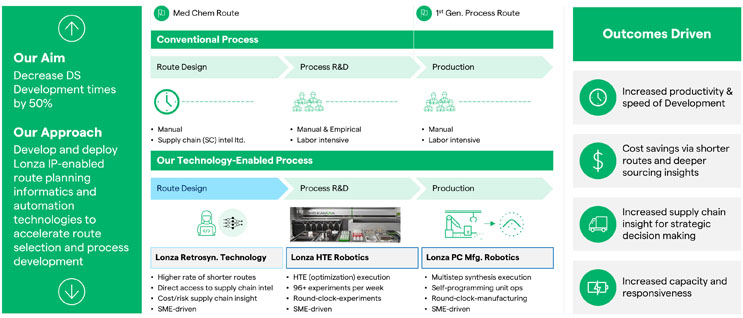
Our subject matter experts (SMEs) in route design, process research and development, and manufacturing draw from proprietary informatics and automation technologies to maximize time for analysis and hypothesis development and minimize time to the next key experimental insights. We are striving to accelerate our clients’ clinical readiness, reduce costs, and serve their strategic priorities.
What is Reaxys?
Reaxys, an Elsevier Life Sciences’ technology, is the world’s largest bioactivity and chemical database. It combines over 1 billion chemistry data points from more than 100 million documents and 250 million substances. Millions of reactions and bioactivity data points form the basis to create artificial intelligence (AI) solutions that support innovation in drug discovery, chemical R&D, and academia. Chemists can design novel, safe, and effective chemical materials with in vitro and in vivo data from its extensive patent and journals collection and the award-winning predictive retrosynthesis.
The Design, Make, Test, and Analyze (DMTA) cycle is a fundamental concept in small molecule discovery, involving iterative hypothesis-driven design (Figure 3). Medicinal chemists work to design an analogue library of compounds, which are then synthesized, purified, and characterized, followed by testing by a range of assays. The resulting data is then analyzed and utilized to further refine the design hypothesis. Reaxys plays a pivotal role in supporting the synthesis or the ‘make’ component of this process.
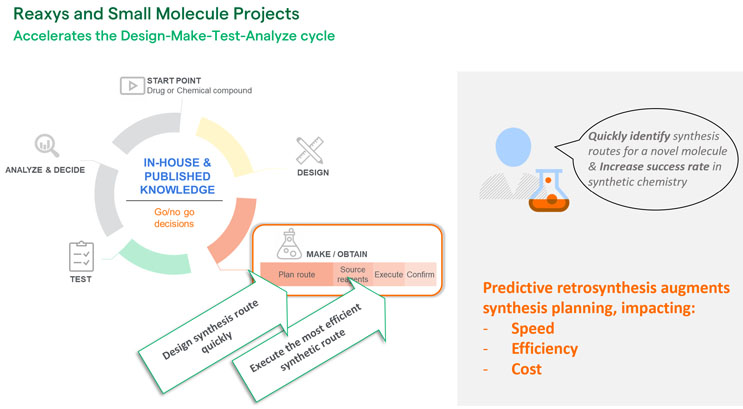
Accelerating the DMTA cycle presents a challenge and optimizing chemical synthesis and route design becomes crucial to potentially reduce the number of DMTA cycles needed. Data-driven approaches help to improve synthesis planning, route optimization, and execution. While Reaxys’ database of chemical reactions and commercial compounds – the world’s largest – is a good starting point, using this data to create a predictive retrosynthesis solution is even more promising. It can augment synthesis planning and impact speed, efficiency, and cost.
The Advantage of the Reaxys Predictive Retrosynthesis Model
Reaxys and Pending.AI teams have collaboratively developed the award-winning Reaxys predictive retrosynthesis solution, which works on the model developed by Mark Waller and the team. Their work presented a new method to approach the complex issue of computer-aided synthesis planning and is one of the most cited works in the field of predictive retrosynthesis. It takes the best-in-class reaction data from Reaxys and leverages AI and machine learning technologies to extract and prioritize transformation rules automatically to generate robust predicted routes within minutes. Since rules generation is done automatically, it can be easily updated to learn from more modern reactions and literature as well as new rules and reaction types. The model can also be customized with customer’s reaction data to further train the model on their in-house data.
Reaxys predictive retrosynthesis has been tried and tested with its customers and proven to be greatly valued. Professor Erick Carreira, Ph.D. from ETH Zurich and Professor Floris Rutjes, Ph.D. from Radboud University have independently evaluated the retrosynthesis solution on selected molecules from their respective research to (1) create and (2) validate synthesis routes, with and without the Reaxys predictive retrosynthesis. As a result of this evaluation, Prof. Carreira’s group provided the following feedback:
- Reaxys retrosynthesis is an interesting approach that proposes robust routes.
- The tool is user-friendly and intuitive.
- It provides time savings for designing synthesis routes and getting ideas for conditions that can be used.
- It is not a black box AI, as it shows literature precedents to underpin the predicted routes.
Customer centricity is at the heart of design, development, and integration for Reaxys. After interviewing and testing with a range of companies, Reaxys predictive retrosynthesis is perceived as being the most intuitive and straightforward solution in the field. Users can easily navigate between customized (yellow), published (blue), and predicted (green) routes (Figure 4). They can also see the commercial availability of starting materials, and an overview of pricing, packaging, and delivery times (Figure 4).
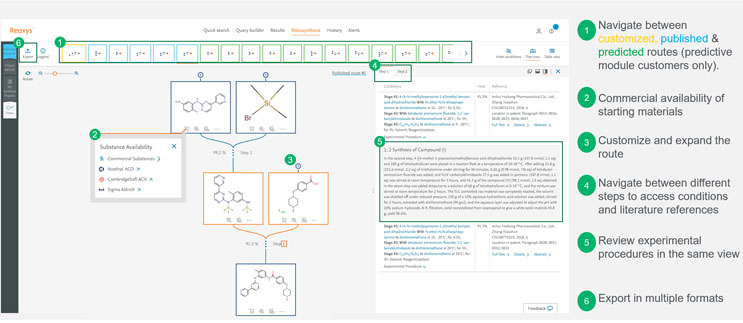
Reaxys allows users to navigate between different steps to review conditions, literature references, and experimental procedures, all in the same view (Figure 4). One can also export routes in multiple formats, including a copy to ChemDraw. Users find two features especially interesting: the ability to see literature precedent with details about reaction conditions including solvents, reagents, and catalysts, and the ability to select various building block libraries. Reaxys takes building blocks into account to create complete synthetic pathways. Per definition and implementation, Reaxys will not provide results that are only partially resolved. This indicates how important building block libraries are for the process, not only to find the success rate of a retrosynthesis project, but to influence the complexity and focus of any predicted route. Thus, Reaxys allows customers to integrate their own libraries, and if desired, they can then be shaped by conditions like pricing, delivery time, or packaging. Curated building block libraries ensure readily available starting materials and result in more desirable routes.
The Impact of Lonza’s Route Scouting Service
Reaxys contains numerous building block libraries which create an extremely large starting material and intermediate landscape. However, from a process chemistry perspective, incumbent libraries can sometimes skew toward discovery phase demands. At Lonza, we considered: what would happen if we aggregated our commercial supply chain expertise behind a Lonza custom building block library? Could we observe outcomes that are tailored to the considerations of development? We explored this by aggregating data that is drawn from our commercial algorithms and supply chain expertise.
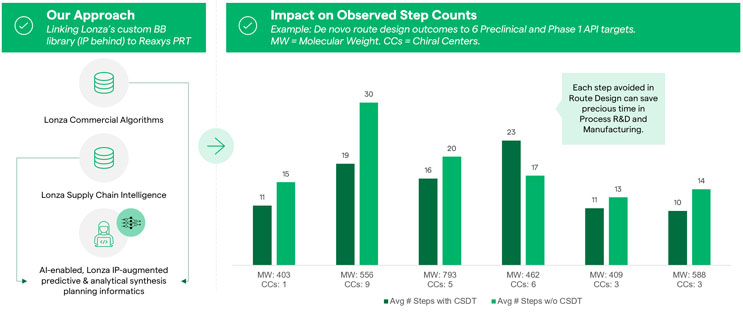
With an experiment like those conducted by ETH Zurich and Radboud University, we found that when subject matter expert (SME) groups leveraged computer-aided synthesis design technology (CSDT), in this case, Reaxys predictive retrosynthesis, they would frequently develop shorter synthesis strategies than groups drawing from earlier-generation cheminformatics tools alone. Figure 5 depicts the average number of synthetic steps to six different preclinical and Phase 1 targets, as developed by these two test groups – one with CSDT (dark green bars) and another without CSDT (light green bars). The complexity of these target compounds is reflected in terms of molecular weight and number of chiral centers (Figure 5). In five of the six cases, shorter strategies were devised when SMEs used Reaxys predictive retrosynthesis. The implication is significant because each step avoided in the first-generation process route design is potential time that can be saved in process R&D, and ultimately, manufacturing.
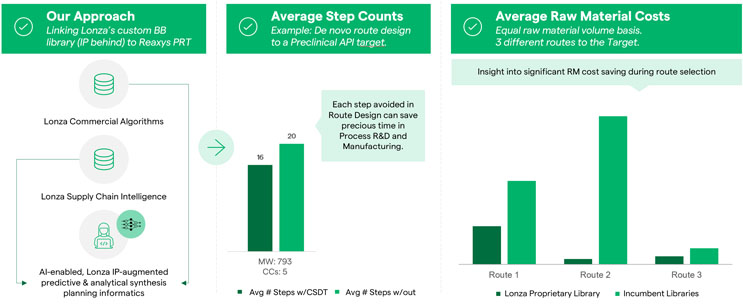
When we investigated pricing differences between Lonza’s custom building block library relative to the very large set available within Reaxys, it was found that actionable insights were available. Using one of the target compounds from the aforementioned example, we observed that the information in our proprietary database would potentially change the prioritization decisions for process chemistry experts. For this particular target compound, when we explored the raw material cost basis of three constituent routes without the activation of our proprietary library, Route 3 was found to be the most appealing approach. However, upon activating our proprietary building block library, that perspective changed, and it suggested that Route 2 would be the preferred approach given the commercial pricing information (Figure 6).
As part of Lonza’s route scouting services, we deliver the benefits of this technology and Lonza IP-enabled design insights to our clients. In phase one of our route scouting services, we collaboratively and systematically prioritize innovative and efficient synthetic route options. In phase two, we consolidate sourcing intelligence that enables our clients to make strategic sourcing decisions for the top priority routes that are evolving from phase one. In phase three, we execute process research and development to affirm the effectiveness and performance of the top-rated, client-nominated process routes that move into the laboratory.
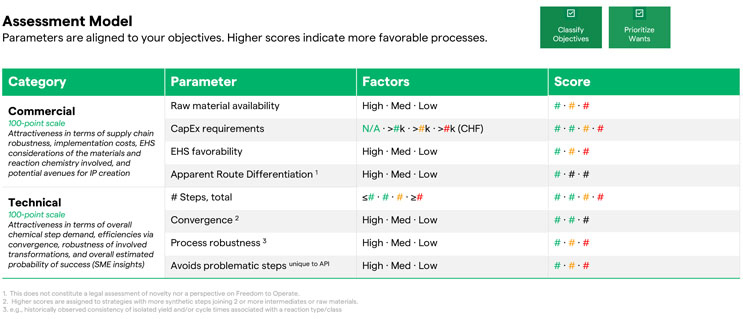
During phase one, we use proven decision-making processes to facilitate prioritizations in route design. Kepner-Tregoe Decision Analysis ensures a complete and common understanding of our client’s objectives before our process route design efforts begin. It is important to note some key aspects of our assessment methodology (Figure 7). Our classification and prioritization efforts create parameters that generally fall into two categories, commercial and technical. They are set up to answer critical manufacturing process questions like:
- Is a raw material supply chain ready for rapid startup at scale, if we were to select this route?
- Does the synthetic plan address specific problematic features of the API, the incumbent synthesis, or both?
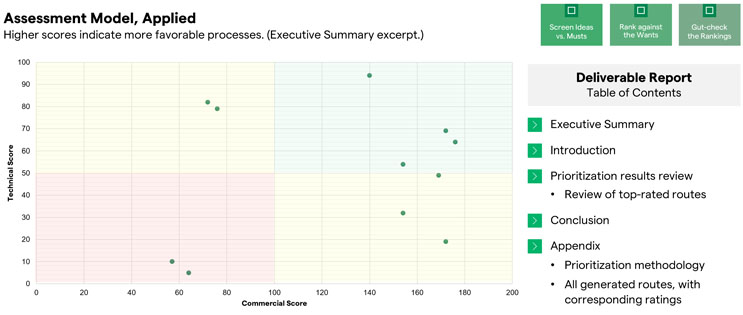
By agreeing on the fitness of the proposed factors and their relative importance using scoring, we create a commercially astute, technically informed prioritization of the possibilities available. Through this process, our scientists deliver structured decision-enabling reports that consolidate our insights. In Figure 8, the chart reflects the respective technical and commercial scores and the prioritization campaign. To clients, we relay an executive summary and introduction with priorities and objectives of the original engagement, a review of the prioritized results, a conclusion on our recommendations for progressing into process research and development, and an appendix which incorporates the prioritization methodology, the generated routes that were considered, and their corresponding commercial ratings.
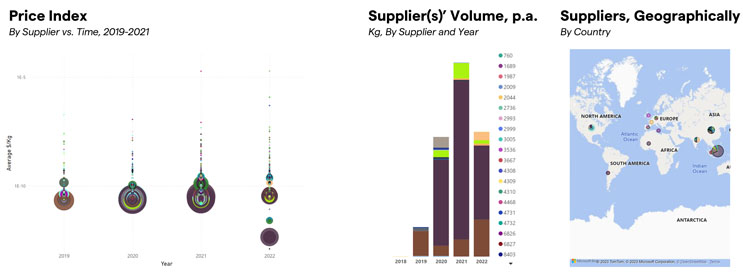
To address phase two, we deliver further information as part of the prioritization results review. For each of the top-rated routes, we provide raw material sourcing information that empowers clients’ supply chain decision-making, including data regarding the number of raw material suppliers available regionally and globally. We highlight which suppliers are Lonza-qualified when that is available for a particular route or starting material, as well as data regarding the volumes available from suppliers annually and the relative pricing of suppliers in our building blocks set (Figure 9). We have more than 75,000 unique building blocks in the proprietary data set, which we have integrated with Reaxys PRT, and continue to actively grow. We deliver raw material sourcing analysis data in the form of interactive analytics. In Figure 9, we demonstrate price index information for L-methionine; bubble sizes provide an indication of the relative volumes at that price. Finally, our clients can filter by region to delve into geographical insights, suppliers available near them, and manufacturing sites.
A Considerable Edge
CSDT offers scientists a powerful tool for managing API synthesis design complexity. To deliver robust predictions for a given target, predictive technologies rely on the existence of plausible starting materials or building blocks. Elsevier Life Sciences’ Reaxys technology and Lonza Small Molecules’ route scouting service are joining forces to help customers save money and ensure efficiency on their path to clinic.
About Lonza Small Molecules
Lonza Small Molecules is a leading contract development and manufacturing organization (CDMO) focused on delivering rapid pathways to specialized drug products for pharmaceutical innovators. Our capabilities span the design, development, and manufacturing continuum, and we integrate end-to-end expertise in drug substance, particle engineering, and drug product. We have an emphasis on specialized oral and inhaled dosage forms and maintain a technology-driven approach to achieve success in the drug substance design phase, particularly in a fast-evolving, small molecule API landscape. At Lonza, we have been privileged to steward the development of many of tomorrow’s breakthrough therapies.
About Elsevier Innovation Intelligence for Life Sciences
This portfolio of solutions and services for life sciences accelerates innovation at every stage of the R&D workflow. Improve your productivity and profitability through AI and analytics that help facilitate novel discoveries, predict outcomes, and conduct post-market surveillance. We combine authoritative data with subject matter and data science expertise to deliver reliable, actionable insights. With Elsevier Innovation Intelligence for Life Sciences harness the potential of data to shape healthier futures.
For more information about Elsevier Innovation Intelligence for Life Sciences, visit www.elsevier.com/rd-solutions/pharma-and-medical-tec