
Using Recurring Toxicity Profiles To Inform Preclinical Study Design
By Sara Selitsky, Founder and CEO, FlashPath AI

When a new drug candidate enters from a well-characterized pharmacological class, some findings in its animal toxicology studies may already be expected. Corticosteroids commonly affect the adrenal gland and lymphoid tissues, for example. If earlier compounds have repeatedly produced the same effects, what should the next study establish? Could using that knowledge more systematically help us answer the remaining questions with fewer animals?
In our preliminary analysis of regulatory reviews, we constructed toxicity profiles from nonclinical animal findings. One of the profiles we identified, the lymphoid-adrenal profile, combined adrenal, lymphoid, and bone marrow changes with decreases in several blood-cell measures. This profile was reported in all 11 corticosteroids included in the network, compared with 247 of 885 other drugs (q = 1.3 × 10⁻⁵, adjusted for multiple testing). The profile emerged from a network of co-occurring findings built without drug-class information. Its frequency among corticosteroids illustrates how historical evidence can establish an expectation before a new study begins and help to refine future study designs.
That expectation is useful only if it informs a decision. The opportunity is to combine recurring profiles with the details of earlier studies to identify what a new candidate still needs to demonstrate: how much exposure produces an effect, whether it impairs function, whether it resolves, and whether anything differs from the class precedent.
From Individual Findings To A Toxicity Profile
Toxicologists interpret individual findings in the context of an animal’s overall response, considering tissue changes alongside laboratory results and clinical observations. Our approach extends this integrated perspective across drugs to quantify which combinations of findings recur (Figure 1). We first measure how often pairs of findings are reported for the same drugs and link those that occur together more often than expected by chance. These links form a network, within which we identify groups of findings that tend to occur together across drugs. These recurring groups help describe toxicity profiles and provide a systematic basis for comparing patterns across compounds.
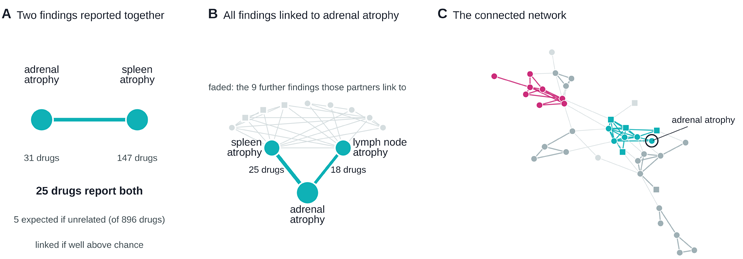
Figure 1. Building a network of co-occurring toxicity findings. Each point represents a finding, and each line links findings reported across the same drugs more often than expected by chance. (A) Adrenal and spleen atrophy were both reported for 25 drugs, compared with approximately five expected if the findings were unrelated. (B) Expanding these connections reveals additional linked findings; faded points show connections through neighboring findings. (C) Groups of interconnected findings form profiles, highlighted in color, that describe recurring toxicity patterns. Drug-class information was examined only after the network was constructed.
We examined repeat-dose findings in rats from public nonclinical reviews issued by five regulatory agencies, including the FDA and the EMA. The analysis included 896 drugs and findings from histopathology, clinical pathology, and clinical observations. We linked findings that were reported together across drugs, then identified profiles within that network. Only afterward did we examine their association with pharmacological classes and modalities. For this analysis, a drug carried a profile when at least two of its findings were reported.
Over 10 recognizable patterns emerged. A reproductive-organ profile that included testicular degeneration and atrophy and epididymal findings appeared among antibody-drug conjugates (ADCs). The lymphoid-adrenal profile, carried by all 11 corticosteroids, also appeared in other classes, including Janus kinase (JAK) and histone deacetylase (HDAC) inhibitors, mostly through its lymphoid, bone marrow, and blood-count findings. These patterns offer a way to organize prior evidence around combinations of effects, rather than reviewing each finding separately.
For the design questions that follow, corticosteroids provide a relatively straightforward example.
What The Profile Tells Us About Corticosteroids
The lymphoid-adrenal profile contained nine findings: atrophy of the adrenal gland, thymus, spleen, lymph node, and bone marrow, together with decreases in lymphocytes, total white blood cells, platelets, and reticulocytes. All 11 corticosteroids carrying the profile had adrenal and thymus atrophy recorded. Adrenal atrophy, for example, was reported for all 11 corticosteroids versus 20 of 885 other drugs (p = 1.2 × 10⁻¹⁷, one-sided Fisher’s exact test). All 11 corticosteroids had at least three of the profile’s tissue findings reported within a single study. The underlying reviews also reported increased neutrophils, decreased eosinophils, and skin atrophy (skin thinning and atrophy of the epidermis, dermis, hair follicles, or sebaceous glands), which were not part of this profile but were more common among corticosteroids than among other drugs.
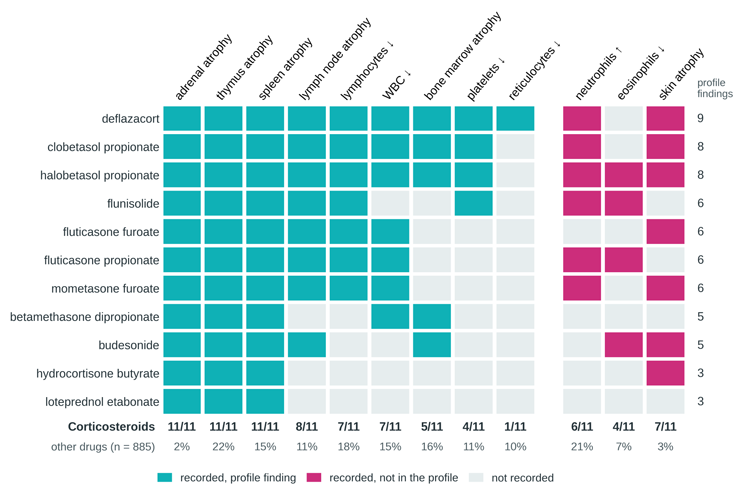
Figure 2. Recurring toxicity findings among corticosteroids. Recorded findings across pooled rat repeat-dose studies for the 11 corticosteroids included in the network. Gray cells indicate findings not recorded, rather than confirmed absent. White blood cells (WBC); ↑ = increased; ↓ = decreased. Results are preliminary.
JAK inhibitors, HDAC inhibitors, and alkylating agents also carried the profile, through lymphoid, bone marrow, and blood-count findings. They rarely had adrenal atrophy (4 of 18 drugs, versus 11 of 11 corticosteroids), increased neutrophils (4 of 18 versus 6 of 11), or skin atrophy (1 of 18 versus 7 of 11). These accompanying findings distinguished the corticosteroids.
The value of our approach is not that these effects are newly discovered. Rather, it is that their recurrence can be assembled into an explicit starting point for study planning. Before selecting the study package, investigators can document the expected findings and the conditions under which earlier compounds produced them. Route, formulation, selectivity, and exposure determine which precedents are relevant. Study planning must also consider which findings are relevant to human safety. Distinguishing species-specific responses from potential human risks can help focus testing, while retaining the ability to detect clinically relevant effects.

Use The Earlier Studies To Choose Informative Measures
A recurring profile identifies likely effects. The regulatory review documents help determine which questions those effects raise for the next compound.
The review of deflazacort illustrates why recovery deserves attention even when the findings are familiar. In its 26-week adult rat study, most drug-related effects were partially or fully reversible after a four-week recovery period, although skin lesions persisted in some recovery animals. In the juvenile study, no drug-related microscopic changes were observed in high-dose recovery animals after eight weeks. Yet reduced body weight and several functional and bone measures persisted. Recovery of the histological changes alone did not establish recovery of the whole animal.¹
The same drug development program for deflazacort shows why endpoint selection matters. In the 39-week monkey study, circulating lymphocyte subsets showed no drug-related changes, while a T-cell-dependent antibody response assay detected impaired immune function. Reduced antibody responses persisted during recovery.¹ For a new compound with an expected immune profile, prior evidence could therefore support including a functional measure alongside routine blood tests or more sensitive analyses such as flow cytometry.
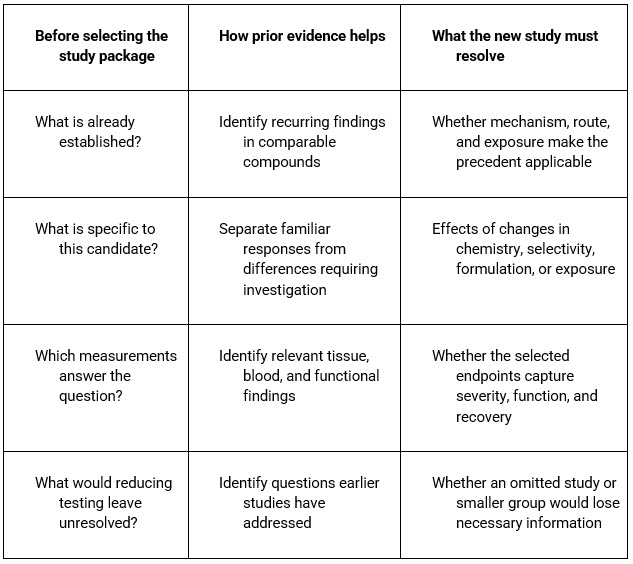
A useful planning exercise is to separate questions already addressed by comparable compounds from those that remain specific to the candidate. For a corticosteroid, an expected adrenal and lymphoid response may direct attention toward exposure dependence, immune function, or persistence after dosing. The study should also retain observations that could reveal a different response or a potential for an improved risk-to-benefit ratio. This makes the purpose of each endpoint explicit and gives the team a basis for comparing alternative designs. The aim is to obtain the information needed to interpret the candidate’s safety, with animal use tied to the questions the experiment must answer.
In a study of ZK 216348, a selective glucocorticoid receptor agonist, cell-based assays showed a preference for suppressing inflammatory signaling (transrepression) over activating gene expression (transactivation). In animal studies, the compound retained anti-inflammatory activity comparable to prednisolone, with less elevation of blood glucose, less spleen involution, and a smaller reduction in skin atrophy. Suppression of adrenocorticotropic hormone, an effect linked to transrepression, remained similar to prednisolone.² The example illustrates how components of a familiar toxicity profile can diverge and how targeted assays may help investigate those differences. Using such assays to replace an animal endpoint requires evidence that they answer the relevant safety question.
Keep Looking For Departures From The Class
Knowing the expected profile should sharpen attention to findings that need another explanation. A new corticosteroid may reproduce familiar adrenal and lymphoid effects while also producing kidney or biliary changes. The same holds for ADCs: About 70% of the adverse tissue findings reported for them in rats (73 of 104) fell outside the reproductive-organ profile.
Fluticasone furoate’s review made this distinction explicitly. The reviewer did not require a no-observed-adverse-effect level (NOAEL) for typical glucocorticoid effects, citing extensive clinical experience and the ability to monitor them. Atypical findings received separate evaluation using historical controls, pathology review, route relevance, and exposure margins.³ This illustrates why expected pharmacology and additional toxicity need distinct interpretation. Dose planning should consider the exposure needed to characterize those effects and how adversity will be assessed, rather than relying on administered dose alone.
That example shows how prior class knowledge can influence interpretation while preserving investigation of other effects. It also makes the design question more precise: Which parts of the expected response need characterization for this candidate, and which observations would challenge the comparison? Changes in selectivity, chemistry, formulation, or exposure can make the answer different even within a familiar class.
Turn Prior Knowledge Into A Specific Proposal
There are circumstances in which historical evidence can support doing less. In an early halobetasol review, the sponsor planned a 28-day minipig study to assess a new dermal formulation. The reviewer considered a nine-month study unnecessary, citing the long history of topical halobetasol use and experience with other potent topical steroids. Similar strategies had been accepted for other topical corticosteroids.⁴ Prior evidence for both the ingredient and the class helped define what additional testing the formulation required.
The principle also appears in the FDA’s May 2026 draft oncology guidance, which proposes streamlined testing for certain antibody-drug conjugates with well-characterized cytotoxic payloads. Our analysis identified a recurring reproductive-organ profile among ADCs, including testicular and epididymal findings. Using that pattern in study planning requires considering the specific payload, together with the antibody target, linker, and exposure. Class toxicity information can contribute to the justification. The guidance remains draft.⁵
For an individual program, the proposal should explain what each study would add and why existing evidence is sufficient for any part being omitted. This could mean avoiding a redundant study, selecting more informative endpoints, or reconsidering recovery groups. Reducing group sizes requires its own assessment of the ability to detect and characterize effects. These are specific, science-based design decisions to discuss with regulators early, rather than a general exemption based on class membership.
Historical profiles have limits. These preliminary counts, from a database snapshot on Oct. 8, 2026, describe reporting across drugs, not incidence among animals; findings were pooled across studies, and an unrecorded finding is not confirmed absent. Public reviews also provide incomplete coverage of failed programs. Those limits matter when judging how much confidence to place in a precedent.
Even so, decades of toxicology studies contain information that can be used before the next experiment begins. Recurring profiles organize what we expect. Study details explain what remains to be learned. Bringing both into study planning gives us a practical basis for asking whether each use of animals will provide information needed for the next safety decision.
References
- FDA. Deflazacort pharmacology/toxicology reviews, NDAs 208684 and 208685. https://www.accessdata.fda.gov/drugsatfda_docs/nda/2017/208684%2C208685Orig1s000
PharmR.pdf. Hawver review pp. 49, 93, 105, 110–111 (PDF pp. 68, 112, 124, 129–130); supervisory review p. 9 (PDF p. 12). - Schäcke H, et al. Dissociation of transactivation from transrepression by a selective glucocorticoid receptor agonist leads to separation of therapeutic effects from side effects. PNAS. 2004;101:227–232. https://doi.org/10.1073/pnas.0300372101.
- FDA. Fluticasone furoate pharmacology/toxicology reviews, NDA 22-051. https://www.accessdata.fda.gov/drugsatfda_docs/nda/2007/022051s000_PharmR.pdf. Supervisory review, PDF pp. 2–3; primary review executive summary, PDF pp. 8–9, and p. 38 (PDF p. 43).
- FDA. Halobetasol propionate lotion pharmacology/toxicology reviews, NDA 208183. https://www.accessdata.fda.gov/drugsatfda_docs/nda/2015/208183Orig1s000PharmR.pdf. Final review p. 3 (PDF p. 7); early IND review p. 9 (PDF p. 74); August 7, 2014 memorandum p. 18 (PDF p. 43), carcinogenicity waiver decision.
- FDA. Oncology Pharmaceuticals: Streamlined Nonclinical Safety Studies for Biologics and Conjugated Products. Draft guidance, May 2026. https://www.fda.gov/media/192723/download. Sections III.A–B. Status checked September 30, 2026.
About The Author
 Sara Selitsky, Ph.D., is founder and CEO of FlashPath, a company connecting preclinical, regulatory, clinical, and post-market evidence to advance drug safety research. She has more than 15 years of experience in computational biology, genomics, and machine learning, focusing on integrating and harmonizing diverse data sources to generate insights for drug development. Previously, she founded QuantBio, which Tempus AI acquired, and served as director of translational research at Tempus. She earned her doctorate in computational biology at the University of North Carolina at Chapel Hill, where she later served as an assistant professor. She has authored more than 40 publications.