
Potency Is Not An Exposure Strategy
By Mahmoud Khatib Al-Ruweidi

Potency is measured in an assay; exposure is achieved in an organism. Confusing the two is a category error that still shapes hit selection. A compound may bind its target at nanomolar concentration and remain pharmacologically implausible because it does not dissolve, cross the relevant barrier, survive clearance, or sustain sufficient unbound concentration at a feasible dose. In that case, potency describes what the molecule can do under protected experimental conditions, not what a patient can receive.
Drug metabolism and pharmacokinetics (DMPK) screening has already changed attrition. Poor pharmacokinetics (PK) is no longer reported as the dominant cause of clinical failure that it once was, although compound properties continue to influence failures assigned to efficacy and safety.1,2 This should not be read as evidence that absorption, distribution, metabolism, and excretion (ADME) has been solved. It is evidence that earlier measurement works. The remaining question is how early the logic of exposure should enter the decision.
It should enter before a chemical series wins. PK tractability is the probability that a scaffold can deliver the required human exposure through realistic medicinal chemistry, without an implausible dose, heroic formulation, or a vanishing safety margin. Treating tractability as a hit-stage property changes ADME from a downstream repair service into a method for choosing where chemistry should begin.3
What Exposure Actually Means
The useful starting point is not an assay menu but an exposure hypothesis. The team should state the intended route, target tissue, relevant unbound concentration, duration of coverage, plausible dosing frequency, and margin over off-target pharmacology. Total plasma area under the curve is rarely an adequate surrogate for all of these. In many programs, unbound concentration at the site of action provides the more defensible bridge between in vitro potency and in vivo pharmacology.4
This immediately changes what deserves early measurement. A central nervous system program may need unbound brain-to-plasma partitioning and an efflux assessment before broad metabolic profiling. An oral anti-infective may care more about absorption and time above a microbiological threshold. A short half-life may defeat continuous target coverage but remain acceptable when target engagement is durable or the mechanism is irreversible. Solubility that is manageable at 2 mg may be prohibitive at 500 mg. None of these judgments can be made from a universal cutoff alone.
The exposure hypothesis therefore has to be written before the data are reviewed. Its purpose is to define the required concentration time profile, name the physiological process most likely to prevent it, and establish what result would change the next chemistry decision. An assay that resolves none of those questions has little claim on scarce compound or project time.
The Problem With Choosing A Single Hit
Hit-stage measurements are noisy, and the most attractive member of a chemotype can be an exception. Selecting that molecule without understanding its neighbors turns an outlier into a strategy. Several confirmed analogs should be profiled per series, with replicate information preserved and property distributions shown. The question is not whether one compound has acceptable solubility or clearance; it is whether the series contains an interpretable route toward both potency and exposure.
That route becomes visible through relationships between structure and property. Changes in substitution, ionization, or lipophilicity should produce coherent changes in solubility, permeability, clearance, or binding. A single metabolic soft spot that responds to a modest structural change is a liability with a plausible repair. Recurrent low solubility, high clearance, and nonspecific binding across distinct analogs points to something more serious: the binding mode may be demanding physicochemical properties that the exposure hypothesis cannot tolerate.
This is why series selection should include headroom, not just a starting value. A series close to the desired profile but moving in the wrong direction may be less tractable than a weaker series whose potency improves without increasing lipophilicity or molecular size. The latter contains a path. The former contains a number.
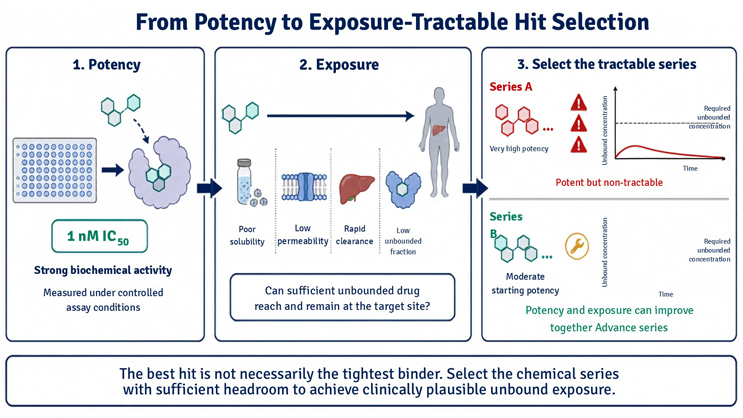
Figure 1. From biochemical potency to exposure-tractable hit-series selection. Biochemical potency establishes target activity under controlled assay conditions but does not demonstrate that sufficient unbound drug concentrations can be achieved at the site of action. Early evaluation of solubility, permeability, systemic clearance, and plasma protein binding identifies the principal barriers separating in vitro activity from in vivo exposure. A highly potent series may therefore remain pharmacologically non-tractable when its concentration time profile fails to exceed the required unbound target site threshold. By contrast, a less potent starting series may be preferable when medicinal chemistry can improve potency and disposition together. Hit selection should therefore prioritize a credible path to clinically plausible unbound exposure rather than the lowest IC₅₀ alone.
Order Assays Around The Failure Mechanism
Before asking whether a hit can be exposed, establish that it is real. Identity, purity, concentration, and chemical stability should be verified, activity reproduced in an orthogonal assay, and suspicious behavior challenged with mechanism-appropriate controls. Pan-assay interference alerts and aggregation predictions are prompts for experiments, not automatic rejection rules. Colloids, reactive compounds, fluorescence interference, and redox cycling can generate persuasive structure-activity relationships around a signal that has no productive mechanism.5,6 No ADME campaign can rescue an artifact.
Once the signal survives, the next measurements should locate the physical barrier to exposure. pKa, logD, and solubility across decision-relevant pH conditions help distinguish ionization from hydrophobicity, but kinetic solubility should not be mistaken for equilibrium solubility of a defined solid form. Passive permeability can be sufficient for an initial question; Caco-2 or an appropriate MDCK system becomes more informative when active transport or efflux may determine absorption or tissue entry. The interpretation must remain joined to dose and free concentration. A low value without that context is a descriptor, not a decision.
Disposition studies should then test the mechanism suggested by the chemistry and the intended tissue. Human liver microsomes provide a rapid view of oxidative stability, whereas intact hepatocytes become important when uptake, Phase II metabolism, or a broader enzyme complement may control clearance. Plasma binding and, where necessary, blood-to-plasma partitioning need methods that remain reliable at very low unbound fractions. Transporter studies should follow a credible clearance or distribution hypothesis. Both the International Transporter Consortium and the Extended Clearance Classification System are useful because they organize mechanisms; neither implies that every transporter assay belongs in every hit cascade.7,8
Physicochemical rules play a similar limited role. Lipinski and Veber descriptors identify regions in which oral absorption often becomes more difficult, while analyses of successful candidates show the development cost of uncontrolled molecular weight and lipophilicity.9–11 These are risk signposts, not biological laws. A beyond-rule-of-five molecule requires evidence appropriate to its chemical space and route; it does not become exempt from the requirement to explain exposure.
Potency should also be read beside ligand efficiency and lipophilic efficiency so that affinity gained through molecular inflation does not appear free.12,13 The metrics have mathematical limitations and should not be collapsed into a new master score. Their value is diagnostic. When an analog gains potency, the team should ask what it paid in lipophilicity, solubility, clearance, and off-target risk. Displaying those properties separately often reveals a trade that a weighted ranking conceals.

A Prediction Should Reveal What Is Unknown
In vitro–in vivo extrapolation and physiologically based PK models can connect clearance, binding, permeability, and physiology to a plausible human concentration time profile.14 At hit stage, their purpose is not to produce a precise human dose from immature data. It is to identify the assumption on which the decision depends. If a twofold change in intrinsic clearance reverses the conclusion while a tenfold change in permeability does not, the next experiment is clear.
This requires ranges, not a solitary prediction. Teams should report the exposure obtained under explicit low, central, and high assumptions; identify which inputs dominate the range; and ask whether any realistic scenario satisfies the exposure hypothesis. A model is useful when it converts uncertainty into an experiment. It is misleading when numerical detail hides the weakness of its inputs.
The same standard applies to machine learning ADME models. Random cross validation can look persuasive when close analogs occur in both training and test sets, even though that split poorly represents the next chemical series. Time-split and scaffold-aware validation provide a harder, more prospective test.15 Applicability domain, endpoint definition, assay provenance, calibration, and uncertainty should accompany the prediction. Artificial intelligence can rank compounds and concentrate experimental effort, but it cannot repair inconsistent source data or infer an in vivo endpoint that the training data do not contain.16
The Real Selection Criterion
The strongest objection to early ADME is that uncertain measurements can eliminate chemistry that would have become viable through optimization. That objection is correct when early screening is treated as a rigid filter. It does not justify postponing exposure reasoning. Results capable of reversing series selection deserve repeat or orthogonal confirmation, and a liability with a mechanistic route to correction may justify a bounded chemistry cycle. A series that would require simultaneous rescue of solubility, permeability, and clearance does not deserve the same presumption.
Those judgments are more reliable when the evidentiary threshold is stated before the most potent compounds are discussed. The team needs to know what result would reverse an interpretation, how much rescue would matter, and what finding would end further work. Assays with no near-term decision role can remain later. P-glycoprotein or breast cancer resistance protein studies move forward when intestinal efflux or tissue penetration matters. Cytochrome P450 phenotyping or inhibition moves forward when projected exposure, metabolic route, chemical structure, or co-medication creates a credible interaction risk. ICH M12 defines the development framework that the later evidence must support; it need not become an indiscriminate hit-stage panel.17
Maintaining at least two chemically and mechanistically distinct series protects this judgment. When only one series remains, every adverse result threatens the program, and evidence becomes easier to rationalize. Parallel series preserve a genuine comparison between potency, exposure, and the amount of chemistry required to reconcile them.
The selection standard is therefore not an acceptable ADME profile at one moment. It is the presence of enough chemical and physiological headroom to reach the exposure hypothesis. The best hit is not necessarily the tightest binder in the plate. It is the series in which potency and disposition can improve together, while the uncertainty that separates an assay result from a human dose can still be reduced by decisive experiments.
References
- Kola I, Landis J. Can the pharmaceutical industry reduce attrition rates? Nature Reviews Drug Discovery. 2004;3(8):711–716. https://doi.org/10.1038/nrd1470.
- Waring MJ, Arrowsmith J, Leach AR, et al. An analysis of the attrition of drug candidates from four major pharmaceutical companies. Nature Reviews Drug Discovery. 2015;14(7):475–486. https://doi.org/10.1038/nrd4609.
- Ballard P, Brassil P, Bui KH, et al. The right compound in the right assay at the right time: an integrated discovery DMPK strategy. Drug Metabolism Reviews. 2012;44(3):224–252. https://doi.org/10.3109/03602532.2012.691099.
- Smith DA, Di L, Kerns EH. The effect of plasma protein binding on in vivo efficacy: misconceptions in drug discovery. Nature Reviews Drug Discovery. 2010;9(12):929–939. https://doi.org/10.1038/nrd3287.
- Baell JB, Holloway GA. New substructure filters for removal of pan-assay interference compounds (PAINS) from screening libraries and for their exclusion in bioassays. Journal of Medicinal Chemistry. 2010;53(7):2719–2740. https://doi.org/10.1021/jm901137j.
- Reker D, Bernardes GJL, Rodrigues T. Computational advances in combating colloidal aggregation in drug discovery. Nature Chemistry. 2019;11(5):402–418. https://doi.org/10.1038/s41557-019-0234-9.
- International Transporter Consortium. Membrane transporters in drug development. Nature Reviews Drug Discovery. 2010;9(3):215–236. https://doi.org/10.1038/nrd3028.
- Varma MVS, Steyn SJ, Allerton C, El-Kattan AF. Predicting clearance mechanism in drug discovery: Extended Clearance Classification System (ECCS). Pharmaceutical Research. 2015;32(12):3785–3802. https://doi.org/10.1007/s11095-015-1749-4.
- Lipinski CA, Lombardo F, Dominy BW, Feeney PJ. Experimental and computational approaches to estimate solubility and permeability in drug discovery and development settings. Advanced Drug Delivery Reviews. 2001;46(1–3):3–26. https://doi.org/10.1016/S0169-409X(00)00129-0.
- Veber DF, Johnson SR, Cheng HY, Smith BR, Ward KW, Kopple KD. Molecular properties that influence the oral bioavailability of drug candidates. Journal of Medicinal Chemistry. 2002;45(12):2615–2623. https://doi.org/10.1021/jm020017n.
- Leeson PD, Springthorpe B. The influence of drug-like concepts on decision-making in medicinal chemistry. Nature Reviews Drug Discovery. 2007;6(11):881–890. https://doi.org/10.1038/nrd2445.
- Hopkins AL, Keserü GM, Leeson PD, Rees DC, Reynolds CH. The role of ligand efficiency metrics in drug discovery. Nature Reviews Drug Discovery. 2014;13(2):105–121. https://doi.org/10.1038/nrd4163.
- Johnson TW, Gallego RA, Edwards MP. Lipophilic efficiency as an important metric in drug design. Journal of Medicinal Chemistry. 2018;61(15):6401–6420. https://doi.org/10.1021/acs.jmedchem.8b00077.
- Rostami-Hodjegan A. Physiologically based pharmacokinetics joined with in vitro-in vivo extrapolation of ADME: a marriage under the arch of systems pharmacology. Clinical Pharmacology & Therapeutics. 2012;92(1):50–61. https://doi.org/10.1038/clpt.2012.65.
- Sheridan RP. Time-split cross-validation as a method for estimating the goodness of prospective prediction. Journal of Chemical Information and Modeling. 2013;53(4):783–790. https://doi.org/10.1021/ci400084k.
- Bender A, Cortés-Ciriano I. Artificial intelligence in drug discovery: what is realistic, what are illusions? Part 1: Ways to make an impact, and why we are not there yet. Drug Discovery Today. 2021;26(2):511–524. https://doi.org/10.1016/j.drudis.2020.12.009.
- International Council for Harmonisation. ICH M12: Drug Interaction Studies. Final guideline. 2024. https://database.ich.org/sites/default/files/ICH_M12_Step4_Guideline_2024_0521.pdf.
About The Author
 Mahmoud K. Al-Ruweidi is a pharmaceutics specialist with expertise in rational drug design, discovery, and delivery. Trained as a biomedical engineer, his research spans formulation science and bioengineering approaches to medicine. He has worked across biochemistry, medical devices, and biomaterials, applying interdisciplinary methods to accelerate therapeutic innovation. Beyond the lab, he is an advocate for improving academic systems to better support young scientists and safeguard research integrity.