
New Enzyme Tied to Tangles in Alzheimer's Disease
Affecting an estimated 4 million people nationwide, Alzheimer's disease is the most common cause of dementia in older people. The disease disrupts memory, thought, and language in the brain by damaging synapses and killing nerve cells. Abnormal clumps called plaques and tangled bundles of fibers are the two major hallmarks of Alzheimer's. Scientists do not know exactly how these changes relate to the loss of nerve cells and brain atrophy. Plaques can occur in the brain without much change in brain function, but tangles appear to be more directly associated with dementia. Pin1 may play a role in the formation—or prevention—of tangles.
The neurofibrillary tangles in Alzheimer's occur inside individual nerve cells. The tangles are largely composed of a long protein dubbed "tau." Normally, tau's job is assembling and maintaining the microtubules that stretch from one end of the nerve cell to the other. Microtubules keep the long nerve axons healthy from the muscle to the brain by transporting cell nourishment and structural components.
Tau can be derailed from a microtubule when too many phosphates leap on board the tau and change tau's shape. The distorted tau cannot maintain the microtubules. The microtubules fall apart, infering with a nerve's crucial function of transmitting signals. Clogging up the works even further, the distorted tau proteins then tangle together.
"There's a lot of evidence over the last two years that shape changes in tau can be lethal to nerve cells and are important in neuronal degeneration in Alzheimer's," says author Peter Davies, Resnick Professor of Alzheimer's Disease Research at Albert Einstein College of Medicine. "Pin1 is the first molecule known to change the shape of tau."
According to the new study, Pin1 may restore the function of tau. In a test tube, Davies and coworkers added Pin1 to a solution containing both the building blocks of the microtubules and the tau protein misshapen by its attached phosphates. Within 10 minutes, Pin1 had rehabilitated the tau proteins so that the tau, in turn, could assemble long thread-like microtubules.
Unfortunately, nerve cells seem to have a limited capacity to produce enough Pin1 to keep up with phosphate additions to the tau protein. In the brains of patients with Alzheimer's disease, Pin1 is apparently depleted by working overtime to keep fixing tau. For this study, the researchers compared tissue samples from brains of people who had died from Alzheimer's disease to those who had died from other causes. Using different methods, both researchers found Pin1 available and ready for action in normal nerve cells. But in nerve cells of Alzheimer's, most of the available Pin1 was depleted from its usual reservoirs in cells and instead bound up in the tangles with the tau-phosphate molecules.
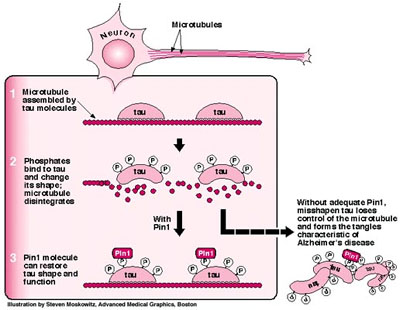
Ultimately, the researchers have yet to determine whether Pin1, or lack of available Pin1, leads to tangle formation. Depletion of Pin1 itself may be yet another mechanism leading to nerve death in Alzheimer's, where the Pin1 is tied up in the tangles. In other cell types, earlier studies by Lu found Pin1 depletion alone was enough to kill the cells.
Several drug companies are experimenting with substances that block phosphates from attaching to tau, but this study offers an alternative way to achieve the same function, says Michel Goedert of the MRC Laboratory of Molecular Biology (Cambridge, UK), who wrote an accompanying commentary for Nature. "The most important observation is the experiment that shows that when Pin1 is added to phosphorylated tau in the test tube, tau is able to fulfill its normal function," he says. However, Goedert cautions that scientists are a long way from showing the therapeutic benefits.
For more information: Peter Davies, Forcheimer Bldg., Room 526, Albert Einstein College of Medicine, 1300 Morris Park Ave., Bronx, NY 10461. Tel: 718 430-3083. Email: davies@aecom.yu.edu.