
How AI-Powered Automation Is Redefining Pharmaceutical R&D
By Anitha Ramu, Senior Analyst, Pharma R&D, Beroe Inc.
Historically, the process of finding new drugs has been risky, costly, and time consuming. It can cost more than $2 billion and take 10 to 15 years to develop a new treatment.1 AI-powered predictive analytics aid in detecting how molecules in compounds interact with biological targets, which speeds up the process of determining which compounds are most likely to be effective in treating medical diseases. The next era of pharmaceutical manufacturing will be founded on digital maturity, not as a differentiator, but as the fundamental foundation upon which competitiveness is predicated.2 Early adopters of AI are already benefiting from quicker decision-making and less operational friction.
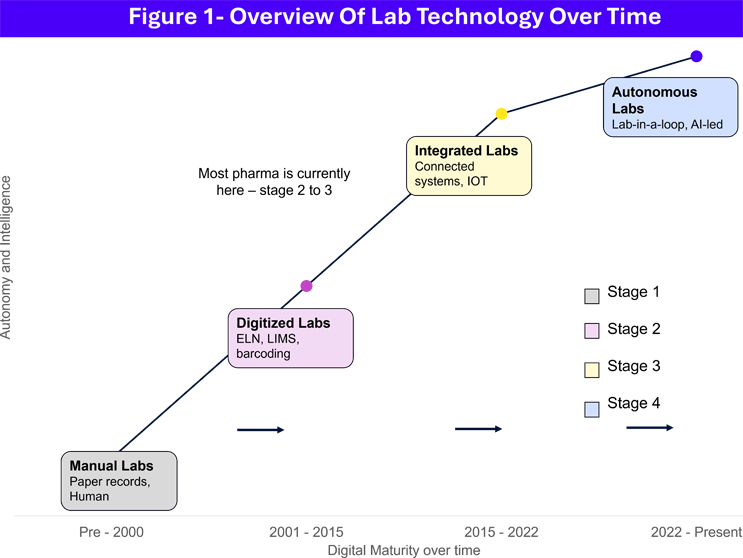
Pharma companies are progressively transitioning from lab of the future (digitized labs) to lab-in-a-loop (autonomous labs) as part of their broader digital transformation strategy as shown in Figure 1. The evolution of pharmaceutical labs follows a four-stage maturity curve. The manual lab (pre-2000s) relied on paper records, human-led operations, and largely siloed knowledge.
Electronic lab notebooks (ELNs), LIMS, and barcode tracking were introduced in the digitized lab (2000–2015), which improved data capturing but did not yet significantly connect systems.3 The integrated lab (2015–2022) brought IoT-enabled instruments, cloud connectivity, and cross-system data flows, enabling real-time monitoring and analytics.
Source: Beroe Analysis based on information available on PubMed4
Today's frontier is the autonomous lab-in-a-loop, where AI continuously produces hypotheses, orders robotic systems to execute tests, interprets results, and designs the next round of experiments with no human interaction between cycles.
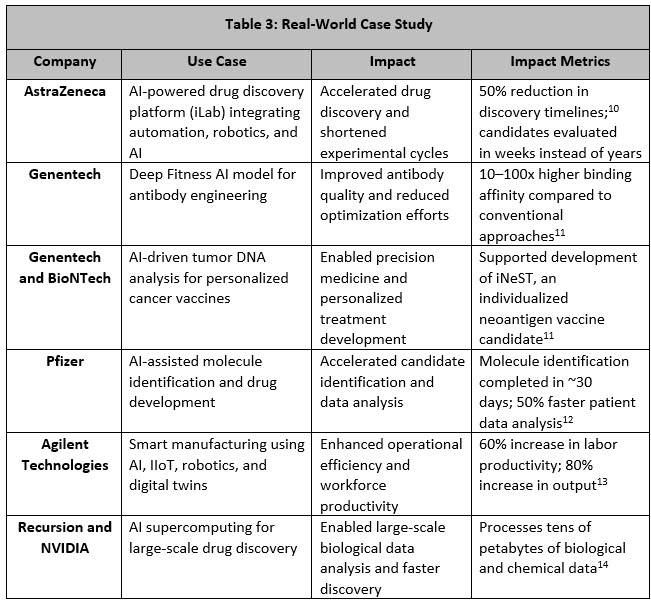
Only a few major pharmaceutical companies, including Genentech, AstraZeneca's iLab, and Recursion, have significantly advanced to stage four. Most of these companies presently function between stages two and three.4 These cohorts' competitive divide is growing quickly.
AI is fundamentally based on algorithms that train models to perform tasks. These algorithms fall into two general categories: supervised learning and unsupervised learning.1 AI systems are trained using labeled data sets in supervised learning, where each data point is linked to a known output. By decreasing the discrepancy between its predictions and the actual labels, the algorithm learns to map inputs to outputs. In contrast to supervised learning, unsupervised learning method uses unlabeled data and aims to find relationships, patterns, or structures without any predetermined output labels.5 Combining these two AI models makes automation more adaptive.
Regulators are demanding traceability, explainability, and human accountability at every level, yet they are not impeding the deployment of AI. As a result, organizations that establish effective AI governance frameworks from the outset will enjoy a significant compliance advantage.6
Pharmaceutical research and development facilities today are at a digital crossroads. There is genuine and increasing impetus to modernize, from cloud-based analytics to robotic operations and AI-powered discovery. Simultaneously, the industry is dealing with a more serious systemic problem: while data generation has increased dramatically, R&D efficiency, as determined by the number of new pharmaceuticals approved for every dollar spent, has been progressively declining. Here, lab automation is essential not only as a tool for efficiency but also as a basis for generating high-quality data that can support quicker and more accurate scientific judgments.
Lab Automation Across Pharma R&D
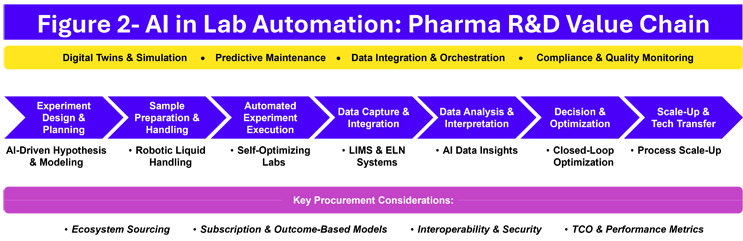
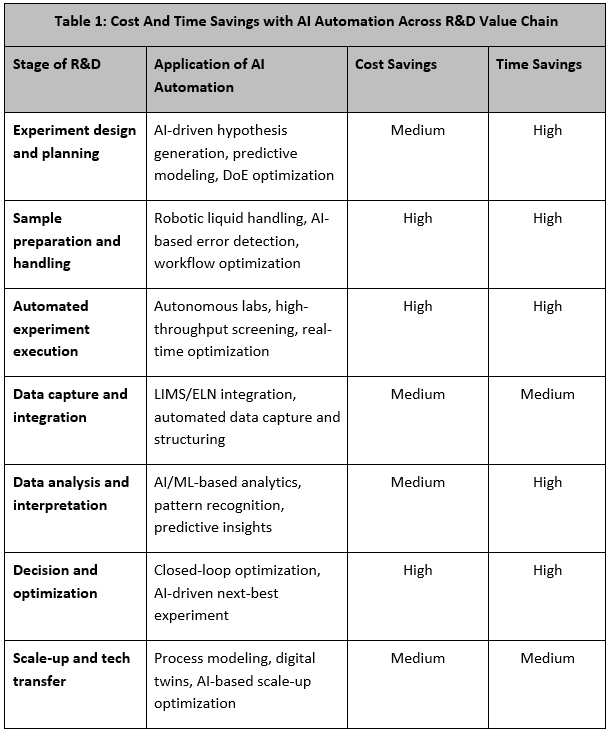
At its core, pharma drug discovery is broken into several stages — target identification, lead generation, preclinical testing, clinical trials, and manufacturing. AI and lab automation can intervene at every one of these stages by compressing timelines, reducing failure rates, or cutting direct costs,1 which is summarized in Table 1. Figure 2 depicts the application of AI across the different stages of pharmaceutical drug development.
Source: Image generated based on Beroe analysis
Source: Beroe Analysis1,7
Cost Savings With AI In Lab Automation
Accelerating timelines translates directly to cost savings. The financial value of each day spared in clinical development is substantial; sponsors incur an estimated $600,000 to $8 million in lost revenue opportunity each day due to delayed market entry.8 Pharma companies might generate an additional $254 billion in annual operational profits worldwide by 2030, assuming a high degree of industrialization of AI use cases, with operations accounting for 39% of the benefit and R&D for 26%.9 Sample preparation, QC automation, and predictive maintenance are the major cost impact areas and companies are employing automation to bring down these costs as shown in Table 2.
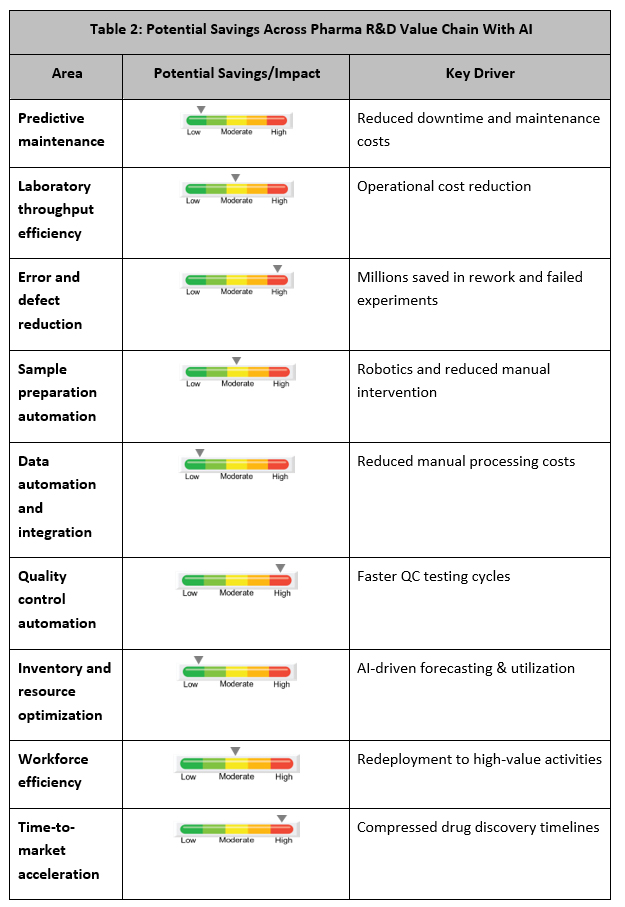
Source: Beroe Analysis7,9
The majority of the big pharmaceutical companies are collaborating with NVIDIA for the following reasons:
- NVIDIA holds an estimated 70%–90% share of the high-performance GPU market necessary for carrying out parallel workloads like protein structure prediction, molecular dynamics simulation, and training foundation models on genomic data.4
- NVIDIA offers BioNeMo, an open-source machine learning framework for building and training models for biopharma.

In short, NVIDIA offers three things pharma desperately needs for automation — the world's best parallel computing hardware, a purpose-built drug discovery software stack, and skilled professionals.
Major Challenges in AI Lab Automation For Pharma
AI lab automation in the pharmaceutical industry faces genuine multifaceted problems that cannot be resolved by technology alone. Legacy infrastructure, cultural opposition, data quality, skills shortages, and regulatory compliance all exacerbate one another rather than existing independently. These challenges are summarized in Figure 3.
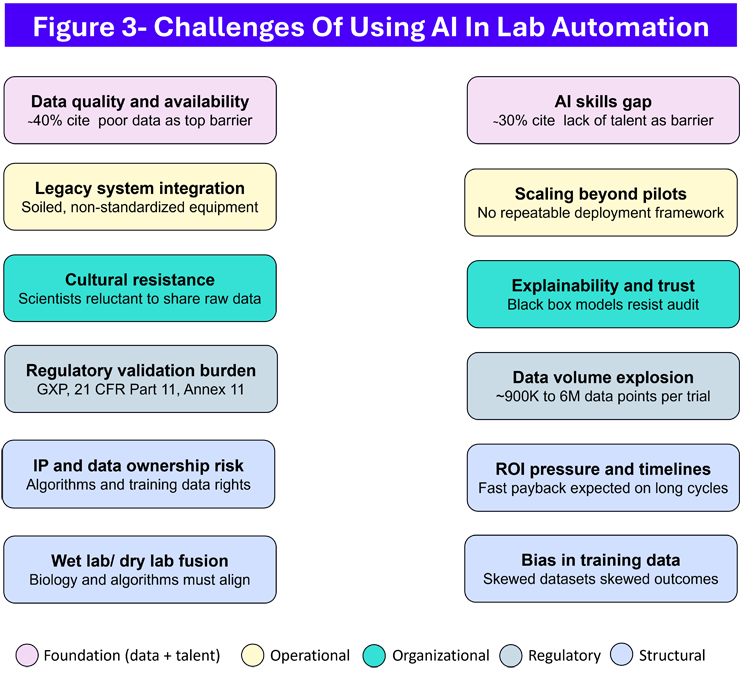
Source: Beroe Analysis based on information available on secondary sources Lab automation in pharma: Turn complexity into progress15
The Pistoia Alliance's 2024 Lab of the Future survey found that low-quality and poorly curated data sets are now the number one barrier to AI implementation, cited by 52% of respondents. The need for qualified experts to develop, implement, manage, and run AI systems frequently outpaces the supply.5,16
Companies must invest in FAIR-compliant data infrastructure before scaling AI tools. Federated learning frameworks, which are already gaining popularity in oncology genomics consortia, enable rivals to train common models across proprietary data sets without disclosing underlying data.13
Precompetitive infrastructure and common data standards, which lower interoperability costs for all parties involved, are being developed by industry-wide projects, like the Innovative Medicines Initiative and the Pistoia Alliance. Additionally, collaborations with tech companies like NVIDIA, Microsoft, and AWS provide pharmaceutical companies with access to processing power and AI technical expertise that would be too costly to develop on their own.
Conclusion
Artificial intelligence has become indispensable to pharmaceutical innovation as the pharmaceutical industry undergoes a paradigm shift toward digital transformation. The autonomous lab is not a distant aspiration but a present-day competitive differentiator, as evidenced by companies such as Genentech, AstraZeneca, Pfizer, Novartis, and Recursion.10,12
Procurement teams must transition from cost-focused sourcing to strategic orchestrators of technology, data, and partnerships as laboratories transform into intelligent, autonomous ecosystems. Businesses that incorporate AI-driven automation into their procurement strategy at this time will not only reduce expenses but also gain a long-term competitive advantage through faster innovation cycles, increased operational effectiveness, and scientific results that are unmatched by conventional methods.
Procurement takeaway: The procurement function has a unique and time-sensitive opportunity to play a strategic role in this transition rather than simply purchasing equipment. This entails shifting from one-time vendor evaluations to ongoing life cycle audits, from unit-price negotiations to platform evaluation and from hardware specifications to data governance standards.
References
- AshfaqUr RehmanMingyu Li, Binjian Wu, Yasir Ali, Salman Rasheed, Sana Shaheen, Xinyi Liu, Jian Zhang “Role of artificial intelligence in revolutionizing drug discovery” Fundamental Research, May 2025.
- “Lab Manager: Investigating the Future of Lab Automation and Digitalization - Scott D. Hanton” July 2025. [Online] Available: https://www.labmanager.com/investigating-the-future-of-lab-automation-and-digitalization-34137
- “Lab Manager: AI and Automation: Preparing Your Lab for the Next Stage - Holden Galusha.” Oct 2025. [Online] Available: https://www.labmanager.com/ai-and-automation-preparing-your-lab-for-the-next-stage-34464
- Mahendiran Dharmasivam, Busra Kaya, Adedoyin Akinware, Mahan Gholam Azad, Des R. Richardson “Leading artificial intelligence—driven drug discovery platforms: 2025 landscape and global outlook”. Pharmacological Reviews, November 2025.
- “SCW.Ai: AI in Pharma, Use cases, success stories and challenges.” January 2025. [Online] Available: https://scw.ai/blog/ai-in-pharma/
- “Emorphis Health: How AI in Pharmaceutical Manufacturing in 2026 Can Transform Your Operations” January 2025. [Online] Available: https://emorphis.health/blogs/ai-in-pharma-manufacturing-company/
- “Danaher Lifesciences: AI in the Pharmaceutical Industry”. [Online] Available: https://lifesciences.danaher.com/us/en/library/ai-in-pharmaceutical-industry.html
- Otis Johnson; inVentiv Health Clinical “Clinical Investigation: An evidence-based approach to conducting clinical trial feasibility assessments” Clinical Investigation, 2015.
- “Re-inventing Pharma with artificial intelligence – PwC 2024”. [Online] Available: https://www.strategyand.pwc.com/de/en/industries/pharma-life-sciences/re-inventing-pharma-with-artificial-intelligence.html
- “AstraZeneca iLab: The automated lab of the future”. [Online] Available: https://www.astrazeneca.com/r-d/our-technologies/ilab.html
- “Drug Discovery & Development: Genentech’s lab in the loop aims to tap the power of quantity for quality drug discovery” March 2025. [Online] Available: https://www.drugdiscoverytrends.com/genentech-ai-lab-in-the-loop-drug-discovery/
- “Pfizer: Data and AI are Helping to Get Medicines to Patients Faster”. [Online] Available: https://www.pfizer.com/sites/default/files/investors/financial_reports/annual_reports/2022/
story/data-and-ai-are-helping-to-get-medicines-to-patients-faster/ - “WEF: Global Lighthouse Network: Shaping the Next Chapter of the Fourth Industrial Revolution” January 2023. [Online]. Available: https://www3.weforum.org/docs/WEF_Global_Lighthouse_Network_2023.pdf
- “Recursion and Exscientia Enter Definitive Agreement to Create a Global Technology-Enabled Drug Discovery Leader with End-to-End Capabilities.” August 2024. [Online] Available: https://www.biospace.com/recursion-and-exscientia-enter-definitive-agreement-to-create-a-global-technology-enabled-drug-discovery-leader-with-end-to-end-capabilities
- “Zulhlke: Lab automation is complex, but essential: Why modern labs need to embrace digital change to progress” June 2025. [Online] Available: https://www.zuehlke.com/en/insights/lab-automation-in-pharma
- “The Pistoia Alliance: 2025 The Evolution of Labs Report.” September 2025. [Online] Available: https://pistoiaalliance.org/resource-library/lab-of-the-future-2025/
About The Author
 Anitha Ramu is a senior research analyst with over four years of experience in market research and consulting. She has supported global clients in supplier outsourcing, category management, and R&D strategy by conducting market sourcing studies, supplier assessments, and competitive analyses. She is passionate in transforming complex data into actionable recommendations and providing rapid strategic insights for both global and regional business needs.