
Datapoints Summit 2026 Highlights: Moving AI Closer To The Lab

By Ray Dogum, Chief Editor, Drug Discovery Online
Last week at the Datapoints Summit in Boston, MA, drug discovery researchers gathered to share their major AI advancements and challenges.
The discussions carried an undercurrent of impatience. Models are improving quickly, promising examples are accumulating, and scientists have more computational tools at their disposal than ever before.
Yet converting those advances into better drug candidates still depends on familiar constraints: the quality of the data, the relevance of the biological model, the judgment of the scientists using it, and the willingness of an organization to change how research gets done (and shared).
AI Agents Move Closer To The Bench
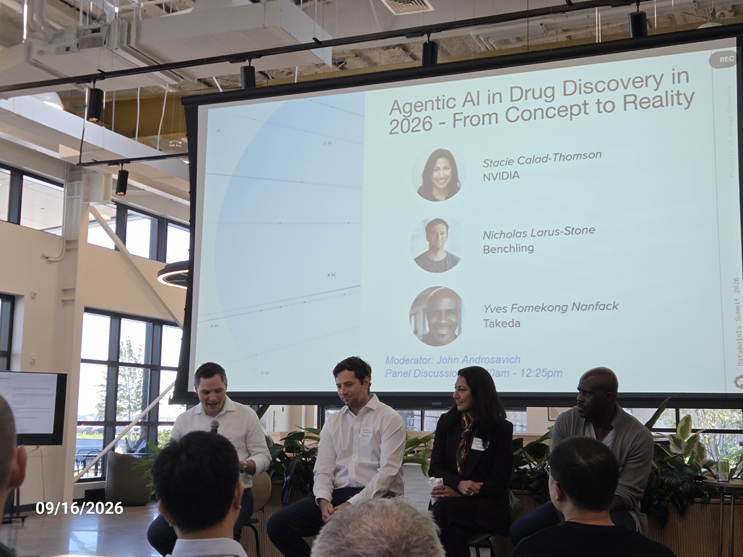
John Androsavich moderating panel on Agentic AI in Drug Discovery with Nicholas Larus-Stone, Stacie Calad-Thomson, and Yves Fomekong Nanfack.
During a panel on agentic AI, John Androsavich, general manager of Ginkgo Datapoints, spoke with Nicholas Larus-Stone, head of AI agents at Benchling; Yves Fomekong Nanfack, head of AI/ML research at Takeda; and Stacie Calad-Thomson, NVIDIA’s global business lead for pharma labs and manufacturing.
The panelists pointed to AI-native drug developers as early evidence that computational methods can reduce design-make-test-analyze cycles and the number of compounds researchers need to make. Inside established pharmaceutical companies, however, comparable technical capabilities must operate within larger organizations, complex governance structures, and portfolios containing many programs at different stages.
Nanfack, who is helping Takeda expand the use of AI across research, said the distinction lies partly in how companies organize themselves around the technology. When comparing pharma with companies like Recursion and Insilico Medicine, Nanfack admitted, “I don’t think it’s just that they were doing it better. There was something that was different. The mindset of those companies was really designed to be driven by AI, and big pharma is just getting into that now.”
For Nanfack, adoption involves changing more than the tools scientists use. He explained, “One of the things large pharma has to address is not just the adoption of the methods. It is change management in the way we are working. I think that is the difference between the companies that have been successful in achieving this kind of acceleration and bigger pharma.”
Agents could help close that gap by making computational capabilities available to project scientists without requiring them to become machine learning specialists. At Takeda, Nanfack described efforts to build agents around the way researchers evaluate targets, diseases, patient populations, and supporting evidence. That scientific scaffolding is critical because a general-purpose model working from public information is unlikely to possess the context needed to answer a specialized research question well.
Larus-Stone, made a similar point. Benchling stores proprietary experimental data, giving agents a way to retrieve information that may be missing from public training sets. He explained that, “If you put the model with a harness, and the agent goes and retrieves relevant context and puts that in front of the model, the quality of that response goes way, way up. This is something we’ve seen over and over again.”
That approach has begun to push agents into more consequential scientific work. Larus-Stone described a hypothesis-generation system that searched internal information, cross-referenced public data, consulted multiple frontier models, and brought the results together for scientists.
Larus-Stone, who has a computer science background and founded the Bits in Bio non-profit community, said, “It was actually able to create new ideas and experimental plans that scientists said, ‘Oh, wow, I didn’t think of that.’ These were experts who had been running the experiment for months or years, and the response was, ‘This is actually a good idea. Maybe I should go and do that.’”
The prospect is enticing, but Larus-Stone also warned against mistaking fluent answers for reliable science. In Benchling’s protocol-optimization benchmark, the best-performing LLM model achieved a score of roughly 59 percent, while most models scored in the 40s. So there is plenty of room for improvement.
He told the audience, “If you’re taking one thing away from today, I’d say start building benchmarks. If you work at a biotech or pharma company and you want to deploy AI, you should be doing this internally or working with someone who knows how.”
Virtual Biology Confronts Biological Complexity
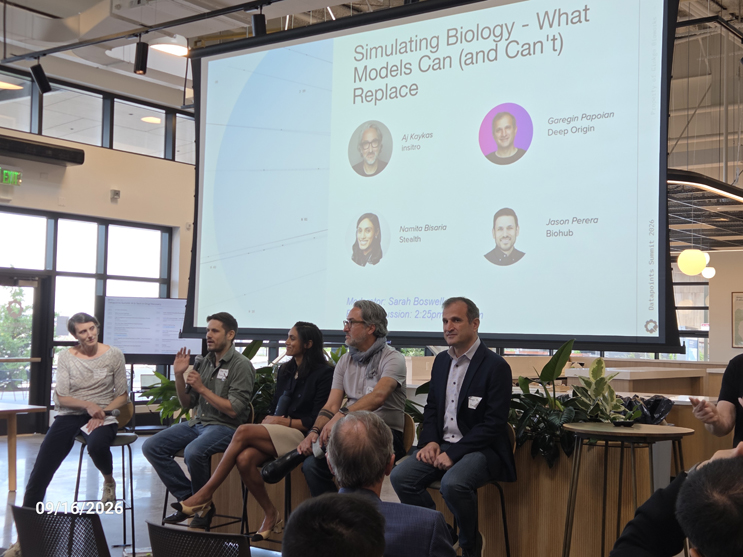
Sarah Boswell moderating panel on Simulating Biology with Jason Perera, Namita Bisaria, Aj Kaykas, and Garegin Papoian.
A panel moderated by Sarah Boswell, director of next-gen sequencing at Ginkgo, examined a more ambitious question: how much of biology can computational models eventually simulate or replace?
The discussion brought together Aj Kaykas, CXO and head of neuroscience at insitro; Garegin Papoian, chief scientific officer of Deep Origin; Namita Bisaria, founder and CEO of a stealth therapeutics company; and Jason Perera, senior manager for AI/ML at Biohub, a nonprofit launched by the Chan Zuckerberg Initiative.
Kaykas framed one of the central weaknesses of current systems, “Most of us want to predict things that are out of distribution [extrapolation] and predict things that are new.”
He argued that virtual-cell research remains fundamentally tied to data generation. Existing datasets do not capture enough biological diversity, cell states, perturbations, or measurable features to support a broadly predictive model. He reminded the crowd, “There are still many unknown unknowns. We don’t know things about a cell that we need to capture, and we’re not able to measure them. I think the hype is good because it’s pushing everybody to think more completely about what we need to capture, but it is further out than ten years, from what I’ve seen.”
Papoian described a complementary challenge. Physics-based simulations may offer mechanistic detail at molecular and cellular scales, while systems biology can encompass hundreds or thousands of interacting genes and proteins. Each loses some of the strengths of the other.
According to him, “What was missing was biological diversity. We would use five or ten proteins and model the cytoskeleton. Systems biology comes from the other side, where you have hundreds of proteins or thousands of genes, but there you start to lose physics. The challenge is how you combine the two.”
Bisaria brought the discussion back to therapeutic development. Her team can use models and available data to support early lead identification, but the harder work begins when a promising molecule must achieve potency, durability, safety, and suitable distribution in the body.
She explained, “These predictable pieces is only four months of our company. We’re done with that stage, and then the model is not useful for us anymore. We move to the harder, potentially more expensive part of drug development: making a potent and durable molecule that goes where we want it to go in the body.”
ADME Models Become Useful When They Get Local
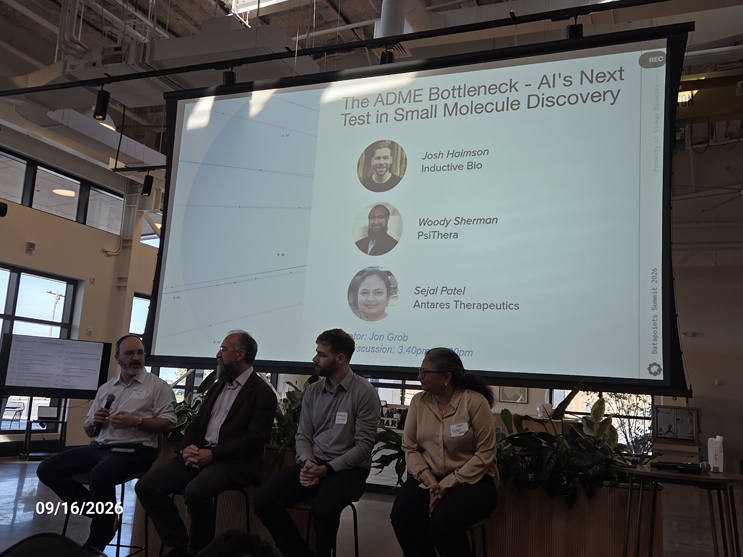
Jonathan Grob moderating a panel on ADME AI Testing in Small Molecule Discovery with Woody Sherman, Josh Haimson, and Sejal Patel.
The panel on ADME bottlenecks placed those questions in the daily work of selecting and optimizing small molecules. Jonathan Grob, VP of small molecules at Ginkgo moderated the discussion with Woody Sherman, cofounder and chief innovation officer of PsiThera; Josh Haimson, cofounder and CEO of Inductive Bio; and Sejal Patel, vice president of medicinal chemistry at Antares Therapeutics.
Sherman distinguished global models trained on broad chemical datasets from local models adapted to a project’s chemical series. For novel targets with little precedent, global models may struggle, but a few dozen project-specific data points can produce useful predictions and guide decisions. This shifts experimental design toward generating strategically informative data across hit series, not simply making compounds expected to deliver immediate gains.
Haimson stressed that local models still benefit from broad pretraining, which helps them adapt faster to unfamiliar chemical space. Models should be judged by whether they improve decisions, not whether they predict a perfect drug. He noted, “We make 3,000 molecules on average before we get to a drug. We don’t need the AI to spit out the perfect drug. If we can get that down to 300 molecules, that is a huge breakthrough.”
Sharing The Models Without Sharing The Data
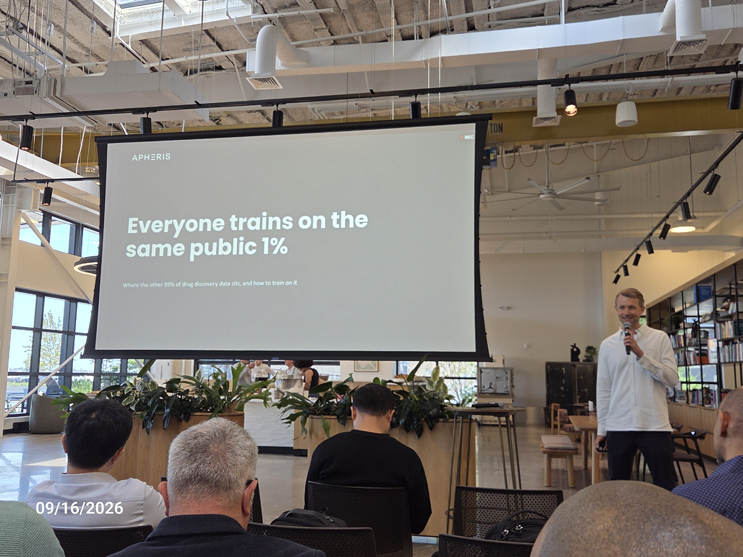
Robin Roehm presenting at the Datapoints Summit 2026.
Other presenters including Robin Roehm, CEO & co-founder of Apheris, and Jonathan Gilbert, Lilly TuneLab, demonstrated the utility of federated learning consortiums for big pharma and biotech. Roehm reminded us, “all models train on the same 1% of data that is public”. How do we responsibly leverage the 99% of private data to help make meaningful early-stage program decisions? Federating models are emerging as a viable option.
At the event, Ginkgo announced a new agreement with Lilly TuneLab, where Ginkgo will provide discovery data generation services to TuneLab companies.
It’s become more evident that AI can help scientists examine more hypotheses, choose experiments more deliberately, and concentrate resources on the compounds and programs most likely to advance. Those gains will accumulate through tighter connections among computational prediction, automation, data generation, and expert judgment.
However, drug discovery will never depend on a single technology. At the Datapoints Summit, AI looked most convincing when speakers treated it as part of the experimental process, subject to the same standards of evidence, validation, and iteration as the science it aims to improve.
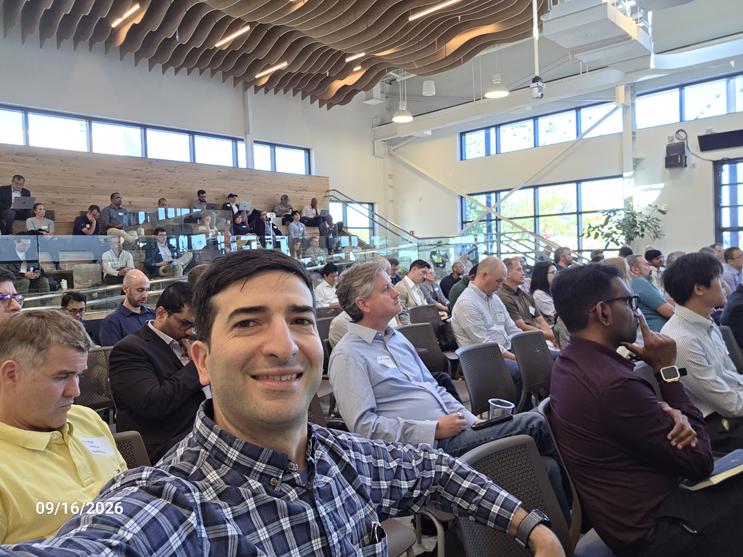
Ray Dogum, chief editor of Drug Discovery Online, at the Datapoints Summit 2026.