
Botanicals: Ask For Reuse, Not Relief
By Odette Hauke, Odette Alina LLC

The FDA has a botanical drug docket open until Nov. 3, 2026. Its request for information (RFI), docket FDA-2026-N-9550, asks what blocks botanical drug product development, which study designs suit complex mixtures, and how well-established use and real-world evidence might facilitate development.1 Three weeks after it opened, the FDA and the European Medicines Agency (EMA) held their first joint public workshop on herbal and botanical drug development, which the FDA's own announcement tied to the same effort.2,3
Anyone who has watched a comment period on a hard development problem can predict the modal submission: The standard is too high, please lower it. I think the workshop record shows that to be the wrong ask, and the people it came from are the reason. Not one participant, including the industry associations, argued for a reduced evidentiary bar. They defended it.
What follows is where the two systems have already converged, where they still diverge, and what to ask the FDA for instead.
No One At The Table Wanted A Lower Bar
Olga Palomino, vice chair of EMA's Committee on Herbal Medicinal Products (HMPC), summarized the first panel by stating that quality is not in doubt and does not vary with the route chosen.3 Holly Johnson, chief science officer at the American Herbal Products Association, volunteered the guardrail unprompted: Broadening pathways must not mean reduced quality in any way.3 Angela Müller, who chairs the herbal committee of the Association of the European Self-Care Industry (AESGP), located the entire value of the European system in premarket assessment.3
The commercial logic behind that position is easy to mistake for lobbying. Stefan Gafner of the American Botanical Council presented adulteration estimates for botanical ingredients in the supplement market running from roughly 17% to 56% depending on the ingredient, against a clear quality difference for products sold as regulated herbal medicines in Europe.3 Marta Sokolowska of the FDA picked that up in her closing remarks: Products that reach patients as regulated medicines show less adulteration.3
Read those together and the industry position stops looking altruistic and starts looking rational. The evidentiary bar is what separates a botanical drug from the adulteration statistics in the adjacent category. Lower it and you destroy the asset you were trying to build. That is the argument I would make to anyone drafting a comment this month.
Nine Things To Put In Your Comment
1. Build the quality package once, to the stricter reading of both regimes. Carmen Purdel, who chairs the HMPC, stated that simplified registration does not mean fewer requirements: Quality control, good manufacturing practice, and good clinical practice stay identical across all three European pathways, and only the safety and efficacy documentation varies.3 Charles Wu, master reviewer in pharmacology and pharmacognosy at the FDA's Center for Drug Evaluation and Research, listed FDA's requirements for Filsuvez. The overlap is close: a certificate of botanical authenticity, good agricultural and collection practice, contaminant testing for pesticides and heavy metals, batch-to-batch consistency demonstrated through the full chromatographic fingerprint rather than marker content alone, and multiple geographically diverse cultivation sites to control natural variability.3 Quality is the portable part of a botanical program. Closing the gap at the outset costs far less than discovering it mid-review.
2. Choose your evidence route before you generate data, because the systems diverge there and only there.
Table 1
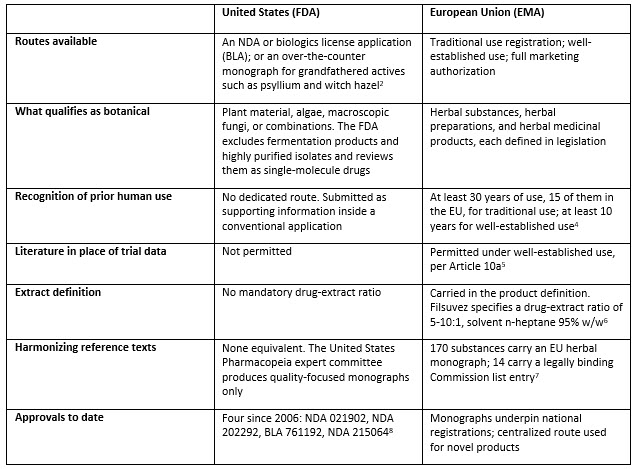
Routes for plant-derived medicines, compiled from agency statements at the Sept. 25, 2026, workshop and verified against Drugs@FDA, and against EMA product and monograph records.3,7,8
3. Quantify what the divergence costs you, using a product the agency already knows. Filsuvez is the only candidate taken through both systems. The EU authorized it on June 21, 2022 for partial thickness wounds in both dystrophic and junctional epidermolysis bullosa in patients 6 months and older.6 The FDA approved it on Dec. 18, 2023, roughly 18 months later, and only after a complete response letter over a subgroup discrepancy that was not statistically significant.8 Wu's own characterization was that the FDA required confirmatory evidence beyond the EMA package. If your program carries a comparable gap, give the agency the months and the studies.
4. Do not assume the European route is the soft one. Ginkgo leaf runs the other way. Its monograph, published April 2015, rests on well-established use for age-related cognitive impairment in mild dementia and on traditional use for minor circulation problems.5 Nine member states filed divergent positions. Spain's holds that the evidence does not support well-established use and recognized efficacy under Article 10a; France's accepts the status but rejects the indication wording.5 The FDA has never approved Ginkgo as a botanical drug. Maintenance is not free either: EMA issued a call for data for Ginkgo's periodic review in February 2022, and the 2015 monograph remains current today.5
5. If your botanical carries a schedule, say so, because the workshop would not. EMA's chief medical officer opened the meeting by naming what the agencies had agreed to leave out, and botanicals carrying misuse liability were out, with cannabis and psilocybin named explicitly.3 The docket draws no such line. I searched the full text of the RFI and found no occurrence of exclusion, scope, controlled substance, abuse, scheduling, cannabis, or psilocybin.1 Ibogaine shows what that class faces. It sits in Schedule I under Drug Enforcement Administration (DEA) code 7260.9 Drugs@FDA returns no approved application for it or for its metabolite, noribogaine.8 ClinicalTrials.gov lists 10 registered studies, one of them recruiting.10 A 2026 review of 30 years of research found no double-blind trial establishing efficacy in opioid use disorder.11 Europe offers these programs one route, not three: Traditional use registration requires a self-medication character, because the legislation defines those products as intended for use without a practitioner's supervision,4 and a compound needing electrocardiographic monitoring cannot meet that definition. If every substantive comment arrives from developers of unscheduled botanicals, the record will show the scheduled ones have no problems worth solving.

6. Keep history of use out of your safety argument. Long traditional use is evidence about some hazards and silent about others, and the asymmetry is not random. It is strongest for what a community could observe and weakest for what it could not measure. One comment arguing that generations of use justify a reduced safety package will discredit every other comment on the docket, including yours.
7. Ask for reuse mechanisms and argue the narrow version of real-world evidence. Susan Winckler, chief executive of the Reagan-Udall Foundation for the FDA, reframed the problem: harmonizing what sponsors prepare for review matters as much as harmonizing the review structures.3 Two deliverables follow that need no legislative change: a common human-exposure repository built on real-world data and a shared batch-to-batch quality framework. Name both. On real-world evidence, Müller drew the line carefully: it supplements clinical data and can reduce, not replace, the number of trials.3 Sokolowska's closing endorsement was narrower still, naming the opportunity as real-world evidence used as part of confirmatory evidence.3 That narrow claim has regulator-side support on both continents. The expansive one does not.
8. Standardize how you describe preparations, starting now. Christelle Anquez-Traxler of AESGP gave the most immediately implementable recommendation of the day: Record the plant, plant part, Latin and English names, drug-extract ratio, solvent, and preparation form in every publication and registry entry.3 Filsuvez's own EU definition is exactly that specific. Without it, comparison across studies is not possible, and a repository built on inconsistent descriptions is worth less than no repository at all.
9. Name the guidance, then decide what belongs on the public record. The FDA asks which updates would clarify its approach.1 The document in play is the Dec. 29, 2016, guidance Botanical Drug Development, whose draft dates to August 2000.12 Cite the section that cost you a review cycle. Then settle the disclosure question before you draft: The FDA publishes comments to the docket, program specifics are what make a submission persuasive, and teams that leave this to the end genericize their comment until it says nothing.
After Nov. 3
A request for information commits the FDA to nothing. No statutory clock runs, no obligation to act follows, and the FDA has announced no timeline. The workshop closed the same way: no joint guidance, no parallel scientific advice arrangement, no next meeting — only a hoped-for written summary. Steffen Thirstrup, EMA's chief medical officer, put it as the agencies being able to swim together without yet swimming in synchrony.3
That is an argument for filing, not against it. A thin docket is the outcome that guarantees nothing changes.
References
- Food and Drug Administration. "Advancing Development of Botanical Drug Products; Request for Information." Docket No. FDA-2026-N-9550. 91 FR 56887, September 4, 2026. Comments close November 3, 2026. https://www.federalregister.gov/documents/2026/09/04/2026-18133/advancing-development-of-botanical-drug-products-request-for-information
- Food and Drug Administration. "FDA Seeks Public Input to Advance Development of Botanical Drug Products." Press announcement, September 3, 2026. https://www.fda.gov/news-events/press-announcements/fda-seeks-public-input-advance-development-botanical-drug-products
- "Regulatory perspectives on herbal medicinal / botanical drug product development: Joint FDA / EMA workshop." European Medicines Agency, Amsterdam and online, September 25, 2026. Event page: https://www.ema.europa.eu/en/events/regulatory-perspectives-herbal-medicinal-botanical-drug-product-development-joint-fda-ema-workshop. Speaker statements are drawn from the author's notes taken during the live public broadcast. EMA published a video recording of the session on the event page, available there as of October 28, 2026.
- European Medicines Agency, Ginkgo folium herbal medicine page, statement of the traditional use and well-established use thresholds. https://www.ema.europa.eu/en/medicines/herbal/ginkgo-folium
- European Medicines Agency. Final European Union herbal monograph on Ginkgo biloba L., folium (EMA/HMPC/321097/2012), published April 8, 2015; Opinion of the HMPC (EMA/HMPC/61601/2015), Appendix II, divergent positions; call for scientific data for the periodic review (EMA/HMPC/72288/2022), February 15, 2022. https://www.ema.europa.eu/en/medicines/herbal/ginkgo-folium
- European Medicines Agency, Filsuvez European public assessment report. EU marketing authorization June 21, 2022. https://www.ema.europa.eu/en/medicines/human/EPAR/filsuvez
- European Medicines Agency, herbal medicines data table, generated October 28, 2026. https://www.ema.europa.eu/en/documents/report/medicines-output-herbal_medicines-report_en.xlsx
- Drugs@FDA application records NDA 021902 (Veregen, approved October 31, 2006), NDA 202292 (crofelemer, approved December 31, 2012, now marketed as Mytesi), BLA 761192 (NexoBrid, approved December 28, 2022), and NDA 215064 (Filsuvez, approved December 18, 2023). Searched October 28, 2026 for ibogaine and noribogaine as active ingredients; no applications returned. Each record is retrievable by application number in Drugs@FDA.
- 21 CFR 1308.11, Schedule I, Drug Enforcement Administration, Department of Justice. Ibogaine, DEA drug code 7260.
- ClinicalTrials.gov, intervention search for ibogaine, October 28, 2026, returning 10 registered studies, including NCT05029401, NCT03380728, and NCT04003948.
- Thirty Years of Ibogaine Research: A Literature Review on Clinical Perspectives. J Clin Psychopharmacol, 2026. doi:10.1097/JCP.0000000000002197
- Food and Drug Administration, guidance for industry "Botanical Drug Development," December 29, 2016, 81 FR 96018. https://www.fda.gov/media/93113/download
Note on sourcing: Statements attributed to workshop speakers come from my notes taken during the live public broadcast on September 25, 2026, checked against the published agenda and speaker list. I give them as reported speech rather than quotation, because my notes, rather than an official record, are their source. EMA has since published a video recording of the session on its event page; no slides or meeting summary had appeared as of October 28, 2026. All product, monograph, date, scheduling, and threshold claims trace to the primary sources listed above.
About The Author
 Odette Alina Hauke is a regulatory strategist and epidemiologist and the founder of Odette Alina LLC, where she advises sponsors on global regulatory strategy and clinical development. In 13 years in the field, she has served as regulatory lead for three first-in-class Schedule I programs and has worked directly with the FDA, EMA, Health Canada, and the DEA on controlled-substance pathways. She began her career at a holistic pharmacy in Brooklyn, New York, dispensing botanical preparations before she worked on their regulation. She holds an MS in regulatory affairs from Northeastern University and a BS in epidemiology from the CUNY Baccalaureate for Unique and Interdisciplinary Studies at Hunter College.