
Beyond Binder Design: Why AI's Next Frontier Is Designing Multispecific Antibodies
By Winston Haynes, Ph.D., VP of computational sciences and engineering, LabGenius Therapeutics
Artificial intelligence has become firmly embedded in modern antibody drug discovery. Today, machine learning models routinely help identify and validate novel therapeutic targets, generate de novo binders, and optimize monoclonal antibodies for properties such as affinity, stability, and developability. Investment in these applications has accelerated rapidly, with both academia and industry demonstrating impressive progress.
However, one stage of antibody engineering remains largely dependent on human intuition. Once optimized antibody binding components have been identified, assembling them into a multispecific therapeutic is often treated as a relatively straightforward protein engineering exercise. Individual binding domains are combined into a final molecular format using rational design principles, with the assumption that highly optimized components will naturally produce a highly optimized therapeutic. Increasingly, however, the evidence suggests that the relationship between molecular architecture and biological function is considerably more complex. Small changes in the way these building blocks are assembled can fundamentally alter the therapeutic potency, selectivity, manufacturability, and safety in ways that are difficult to predict using conventional design approaches. By coupling multispecific antibody construction with high-throughput infrastructure, machine learning-driven optimization can be unlocked.
Three Stages Of AI-Powered Antibody Discovery
Machine learning applications in antibody discovery can broadly be divided into three categories, each defined by the amount and quality of data available.
The first is target discovery, where decades of publicly available omics data sets from open repositories, such as National Center for Biotechnology Information Gene Expression Omnibus and Open Targets, have enabled AI to identify and prioritize promising therapeutic targets. The second is de novo antibody design and monospecific antibody optimization, where tens of thousands of experimentally determined antibody structures in the Protein Data Bank (PDB), alongside billions of naturally occurring antibody sequences in databases such as Observed Antibody Space (OAS) and Integrated Nanobody Database for Immunoinformatics (IND), have driven rapid advances in protein foundation models. Together, these data resources have fueled increasingly sophisticated approaches to target identification, sequence generation, and antibody optimization.
The third category, multispecific antibody optimization, presents a fundamentally different challenge. Rather than optimizing individual antibody components, the goal is to determine how those components should be assembled into a functional therapeutic molecule. Unlike target discovery or monospecific antibody engineering, there is effectively no public data set capturing how these complex formats perform in biologically relevant functional assays. Progress therefore depends on generating proprietary experimental data. By automating this process at high throughput and feeding the resulting data back into machine learning models, a tightly integrated closed-loop discovery system can continuously refine its predictions and design increasingly effective therapeutic molecules.
Understanding Complex Fitness Landscapes
Multispecific antibodies introduce a large combinatorial design space in which multiple design variables, including linker length, linker flexibility, antigen-binding valency, domain positioning, and molecular topology, all interact simultaneously. As a result, modifying a single design feature can influence multiple biological properties at once, often in ways that are difficult to predict.
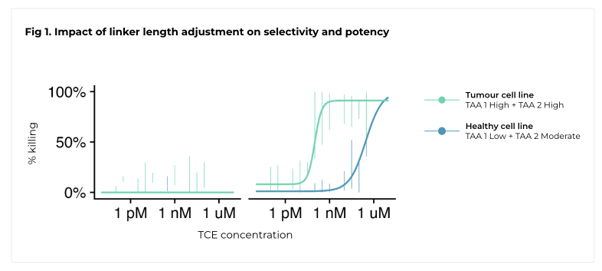
Experimental studies increasingly demonstrate these non-intuitive relationships. Molecules built from identical binding domains but differing only in linker architecture can exhibit markedly different biological behavior (Figure 1).
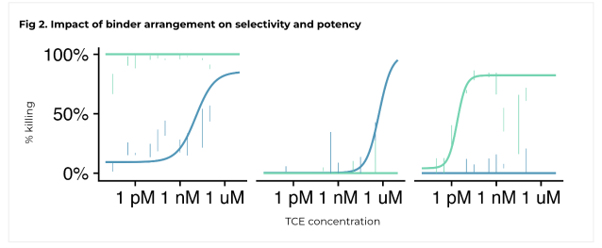
One configuration may demonstrate femtomolar potency alongside exceptional selectivity, another may lose much of its therapeutic window, and a third may show picomolar potency with moderate selectivity (Figure 2).
Similar effects have been observed when altering antigen-binding valency or repositioning individual binding domains within the molecule. Collectively, these findings demonstrate that assembling individually optimized components using rational, human-led design does not necessarily produce an optimized multispecific therapeutic.
Balancing Multiple Design Objectives
When designing multispecific antibodies, the goal is not to maximize a single attribute, like potency or selectivity, but to develop molecules that can ultimately become medicines. That means jointly optimizing across multiple characteristics, including efficacy, selectivity, manufacturability, purity, yield, stability, and other developability attributes. These properties are often interdependent and competing: a highly potent molecule may be difficult to manufacture at scale, while one with excellent selectivity may exhibit poor expression or stability (Figure 3).
Fig 3. Fitness landscapes are multi-objective, complex, and competing
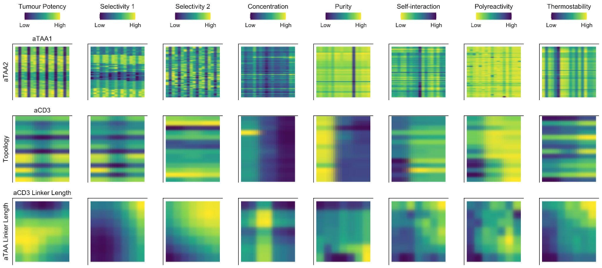
Successfully navigating these trade-offs requires approaches that can optimize across many objectives simultaneously, rather than improving one characteristic in isolation.
Agentic Active Learning As A Design Tool
Agentic active learning offers a powerful way to tackle this challenge by tightly coupling computational prediction with automated experimental validation. In this framework, AI models act as computational agents, proposing promising molecular designs, while automated laboratories serve as physical agents, building and testing those predictions at high throughput. Together, they create a closed-loop discovery system that learns from every experiment.
Rather than optimizing individual parameters one at a time, agentic active learning can identify molecular configurations that balance multiple competing objectives simultaneously. Each round of experimental data feeds back into the model, refining its understanding of the underlying design landscape and improving the quality of subsequent predictions. This iterative cycle enables exploration of complex regions of molecular design space that would be impractical to navigate using conventional experimental approaches alone.
The Biggest Opportunity For AI Is Still Ahead
It’s no surprise that AI has made its biggest strides in areas where large data sets already exist, such as target discovery, de novo design, and monospecific antibody optimization. But many of the therapies with the greatest potential to improve patient outcomes are complex multispecifics, where the data simply doesn't exist. Unlocking the next wave of innovation will therefore require more than better algorithms. It will require tightly integrating machine learning with automated experimentation to generate the data needed to design entirely new classes of therapeutic molecules.
About The Author

Winston is the VP of Computational Sciences and Engineering at LabGenius Therapeutics, where he leads a team of experts in data science, machine learning, and software development to expand LabGenius’ ML-driven discovery platform capabilities. He has extensive experience leading the development and application of computational tools to advance both antibody therapeutics (BigHat Biosciences) and diagnostics (Serimmune). Winston holds a Ph.D. in biomedical informatics from Stanford University, where he was an NSF GRFP fellow.