
Alpha-Synuclein Is Not One Target
By Mahmoud Khatib Al-Ruweidi

The phrase aggregated alpha-synuclein is too imprecise to anchor a drug discovery campaign. It compresses a family of conformational, biochemical, and anatomical target states into one label. Filaments extracted from multiple system atrophy (MSA) brains adopt architectures that differ from those found in Parkinson's disease, Parkinson's disease dementia, and dementia with Lewy bodies. Patient-derived Parkinson's disease and MSA seeds also show distinct biochemical behavior, and carefully designed amplification can preserve important properties of MSA material.1–4 A binder selected against one recombinant fibril preparation may therefore be highly specific for a laboratory reagent and poorly matched to the disease state it is expected to modify.
Nanobodies expose this problem unusually clearly. Their small, modular single-domain format can access sterically restricted epitopes, support multivalent engineering, and function as genetically encoded intrabodies. Those advantages do not make them automatically brain-penetrant or therapeutically active. For alpha-synuclein, discovery teams should define four connected variables before optimizing affinity: the pathological state, the compartment, the event caused by binding, and the exposure required to sustain that event.
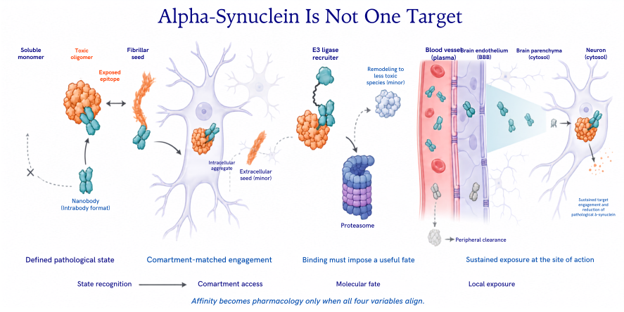
Figure 1. A state-, compartment-, fate-, and exposure-directed framework for alpha-synuclein therapeutics. Alpha-synuclein exists as multiple conformational and anatomical target states, and selective binding alone does not establish therapeutic value. A viable construct must recognize the disease-relevant species; access the compartment in which it acts; impose a defined molecular fate, such as neutralization, remodeling, or degradation; and sustain sufficient local exposure to produce that effect. Misalignment at any stage can yield high-affinity binding without meaningful pharmacology.
Define The Pathological State
Monomer, oligomer, and fibril are useful starting categories, not finished target definitions. Oligomers differ in stability, membrane activity, and seeding competence. Fibrils differ in protofilament organization, exposed surfaces, cofactor content, and cellular tropism. Post-translational modifications and truncations can erase an epitope without changing the protein name on the assay plate.
That last point is experimentally consequential. Phosphorylation of alpha-synuclein at Tyr125 reduced binding of the C-terminal nanobody NbSyn87 by approximately 400-fold, whereas phosphorylation at nearby Ser129 had little detectable effect.5 A campaign that screens only unmodified recombinant protein can optimize a paratope against an epitope that is altered, buried, or absent in the intended pathology.
Build the screening cascade around a target state matrix rather than a single antigen. Include patient-derived or fidelity-validated amplified seeds from the intended indication, recombinant controls, soluble oligomer preparations with defined functional properties, and relevant modified or truncated species. Run counter-screens against physiological monomer, unrelated amyloids, abundant brain proteins, and assay surface artifacts. Confirm ranking with orthogonal solution- and surface-based methods because immobilization can create avidity and orientation effects that disappear in tissue.
Use valency only after establishing epitope availability. Repeating one nanobody can increase apparent avidity when the same epitope is densely displayed, but it cannot rescue an epitope that the disease conformer has buried. If strain breadth is the objective, combine independently mapped paratopes and retest domain order and linker geometry across the complete seed panel. Multivalent and multiepitope are not synonyms.
Match Mechanism To Compartment
Most pathological alpha-synuclein is intracellular. Extracellular antibodies or nanobodies can intercept released seeds and reduce cell-to-cell transfer, but they do not automatically reach cytosolic or organelle-associated pools. Intrabodies can act earlier in the intracellular life cycle, provided they fold in a reducing environment, remain soluble, and spare the physiological protein pool.
PFFNB2 illustrates what correct compartment matching can achieve. Investigators selected this disulfide-free nanobody for preferential recognition of alpha-synuclein preformed fibrils over monomer. PFFNB2 did not prevent monomer aggregation, but it dissociated fibrils in vitro. When expressed intracellularly from an adeno-associated virus vector, it reduced preformed-fibril-induced Ser129 phosphorylation in primary neurons and limited cortical spread in a mouse model.6 The result supports the architecture, not yet a clinical product: intracellular expression aligned the binder with the compartment in which it could act.
NB1 and NB2 provide the opposite lesson. These nanobodies selectively recognized a defined cytotoxic oligomer, yet they did not significantly inhibit oligomer-mediated vesicle permeabilization or alpha-synuclein fibrillation. RQLL-tagged versions promoted sortilin-dependent uptake in engineered HEK293 cells, but that uptake depended on an added trafficking motif and an engineered receptor context.7 Binding, internalization, neutralization, and clearance were separate experimental outcomes. Discovery teams should measure them separately.
Compartment also includes cell type. A neuronal preformed fibril model can answer questions about neuronal seeding, but it cannot establish coverage of oligodendroglial pathology in MSA. The relevant model should reproduce the intended disease conformer, cell population, uptake route, and intracellular destination rather than merely generate a convenient phospho-Ser129 signal.

Measure What Binding Does
Affinity describes occupancy; it does not define pharmacology. An alpha-synuclein binder can sequester a soluble species, cap fibril elongation, remodel an oligomer, destabilize an assembly, block receptor engagement, or route cargo to a degradation pathway. These mechanisms require different assays and may demand different epitopes.
NbSyn2 and NbSyn87 demonstrate conformational remodeling. Both inhibited fibril formation and shifted preformed high-FRET oligomers toward less stable and less toxic conformational states.8 Their value did not arise from affinity alone. The key result was a measurable change in the energy landscape and biological activity of the bound assembly.
A 2D8-based construct demonstrates a different strategy. Conjugation to a thalidomide-derived cereblon recruiter promoted alpha-synuclein ubiquitination and proteasomal degradation while retaining lysosomal handling. In M83 mice, three intravenous doses reduced imaging, biochemical, and histological measures of alpha-synuclein pathology.9 This is compelling proof of modular fate engineering, but it remains a short duration study in an A53T-overexpressing model. It validates a mechanism and an architecture; it does not establish chronic human efficacy or safety.
For neutralizing constructs, quantify seeded amplification, membrane injury, receptor engagement, and rescue of disease-relevant neuronal or glial phenotypes. For degradation-directed constructs, demonstrate pathway dependence with perturbation and rescue experiments, measure cargo half-life, and distinguish soluble from insoluble fractions. Add global proteomics and proteostasis stress readouts. A fall in target signal is not sufficient if the construct redistributes aggregates, saturates clearance machinery, or perturbs unrelated proteins.
Engineer Exposure Without Losing Function
Small size creates a pharmacokinetic contradiction. A roughly 15-kDa domain can diffuse through tissue more readily than an immunoglobulin G, but it is also rapidly filtered by the kidney. Small size alone does not guarantee meaningful blood-brain barrier transport. Microdialysis studies have shown that monovalent nanobody passage can be limited and context-dependent.10
Measure exposure where pharmacology occurs. Total brain homogenate and brain-to-plasma ratios can be dominated by vascular, endothelial, or intracellularly trapped material. Quantify unbound interstitial concentration, duration above the functional concentration, regional distribution, cell type localization, and target engagement. For intracellular mechanisms, cerebrospinal fluid exposure is not a substitute for cytosolic engagement.
Half-life extension and brain-shuttle modules solve one problem by creating another molecule. Albumin binders, Fc fusion, polyethylene glycol, or multimerization can prolong systemic exposure, but they increase hydrodynamic size and can alter diffusion, uptake, valency, and clearance.11,12 Receptor-mediated shuttles require calibrated affinity: very strong binding can favor endothelial retention and lysosomal routing, whereas lower-affinity engagement can improve release after transcytosis.11 Every exposure module therefore requires a fresh assessment of potency, biodistribution, and molecular behavior.
Developability should remain continuous with pharmacology. Recheck expression yield, monomer content, thermal and colloidal stability, nonspecific binding, chemical liabilities, linker integrity, and immunogenicity after every change in valency, humanization, half-life extension, or trafficking module. Framework humanization can be highly successful, but framework substitutions still require experimental confirmation that affinity, folding, and solubility were preserved.13
Build Four Evidence Maps
A useful preclinical package should produce four maps rather than one affinity leaderboard:
- Target state coverage: which patient-derived, amplified, recombinant, modified, and truncated species are recognized, and which physiological or off-target proteins are spared.
- Mechanism: which biological event follows binding, at what concentration and stoichiometry, and whether that event rescues a disease-relevant phenotype.
- Compartment and fate: where the construct and cargo travel, whether uptake is productive, and whether neutralization or degradation is durable and pathway-specific.
- Exposure and developability: whether free concentration and target engagement can be sustained with a manufacturable, stable, and chronically usable architecture.
This framework changes how candidates are described. Instead of saying that a nanobody binds aggregated alpha-synuclein at nanomolar affinity, state that it recognizes a defined seed state, in a defined cell and compartment, imposes a measured molecular fate, and sustains the local exposure needed to produce that effect. The second description is harder to earn, but it is pharmacologically meaningful.
Final Word
Alpha-synuclein is not one target, and a nanobody is not a smaller antibody with automatic access. The useful unit of discovery is the complete architecture: paratope, valency, linker, trafficking element, fate-inducing module, and exposure strategy. PFFNB2, NB1/NB2, NbSyn2/NbSyn87, and the 2D8 degrader all reinforce the same principle from different directions. Selectivity can exist without neutralization, uptake can exist without productive disposal, and in vivo activity can depend more on compartment and fate than on the lowest dissociation constant.
The decisive question is not whether a construct binds alpha-synuclein more tightly. It is whether the construct reaches the relevant alpha-synuclein state and changes its biology at an exposure the product can realistically sustain.
References
- Schweighauser M, Shi Y, Tarutani A, et al. Structures of α-synuclein filaments from multiple system atrophy. Nature. 2020;585:464-469. doi:10.1038/s41586-020-2317-6.
- Yang Y, Shi Y, Schweighauser M, et al. Structures of α-synuclein filaments from human brains with Lewy pathology. Nature. 2022;610:791-795. doi:10.1038/s41586-022-05319-3.
- Yamasaki TR, Holmes BB, Furman JL, et al. Parkinson's disease and multiple system atrophy have distinct α-synuclein seed characteristics. J Biol Chem. 2019;294(3):1045-1058. doi:10.1074/jbc.RA118.004471.
- Wang F, Banerjee V, Barria C, et al. Seed amplification of MSA alpha-synuclein aggregates preserves the biological and structural properties of brain-derived aggregates. Nat Commun. 2025;16:11266. doi:10.1038/s41467-025-66146-4.
- El Turk F, De Genst E, Guilliams T, et al. Exploring the role of post-translational modifications in regulating α-synuclein interactions by studying the effects of phosphorylation on nanobody binding. Protein Sci. 2018;27(7):1262-1274. doi:10.1002/pro.3412.
- Butler YR, Liu Y, Kumbhar R, et al. α-Synuclein fibril-specific nanobody reduces prion-like α-synuclein spreading in mice. Nat Commun. 2022;13:4060. doi:10.1038/s41467-022-31787-2.
- Nielsen J, Pedersen JN, Kleijwegt G, et al. Nanobodies raised against the cytotoxic α-synuclein oligomer are oligomer-specific and promote its cellular uptake. npj Biosensing. 2025;2:23. doi:10.1038/s44328-025-00042-1.
- Iljina M, Hong L, Horrocks MH, et al. Nanobodies raised against monomeric α-synuclein inhibit fibril formation and destabilize toxic oligomeric species. BMC Biol. 2017;15:57. doi:10.1186/s12915-017-0390-6.
- Jiang Y, Lin Y, Tetlow AM, et al. Single-domain antibody-based protein degrader for synucleinopathies. Mol Neurodegener. 2024;19:44. doi:10.1186/s13024-024-00730-y.
- Caljon G, Caveliers V, Lahoutte T, et al. Using microdialysis to analyse the passage of monovalent nanobodies through the blood-brain barrier. Br J Pharmacol. 2012;165(7):2341-2353. doi:10.1111/j.1476-5381.2011.01723.x.
- Yu YJ, Zhang Y, Kenrick M, et al. Boosting brain uptake of a therapeutic antibody by reducing its affinity for a transcytosis target. Sci Transl Med. 2011;3(84):84ra44. doi:10.1126/scitranslmed.3002230.
- Jovčevska I, Muyldermans S. The therapeutic potential of nanobodies. BioDrugs. 2020;34:11-26. doi:10.1007/s40259-019-00392-z.
- Vincke C, Loris R, Saerens D, Martinez-Rodriguez S, Muyldermans S, Conrath K. General strategy to humanize a camelid single-domain antibody and identification of a universal humanized nanobody scaffold. J Biol Chem. 2009;284(5):3273-3284. doi:10.1074/jbc.M806889200.
About The Author
 Mahmoud K. Al-Ruweidi is a pharmaceutics specialist with expertise in rational drug design, discovery, and delivery. Trained as a biomedical engineer, his research spans formulation science and bioengineering approaches to medicine. He has worked across biochemistry, medical devices, and biomaterials, applying interdisciplinary methods to accelerate therapeutic innovation. Beyond the lab, he is an advocate for improving academic systems to better support young scientists and safeguard research integrity.