
Viral immunity triggered by potato based vaccine

Whatever your approach to pharmaceutical development and manufacturing, producing drugs or vaccines in plants, and administering them by "prescribing" a dinner of, say, french fries, has a certain appeal. That's why you should keep an eye on research at Cornell's Boyce Thompson Institute (BTI; Ithaca, NY), which conducts some of the most innovative pharmaceutical and chemical "plant" R&D in the world.
BTI scientists recently announced that they had triggered human immunity to Norwalk virus through a potato-based "vaccine." Norwalk happens to be the leading cause of food-borne illness in the United States and much of the developed world.
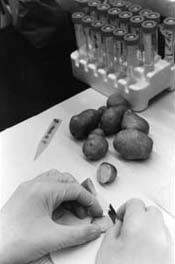 Working with scientists at the University of Maryland, BTI researchers reported their findings in the July, 2000 issue of the Journal of Infectious Diseases.
"This plant-based vaccine could be the first one readily accepted in the developed world," says Charles Arntzen, president and CEO of BTI. "It's very exciting … [since] … in the United States, this Norwalk virus vaccine could easily be the first licensed product based on our plant biology research."
Even in developed nations, the idea of inducing immunity by means other than traditional vaccines is intriguing. If this technology takes off a host of legal, ethical, and regulatory issues will no doubt be raised, under the guise of "protecting the consumer," by companies threatened by the new technology.
Arntzen and coworkers previously conducted a successful clinical trial in triggering immune response in humans to Escherichia coli through a transgenic potato vaccine. The results were published in Nature Medicine in 1998.
The first of three stages of human clinical trials for the Norwalk virus plant-based vaccine began in April 1999 and was conducted at the Center for Vaccine Development at the University of Maryland. Volunteers ate two or three doses of BTI-developed transgenic, raw potato containing the viral antigen. Overall, 19 of the 20 volunteers (95%) who ate the transgenic potatoes developed an immune response to the Norwalk virus. Before eating the potatoes, the volunteers were tested for Norwalk antibodies, and all indicated previous exposure to the virus.
The Centers for Disease Control and Prevention in Atlanta estimates that more than 23 million people in the United States are infected annually by the Norwalk or Norwalk-like viruses. That compares to 79,000 cases of E. coli, 2,500 cases of listeriosis, and 1.4 million cases of illness from salmonella.
Norwalk virus received its name in 1968 when nearly 100 students in a Norwalk, Ohio, school simultaneously came down with nausea, vomiting, stomach cramps, and diarrhea. It was not until four years later that scientists realized the pathogen was a virus.
Until 1990, scientists and doctors routinely blamed common food-borne disease symptoms on bacterial pathogens. Microbiologist Mary K. Estes and others at the Baylor College of Medicine in Houston cracked the Norwalk virus's genetic code 10 years ago, and scientists routinely began testing for it.
For more information: Charles Arntzen, President and CEO, Boyce Thompson Institute for Plant Research, Tower Rd., Ithaca, NY 14853-1801. Tel: 607-254-1234. Fax: 607-254-1242.
Edited by Angelo DePalma
Managing Editor, Drug Discovery Online